4,068 posters, 219 videos, 101 topics, 69 sessions, 14,365 authors, 6,128 institutions
ePostersLive by SciGen Technologies S.A. All rights reserved.
Alzheimer's Association International Conference 2026
July 12-15, 2026 | London, United Kingdom, and Online

9542
Implementing Blood-based Biomarkers For Alzheimer’S Disease: Challenges And Opportunities In Low- And Middle-income Countries
Poster Presenter
Authors
Henry Oyoyo, Precious Fadele, Victor Femi-Lawal, Jonas Ibekwe, Chukwuebuka Asogwa, Ajibola Moshood, Timileyin Olarenwaju, Olajire Ajegbemika, Marvellous Adelaja, Chukwuma Igwe, Samuel Omojola, Blessed Olaomo, Olumide Noah, Mayowa Owolabi, Rufus Akinyemi
Affiliations
, Department of Medicine and Surgery, University of Ibadan, Ibadan, Nigeria., Department of Medicine and Surgery, University of Nigeria, Enugu, Nigeria., Department of Medicine and Surgery, University of Ibadan, Ibadan, Nigeria, Department of Physiotherapy, University of Ibadan, Ibadan, Nigeria., Center for Genomics And Precision Medicine, Ibadan, Nigeria
Part of Topic
Implementing Blood-Based Biomarkers for Alzheimer’s Disease: Challenges and Opportunities in Low- and Middle-Income Countries
Authors:
Henry Demian Oyoyo {1,2}, Precious Kehinde Fadele 3, Victor Oluwafemi Femi-Lawal {1,2}, Jonas Ibekwe {1,2}, Chukwuebuka Asogwa {1,2}, Ajibola Ajibola Moshood {1,2}, Timileyin Victoria Olanrewaju {4,2}, Olajire Ajegbemika {1,2}, Marvellous Adelaja {1,2}, Olumide Noah 5, Chukwuma Igwe {1,2}, Samuel Omojola {1,2}, Blessed Olaomo {1,2}, Mayowa Ojo Owolabi {6,7}, Rufus Akinyemi {6,7}
Affiliations:
1. Department of Medicine and Surgery, University of Ibadan, Ibadan, Nigeria
2. College Research and Innovation Hub (CRIH), Ibadan, Nigeria.
3 Department of Medicine and Surgery, University of Nigeria, Enugu, Nigeria.
4 Department of Physiotherapy, University of Ibadan, Ibadan, Nigeria.
5 Department of Medicine and Surgery, University of Lagos, Lagos, Nigeria.
6 Department of Medicine and Surgery, College of Medicine, University of Ibadan, Ibadan, Nigeria.
7 Center for Genomics And Precision Medicine, Ibadan, Nigeria
Abstract
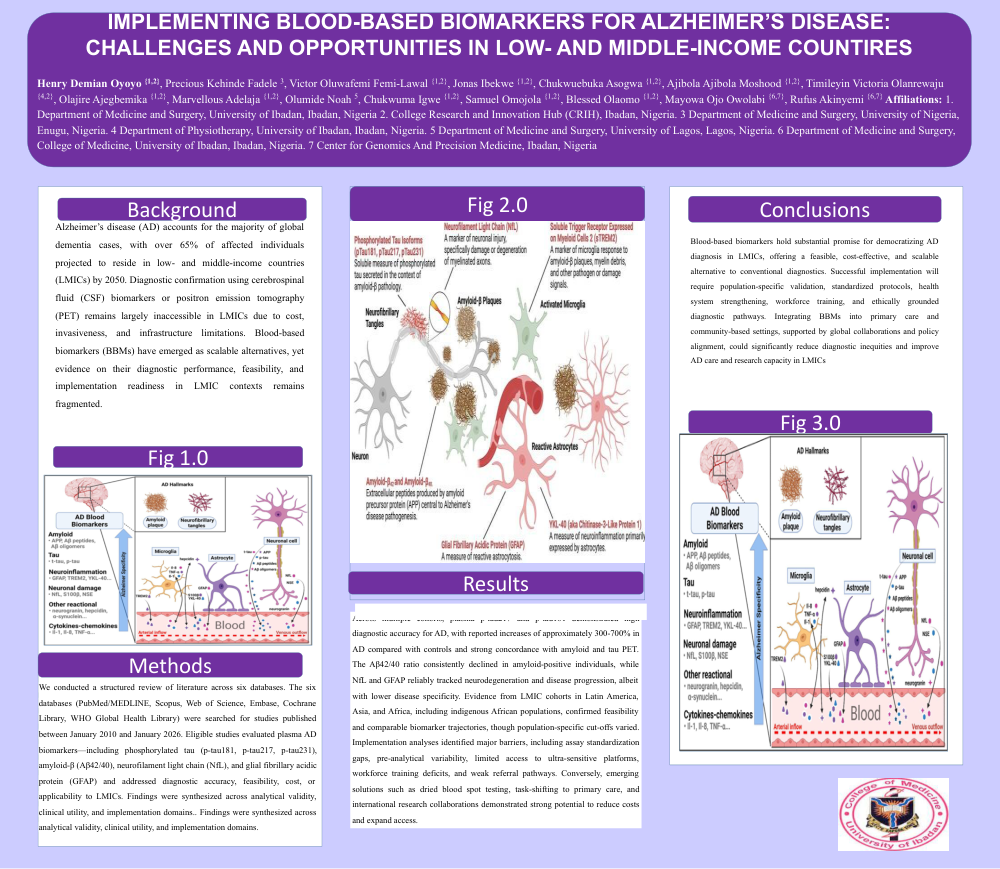
Background: Alzheimer’s disease (AD) accounts for the majority of global dementia cases, with over 65% of affected individuals projected to reside in low- and middle-income countries (LMICs) by 2050. Diagnostic confirmation using cerebrospinal fluid (CSF) biomarkers or positron emission tomography (PET) remains largely inaccessible in LMICs due to cost, invasiveness, and infrastructure limitations. Blood-based biomarkers (BBMs) have emerged as scalable alternatives, yet evidence on their diagnostic performance, feasibility, and implementation readiness in LMIC contexts remains fragmented.
Methods: We conducted a structured review of literature across six databases. The six databases (PubMed/MEDLINE, Scopus, Web of Science, Embase, Cochrane Library, WHO Global Health Library) were searched for studies published between January 2010 and January 2026. Eligible studies evaluated plasma AD biomarkers—including phosphorylated tau (p-tau181, p-tau217, p-tau231), amyloid-β (Aβ42/40), neurofilament light chain (NfL), and glial fibrillary acidic protein (GFAP) and addressed diagnostic accuracy, feasibility, cost, or applicability to LMICs. Findings were synthesized across analytical validity, clinical utility, and implementation domains.. Findings were synthesized across analytical validity, clinical utility, and implementation domains.
Results: Across multiple cohorts, plasma p-tau217 and p-tau181 demonstrated high diagnostic accuracy for AD, with reported increases of approximately 300-700% in AD compared with controls and strong concordance with amyloid and tau PET. The Aβ42/40 ratio consistently declined in amyloid-positive individuals, while NfL and GFAP reliably tracked neurodegeneration and disease progression, albeit with lower disease specificity. Evidence from LMIC cohorts in Latin America, Asia, and Africa, including indigenous African populations, confirmed feasibility and comparable biomarker trajectories, though population-specific cut-offs varied. Implementation analyses identified major barriers, including assay standardization gaps, pre-analytical variability, limited access to ultra-sensitive platforms, workforce training deficits, and weak referral pathways. Conversely, emerging solutions—such as dried blood spot testing, task-shifting to primary care, and international research collaborations—demonstrated strong potential to reduce costs and expand access.
Conclusion: Blood-based biomarkers hold substantial promise for democratizing AD diagnosis in LMICs, offering a feasible, cost-effective, and scalable alternative to conventional diagnostics. Successful implementation will require population-specific validation, standardized protocols, health system strengthening, workforce training, and ethically grounded diagnostic pathways. Integrating BBMs into primary care and community-based settings, supported by global collaborations and policy alignment, could significantly reduce diagnostic inequities and improve AD care and research capacity in LMICs
Comments
Email is required but is not shown publicly.
Loading comments...