4,068 posters, 219 videos, 101 topics, 69 sessions, 14,365 authors, 6,128 institutions
ePostersLive by SciGen Technologies S.A. All rights reserved.
Alzheimer's Association International Conference 2026
July 12-15, 2026 | London, United Kingdom, and Online

6496
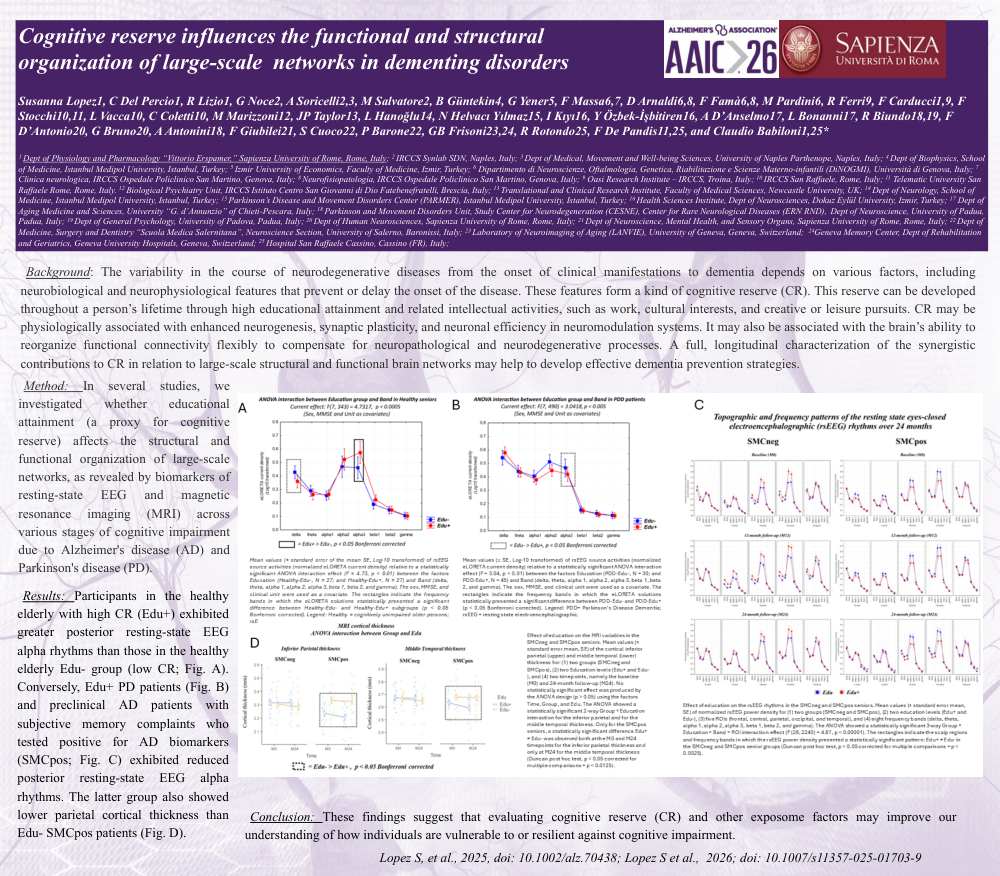
Cognitive Reserve Influences The Functional And Structural Organization Of Large-scale Networks In Dementing Disorders
Poster Presenter
Part of Topic
Background: The variability in the course of neurodegenerative diseases from the onset of clinical manifestations to dementia depends on various factors, including neurobiological and neurophysiological features that prevent or delay the onset of the disease. These features form a kind of cognitive reserve (CR). This reserve can be developed throughout a person’s lifetime through high educational attainment and related intellectual activities, such as work, cultural interests, and creative or leisure pursuits. CR may be physiologically associated with enhanced neurogenesis, synaptic plasticity, and neuronal efficiency in neuromodulation systems. It may also be associated with the brain’s ability to reorganize functional connectivity flexibly in order to compensate for neuropathological and neurodegenerative processes. A full, longitudinal characterization of the synergistic contributions to CR in relation to large-scale structural and functional brain networks may help to develop effective dementia prevention strategies.
Method: In several studies, we investigated whether educational attainment (a proxy for cognitive reserve) affects the structural and functional organization of large-scale networks, as revealed by biomarkers of resting-state EEG and magnetic resonance imaging (MRI) across various stages of cognitive impairment due to Alzheimer's disease (AD) and Parkinson's disease (PD).
Results: Participants in the healthy elderly with high CR (Edu+) group exhibited greater posterior resting-state EEG alpha rhythms than those in the healthy elderly with low CR (Edu-) group (see Fig. A). Conversely, Edu+ PD patients (see Fig. B) and preclinical AD patients with subjective memory complaints who tested positive for AD biomarkers (SMCpos; see Fig. C) exhibited reduced posterior resting-state EEG alpha rhythms. The latter group also showed lower parietal cortical thickness than Edu- SMCpos patients.
Conclusion: These findings suggest that evaluating cognitive reserve (CR) and other exposome factors may improve our understanding of how individuals are vulnerable to or resilient against cognitive impairment.
Comments
Email is required but is not shown publicly.
Loading comments...