4,068 posters, 219 videos, 101 topics, 69 sessions, 14,365 authors, 6,128 institutions
ePostersLive by SciGen Technologies S.A. All rights reserved.
Alzheimer's Association International Conference 2026
July 12-15, 2026 | London, United Kingdom, and Online

10432
From Diagnostic Accuracy To Clinical Utility: A Comparative Review Of Blood-based Biomarkers In Alzheimer’s Disease Care In LMICs
Poster Presenter
Authors
Ogbeide Aghahowa, Michael Agbaiza, Emmanuel Ehizele, Israel Inegbenose
Affiliations
Part of Topic
TITLE: From Diagnostic Accuracy to Clinical Utility: A Comparative Review of Blood-Based Biomarkers in Alzheimer’s Disease Care in LMICs
Background
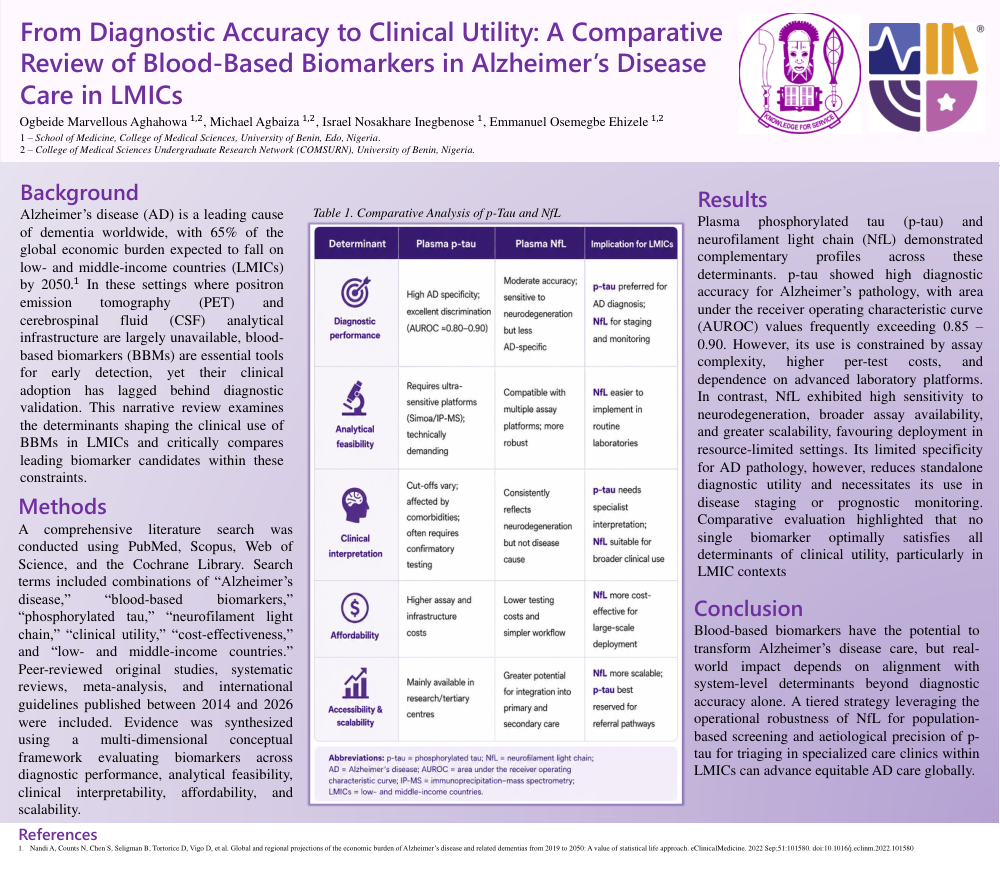
Alzheimer’s disease (AD) is a leading cause of dementia worldwide, with 65% of the global economic burden expected to fall on low- and middle-income countries (LMICs) by 2050. In these settings where positron emission tomography (PET) and cerebrospinal fluid (CSF) analytical infrastructure are largely unavailable, blood-based biomarkers (BBMs) are essential tools for early detection, yet their clinical adoption has lagged behind diagnostic validation. This narrative review examines the determinants shaping the clinical use of BBMs in LMICs and critically compares leading biomarker candidates within these constraints.
Method
A comprehensive literature search was conducted using PubMed, Scopus, Web of Science, and the Cochrane Library. Search terms included combinations of “Alzheimer’s disease,” “blood-based biomarkers,” “phosphorylated tau,” “neurofilament light chain,” “clinical utility,” “cost-effectiveness,” and “low- and middle-income countries.” Peer-reviewed original studies, systematic reviews, meta-analysis, and international guidelines published between 2014 and 2026 were included. Evidence was synthesized using a multi-dimensional conceptual framework evaluating biomarkers across diagnostic performance, analytical feasibility, clinical interpretability, affordability, and scalability.
Result
Plasma phosphorylated tau (p-tau) and neurofilament light chain (NfL) demonstrated complementary profiles across these determinants. p-tau showed high diagnostic accuracy for Alzheimer’s pathology, with area under the receiver operating characteristic curve (AUROC) values frequently exceeding 0.85 – 0.90. However, its use is constrained by assay complexity, higher per-test costs, and dependence on advanced laboratory platforms. In contrast, NfL exhibited high sensitivity to neurodegeneration, broader assay availability, and greater scalability, favouring deployment in resource-limited settings. Its limited specificity for AD pathology, however, reduces standalone diagnostic utility and necessitates its use in disease staging or prognostic monitoring. Comparative evaluation highlighted that no single biomarker optimally satisfies all determinants of clinical utility, particularly in LMIC contexts.
Conclusion
Blood-based biomarkers have the potential to transform Alzheimer’s disease care, but real-world impact depends on alignment with system-level determinants beyond diagnostic accuracy alone. A tiered strategy leveraging the operational robustness of NfL for population-based screening and aetiological precision of p-tau for triaging in specialized care clinics within LMICs can advance equitable AD care globally.
Comments
Email is required but is not shown publicly.
Loading comments...