4,068 posters, 219 videos, 101 topics, 69 sessions, 14,365 authors, 6,128 institutions
ePostersLive by SciGen Technologies S.A. All rights reserved.
Alzheimer's Association International Conference 2026
July 12-15, 2026 | London, United Kingdom, and Online

10400
Informant-rated Mild Behavioral Impairment Predicts Informant-perceived Cognitive Decline Independent Of Apoe e4 And Plasma P-tau217
Poster Presenter
Authors
VICTORIA TIZELI SOUZA, Bárbara Uebel, Gabriela Raquel Paz Rivas, Simone Sieben da Mota, Bruno de Oliveira de Marchi, Guilherme da Silva Carvalho, Haniel Bispo de Souza, Lucas Bastos Beltrami, Lorenna Lima Costa, Paula Martini, Rhaná Carolina Santos, Sarah Carnevalli, Ana Letícia Amorim de Albuquerque, Leonardo Martins de Paula, Manuella Edler Zandoná Giordani, Wyllians Vendramini Borelli, Giovanna Carello-Collar, Márcia Lorena Fagundes Chaves, Eduardo R. Zimmer, Raphael Machado Castilhos
Affiliations
Programa de Pós-Graduação em Ciências Médicas, Universidade Federal do Rio Grande do Sul, Brazil, Serviço de Neurologia, Hospital de Clínicas de Porto Alegre, Brazil, Faculdade de Medicina, Universidade Federal do Rio Grande do Sul, Brazil, Faculdade de Medicina, Universidade do Vale do Rio dos Sinos, Brazil, Programa de Pós-Graduação em Ciências Biológicas: Farmacologia e Terapêutica, Universidade Federal do Rio Grande do Sul, Brazi, Programa de Pós-Graduação em Ciências Biológicas: Farmacologia e Terapêutica, Universidade Federal do Rio Grande do Sul, Brazil, Departamento de Farmacologia, Universidade Federal do Rio Grande do Sul, Brazil, Programa de Pós-Graduação em Ciências Médicas, Universidade Federal do Rio Grande do Sul, Brazil; Serviço de Neurologia, Hospital de Clínicas de Porto Alegre, Brazil
Part of Topic
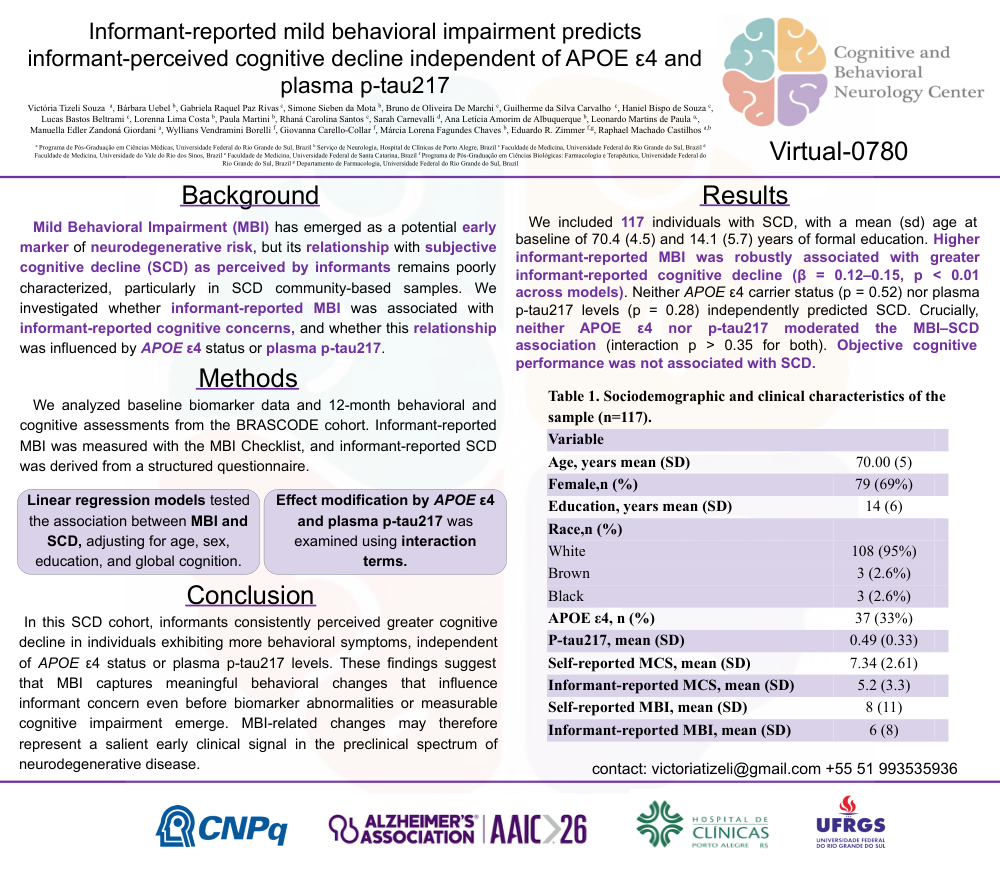
Informant-reported mild behavioral impairment predicts informant-perceived cognitive decline independent of APOE ε4 and plasma p-tau217.
Background: Mild Behavioral Impairment (MBI) has emerged as a potential early marker of neurodegenerative risk, but its relationship with subjective cognitive decline (SCD) as perceived by informants remains poorly characterized, particularly in SCD community-based samples. We investigated whether informant-reported MBI was associated with informant-reported cognitive concerns, and whether this relationship was influenced by APOE ε4 status or plasma p-tau217.
Methods: We analyzed baseline biomarker data and 12-month behavioral and cognitive assessments from the Brazilian Subjective Cognitive Decline (BRASCODE) cohort. Informant-reported MBI was measured with the MBI Checklist, and informant-reported SCD was derived from a structured questionnaire. Linear regression models tested the association between MBI and SCD, adjusting for age, sex, education, and global cognition. Effect modification by APOE ε4 and plasma p-tau217 was examined using interaction terms.
Results: We included 117 individuals with SCD, with a mean (sd) age at baseline of 70.4 (4.5) and 14.1 (5.7) years of formal education. Higher informant-reported MBI was robustly associated with greater informant-reported cognitive decline (β = 0.12–0.15, p < 0.01 across models). Neither APOE ε4 carrier status (p = 0.52) nor plasma p-tau217 levels (p = 0.28) independently predicted SCD. Crucially, neither APOE ε4 nor p-tau217 moderated the MBI–SCD association (interaction p > 0.35 for both). Objective cognitive performance was not associated with SCD.
Conclusions: In this SCD cohort, informants consistently perceived greater cognitive decline in individuals exhibiting more behavioral symptoms, independent of APOE ε4 status or plasma p-tau217 levels. These findings suggest that MBI captures meaningful behavioral changes that influence informant concern even before biomarker abnormalities or measurable cognitive impairment emerge. MBI-related changes may therefore represent a salient early clinical signal in the preclinical spectrum of neurodegenerative disease.
Comments
Email is required but is not shown publicly.
Loading comments...