4,068 posters, 219 videos, 101 topics, 69 sessions, 14,365 authors, 6,128 institutions
ePostersLive by SciGen Technologies S.A. All rights reserved.
Alzheimer's Association International Conference 2026
July 12-15, 2026 | London, United Kingdom, and Online

9923
Amyloid-beta Progression And Cognitive Performance In Marmosets With Autosomal Dominant Alzheimer’s Disease PSEN1 Mutations
Poster Presenter
Authors
Affiliations
Part of Topic
•Fundamental questions remain about the key mechanisms that initiate Alzheimer’s disease (AD), the factors that promote its progression, and the relationship with cognitive impairment.
•Therapeutic interventions that are successful at clearing amyloid plaque accumulation, fail to rescue and prevent cognitive decline.
•To understand the association between amyloid burden and cognitive decline, we are studying marmosets that carry a C410Y point mutation in the presenilin-1 (PSEN1) gene that confers early onset AD in human carriers, and the association of cognitive function with amyloid progression measured by fluid and neuroimaging biomarkers.
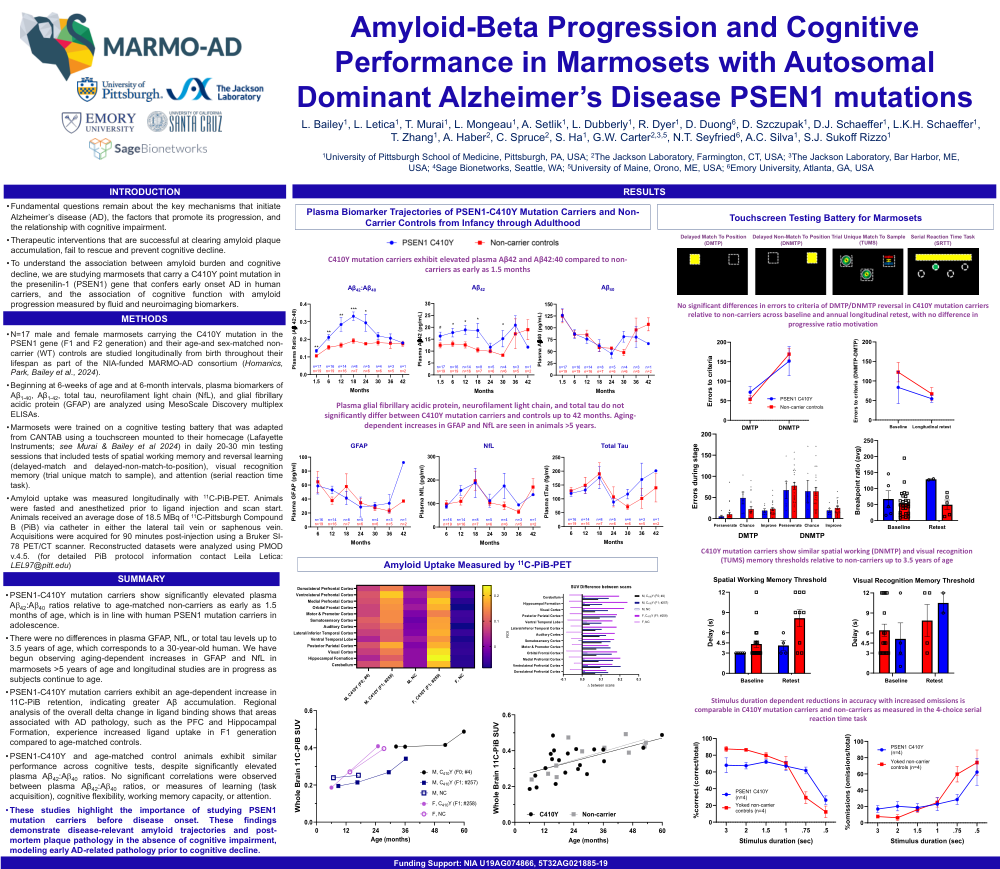
•N=17 male and female marmosets carrying the C410Y mutation in the PSEN1 gene (F1 and F2 generation) and their age-and sex-matched non-carrier (WT) controls are studied longitudinally from birth throughout their lifespan as part of the NIA-funded MARMO-AD consortium (Homanics, Park, Bailey et al., 2024).
•Beginning at 6-weeks of age and at 6-month intervals, plasma biomarkers of Aβ1-40, Aβ1-42, total tau, neurofilament light chain (NfL), and glial fibrillary acidic protein (GFAP) are analyzed using MesoScale Discovery multiplex ELISAs.
•Marmosets were trained on a cognitive testing battery that was adapted from CANTAB using a touchscreen mounted to their homecage (Lafayette Instruments; see Murai & Bailey et al 2024) in daily 20-30 min testing sessions that included tests of spatial working memory and reversal learning (delayed-match and delayed-non-match-to-position), visual recognition memory (trial unique match to sample), and attention (serial reaction time task).
•Amyloid uptake was measured longitudinally with 11C-PiB-PET. Animals were fasted and anesthetized prior to ligand injection and scan start. Animals received an average dose of 18.5 MBq of 11C-Pittsburgh Compound B (PiB) via catheter in either the lateral tail vein or saphenous vein. Acquisitions were acquired for 90 minutes post-injection using a Bruker SI-78 PET/CT scanner. Reconstructed datasets were analyzed using PMOD v.4.5. (for detailed PiB protocol information contact Leila Letica: LEL97@pitt.edu)
•PSEN1-C410Y mutation carriers show significantly elevated plasma Ab42:Ab40 ratios relative to age-matched non-carriers as early as 1.5 months of age, which is in line with human PSEN1 mutation carriers in adolescence.
•There were no differences in plasma GFAP, NfL, or total tau levels up to 3.5 years of age, which corresponds to a 30-year-old human. We have begun observing aging-dependent increases in GFAP and NfL in marmosets >5 years of age and longitudinal studies are in progress as subjects continue to age.
•PSEN1-C410Y mutation carriers exhibit an age-dependent increase in 11C-PiB retention, indicating greater Aβ accumulation. Regional analysis of the overall delta change in ligand binding shows that areas associated with AD pathology, such as the PFC and Hippocampal Formation, experience increased ligand uptake in F1 generation compared to age-matched controls.
•PSEN1-C410Y and age-matched control animals exhibit similar performance across cognitive tests, despite significantly elevated plasma Aβ42:Ab40 ratios. No significant correlations were observed between plasma Aβ42:Ab40 ratios, or measures of learning (task acquisition), cognitive flexibility, working memory capacity, or attention.
•These studies highlight the importance of studying PSEN1 mutation carriers before disease onset. These findings demonstrate disease-relevant amyloid trajectories and post-mortem plaque pathology in the absence of cognitive impairment, modeling early AD-related pathology prior to cognitive decline.
Comments
Email is required but is not shown publicly.
Loading comments...