4,068 posters, 219 videos, 101 topics, 69 sessions, 14,365 authors, 6,128 institutions
ePostersLive by SciGen Technologies S.A. All rights reserved.
Alzheimer's Association International Conference 2026
July 12-15, 2026 | London, United Kingdom, and Online

5011
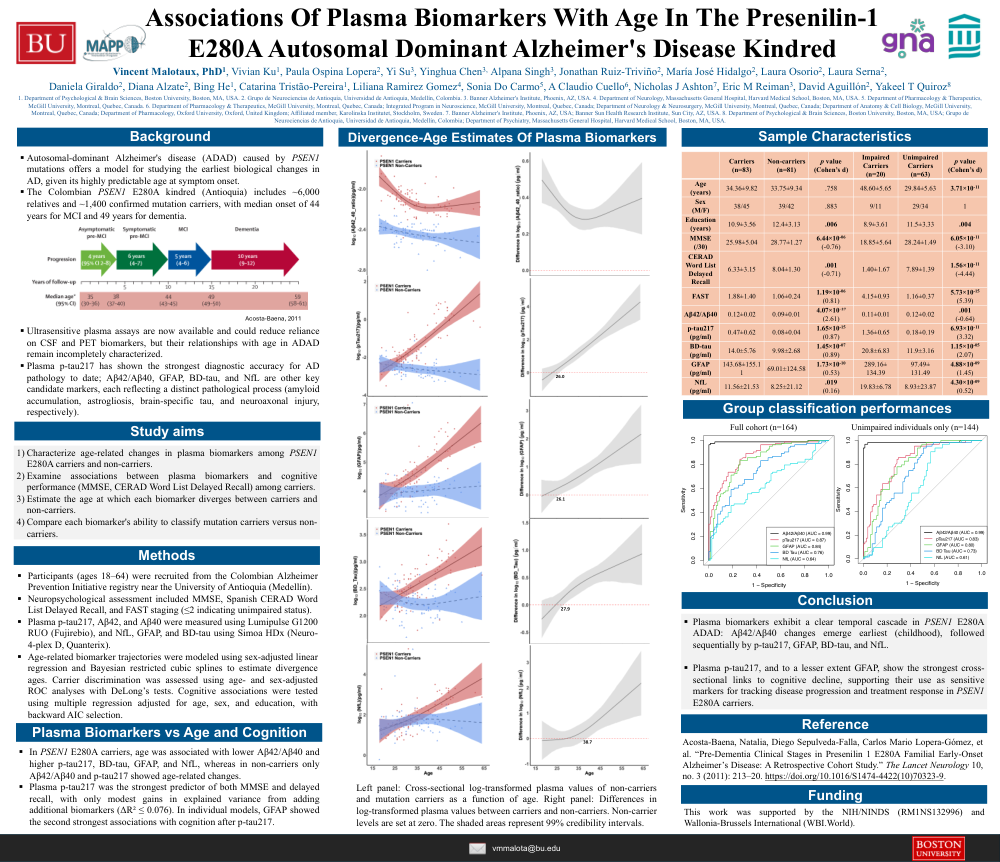
Associations Of Plasma Biomarkers With Age In The Presenilin-1 E280A Autosomal Dominant Alzheimer's Disease Kindred
Poster Presenter
Authors
Vincent Malotaux, Vivian Ku, Paula Ospina Lopera, Yi Su, Yinghua Chen, Alpana Singh, Jonathan Ruiz-Triviño, María José Hidalgo, Laura Osorio, Laura Serna, Daniela Giraldo, Diana Alzate, Bing He, Catarina Tristão-Pereira, Liliana Ramirez Gomez, Sonia Do Carmo, A Claudio Cuello, Nicholas J Ashton, Eric M Reiman, David Aguillón, Yakeel T Quiroz
Affiliations
Banner Alzheimer's Institute, Phoenix, AZ, USA, Department of Psychological & Brain Sciences, Boston University, Boston, MA, USA, Grupo de Neurociencias de Antioquia, Universidad de Antioquia, Medellín, Colombia, Department of Neurology, Massachusetts General Hospital, Harvard Medical School, Boston, MA, USA, Department of Pharmacology & Therapeutics, McGill University, Montreal, Quebec, Canada, Department of Pharmacology & Therapeutics, McGill University, Montreal, Quebec, Canada; Integrated Program in Neuroscience, McGill University, Montreal, Quebec, Canada; Department of Neurology & Neurosurgery, McGill University, Montreal, Quebec, Canada; Department of Anatomy & Cell Biology, McGill University, Montreal, Quebec, Canada; Department of Pharmacology, Oxford University, Oxford, United Kingdom; Affiliated member, Karolinska Institutet, Stockholm, Sweden, Department of Psychological & Brain Sciences, Boston University, Boston, MA, USA; Grupo de Neurociencias de Antioquia, Universidad de Antioquia, Medellín, Colombia; Department of Psychiatry, Massachusetts General Hospital, Harvard Medical School, Boston, MA, USA
Part of Topic
Background:
Autosomal-dominant Alzheimer's disease (ADAD) caused by PSEN1 mutations offers a model for studying the earliest biological changes in AD, given its highly predictable age at symptom onset. The Colombian PSEN1 E280A kindred (Antioquia) includes ~6,000 relatives and ~1,400 confirmed mutation carriers, with median onset of 44 years for MCI and 49 years for dementia. Ultrasensitive plasma assays are now available and could reduce reliance on CSF and PET biomarkers, but their relationships with age in ADAD remain incompletely characterized. Plasma p-tau217 has shown the strongest diagnostic accuracy for AD pathology to date; Aβ42/Aβ40, GFAP, BD-tau, and NfL are other key candidate markers, each reflecting a distinct pathological process (amyloid accumulation, astrogliosis, brain-specific tau, and neuroaxonal injury, respectively).
Study aims:
Plasma Biomarkers vs Age and Cognition:
Comments
Email is required but is not shown publicly.
Loading comments...