4,068 posters, 219 videos, 101 topics, 69 sessions, 14,365 authors, 6,128 institutions
ePostersLive by SciGen Technologies S.A. All rights reserved.
Alzheimer's Association International Conference 2026
July 12-15, 2026 | London, United Kingdom, and Online

10215
Sex differences in Alzheimer’s disease plasma biomarker levels and clinical utility
Poster Presenter
Authors
Marta Mila Aloma, Isabella Hausle, Alison Myoraku, Clara Sorensen, Pamela Thropp, Leslie M. Shaw, Michael W. Weiner, Duygu Tosun
Affiliations
Northern California Institute for Research and Education, San Francisco, CA, USA, Department of Radiology and Biomedical Imaging, University of California San Francisco, San Francisco, CA, USA, Department of Pathology and Laboratory Medicine, Perelman school of Medicine, University of Pennsylvania, Philadelphia, PA, USA
Part of Topic
INTRODUCTION
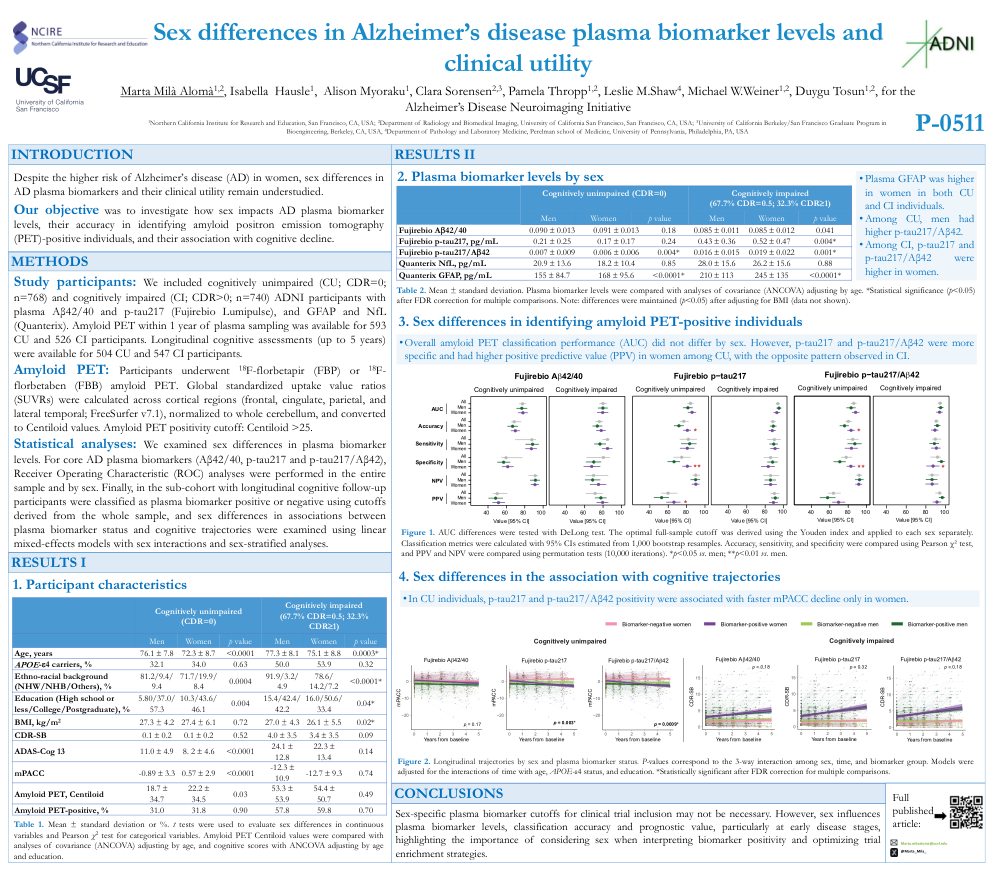
Despite the higher risk of Alzheimer’s disease (AD) in women, sex differences in AD plasma biomarkers and their clinical utility remain understudied.
Our objective was to investigate how sex impacts AD plasma biomarker levels, their accuracy in identifying amyloid positron emission tomography (PET)-positive individuals, and their association with cognitive decline.
METHODS
Study participants: We included cognitively unimpaired (CU; CDR=0; n=768) and cognitively impaired (CI; CDR>0; n=740) ADNI participants with plasma Aβ42/40 and p-tau217 (Fujirebio Lumipulse), and GFAP and NfL (Quanterix). Amyloid PET within 1 year of plasma sampling was available for 593 CU and 526 CI participants. Longitudinal cognitive assessments (up to 5 years) were available for 504 CU and 547 CI participants.
Amyloid PET: Participants underwent 18F-florbetapir (FBP) or 18F-florbetaben (FBB) amyloid PET. Global standardized uptake value ratios (SUVRs) were calculated across cortical regions (frontal, cingulate, parietal, and lateral temporal; FreeSurfer v7.1), normalized to whole cerebellum, and converted to Centiloid values. Amyloid PET positivity cutoff: Centiloid >25.
Statistical analyses: We examined sex differences in plasma biomarker levels. For core AD plasma biomarkers (Aβ42/40, p-tau217 and p-tau217/Aβ42), Receiver Operating Characteristic (ROC) analyses were performed in the entire sample and by sex. Finally, in the sub-cohort with longitudinal cognitive follow-up participants were classified as plasma biomarker positive or negative using cutoffs derived from the whole sample, and sex differences in associations between plasma biomarker status and cognitive trajectories were examined using linear mixed-effects models with sex interactions and sex-stratified analyses.
RESULTS
Plasma biomarker levels by sex: Plasma GFAP was higher in women in both CU and CI individuals. Among CU, men had higher p-tau217/Aβ42. Among CI, p-tau217 and p-tau217/Aβ42 were higher in women.
Sex-specific plasma biomarker cutoffs for clinical trial inclusion may not be necessary. However, sex influences plasma biomarker levels, classification accuracy and prognostic value, particularly at early disease stages, highlighting the importance of considering sex when interpreting biomarker positivity and optimizing trial enrichment strategies.
Comments
Email is required but is not shown publicly.
Loading comments...