4,068 posters, 219 videos, 101 topics, 69 sessions, 14,365 authors, 6,128 institutions
ePostersLive by SciGen Technologies S.A. All rights reserved.
Alzheimer's Association International Conference 2026
July 12-15, 2026 | London, United Kingdom, and Online

10410
Task-evoked EEG Markers Of Impaired Neural Dynamics In MCI And AD
Poster Presenter
Authors
Affiliations
Part of Topic
Background
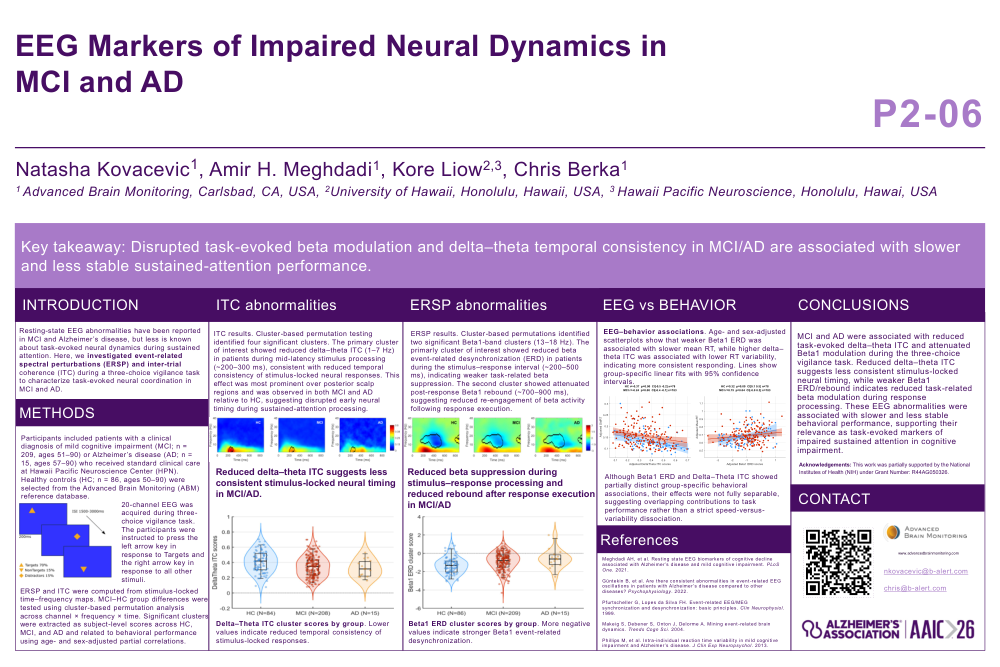
Resting-state EEG spectral power measures have provided several biomarkers of cognitive decline in mild cognitive impairment (MCI) and Alzheimer’s disease (AD). However, how neural dynamics adapt during cognitively demanding tasks, particularly those requiring sustained attention and response selection, remains less well understood. Here, we investigated event-related spectral perturbations (ERSP) and inter-trial coherence (ITC) during a three-choice vigilance task to characterize task-evoked neural coordination in MCI and AD.
Methods
Participants included patients with a clinical diagnosis of MCI (n=136,ages51-90) or AD (n=15,ages 57-90) who received standard clinical care at a memory clinic, as well as healthy controls (HC;n=136,ages 50-90) drawn from a reference database. EEG (20-channel) was acquired during resting-state and a visual three-choice vigilance task. Time–frequency representations were computed to derive ERSP and ITC measures. Group differences were assessed using cluster-based-permutation testing in the channel-frequency-time space. Significant clusters were summarized and related to behavioral performance.
Results
Cluster-based-permutation analysis revealed significant group differences in task-evoked neural dynamics. Compared with HC, both MCI and AD groups showed significantly reduced Beta1 event-related desynchronization (13–18Hz) during the stimulus–response interval (~200–500ms) and attenuated post-response Beta1 rebound (~700–900ms). In addition, posterior delta–theta (1–7Hz) ITC was significantly reduced in MCI and AD during early post-stimulus processing (200–300ms). At the individual level, stronger Beta1 ERD was associated with faster response times (HC:r=0.26,p<0.001,MCI:r=0.26,p<0.001), while lower delta–theta ITC was associated with greater response time variability (HC:r=-0.29,p<0.01,MCI:r=-0.26,p<0.01).
Conclusions
These results suggest that cognitive impairment in MCI/AD is characterized by a dual disruption of neural timing and control mechanisms during sustained attention. Weakened Beta1 desynchronization and rebound point to less efficient release and re-engagement of beta-mediated inhibitory control during stimulus–response processing. Reduced delta–theta ITC indicates increased trial-to-trial variability of stimulus processing. Stronger Beta1 ERD was associated with faster response times, whereas lower delta–theta ITC was associated with greater response time variability across both HC and MCI. Together, these findings suggest that beta-band dynamics and low-frequency phase locking index are complementary neural mechanisms supporting response speed and response stability.
Comments
Email is required but is not shown publicly.
Loading comments...