4,068 posters, 219 videos, 101 topics, 69 sessions, 14,365 authors, 6,128 institutions
ePostersLive by SciGen Technologies S.A. All rights reserved.
Alzheimer's Association International Conference 2026
July 12-15, 2026 | London, United Kingdom, and Online

2023
Spectris™ Sensory Stimulation Increases CSF HDL-like Lipid Transport Proteins In Alzheimer’s Disease
Poster Presenter
Authors
Ralph Kern, James Lah, Saima Rathore, Annabelle Singer, Nicholas Seyfried, Duc Duong, Eric Dammer, Mihaly Hajos, Monika Shpokayte, Zach Malchano, Robbert Zusterzeel, Elvira Ponce, Julia Riddle, Allan Levey
Affiliations
R&D, Cognito Therapeutics, Cambridge, MA, USA, Emory University School of Medicine, Atlanta, GA, USA, R&D, Emtherapro, Atlanta, GA, USA, Georgia Institute of Technology, Atlanta, GA, USA, Biochemistry, Emory University, Atlanta, GA, USA, R&D, Cognito Therapeutics, Cambridge, MA, USA and Yale University, New Haven, CT, USA
Part of Topic
Background:
Cholesterol andlipid-transport dysfunction contribute to Alzheimer’s disease (AD) pathophysiology. It has beenobserved that CSF APOA1 was lower in AD and associated with both MMSE and CSF pTau1811. Preclinical evidence suggests thatincreasing APOA1 expression may improve cognition, reduce neuroinflammation, and support synaptic and myelin integrity2-4. We describe the effect of investigational Spectris™ treatment on CSF lipid transport proteins.
Methods:
We conducted CSF proteomics in amyloid-positive MCI participants (n=10) enrolled in the FLICKER trial (NCT03543878)5. Participants used the investigational Spectris sensory stimulation device daily for 1 hour for 4 (N=5) or 8 (N=5) weeks (delayed startdesign). CSF was collected at baseline, 4 weeks, and 8 weeks; proteins were measured using unbiased tandem mass tag massspectrometry6. Changes in protein abundance were compared between participants who received 8 weeks treatment (n=5) andparticipants (n=5) who did not receive stimulation; proteins were mapped to published brain protein co-expression modules7 viaGo Elite (version 1.2.5) to assess the impact of Spectris treatment on AD-related pathophysiological pathways8.
Results:
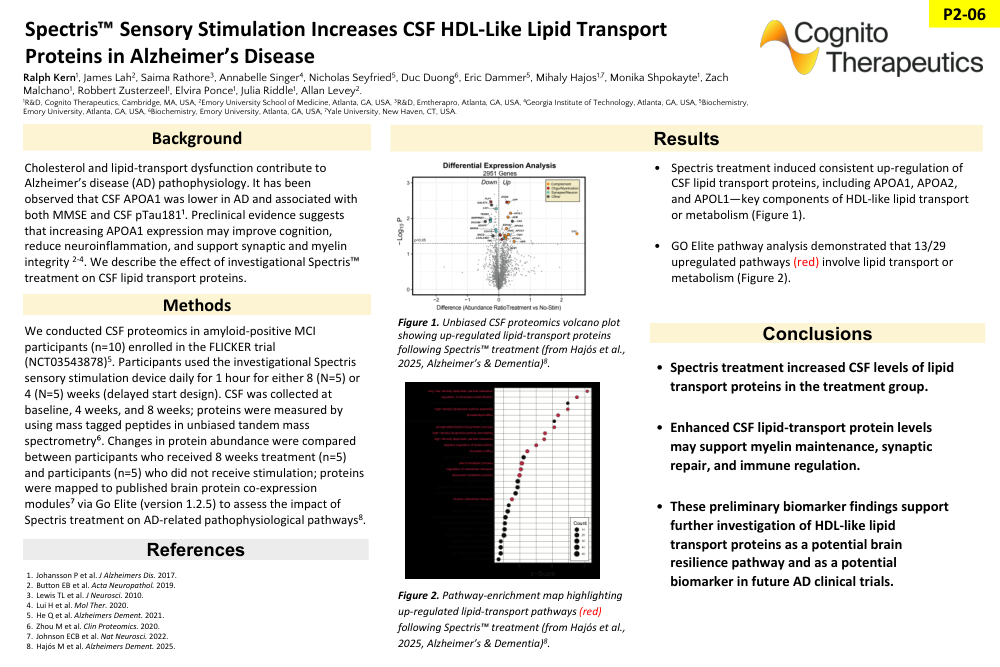
Spectris treatment induced consistent up-regulation of CSF lipid transport proteins, including APOA1, APOA2, and APOL1—key components of HDL-like lipid transport or metabolism (Figure 1). GO Elite pathway analysis demonstrated that 13/29 upregulated pathways involve lipid transport or metabolism (Figure 2).
Conclusion:
Spectris treatment increased CSF levels of lipid transport proteins in the treatment group. Enhanced CSF lipid-transportprotein levels may support myelin maintenance, synaptic repair, and immune regulation. These preliminary biomarker findingssuggest that modulation of HDL-like lipid transport proteins supports further investigation of lipid transport modulation as apotential brain resilience pathway and as a potential biomarker in future AD clinical trials.
Comments
Email is required but is not shown publicly.
Loading comments...