4,068 posters, 219 videos, 101 topics, 69 sessions, 14,365 authors, 6,128 institutions
ePostersLive by SciGen Technologies S.A. All rights reserved.
Alzheimer's Association International Conference 2026
July 12-15, 2026 | London, United Kingdom, and Online

10067
Plasma P-tau217 Mediates Apoe e4 Effects On Informant-rated Subjective Cognitive Decline In Preclinical AD.
Poster Presenter
Part of Topic
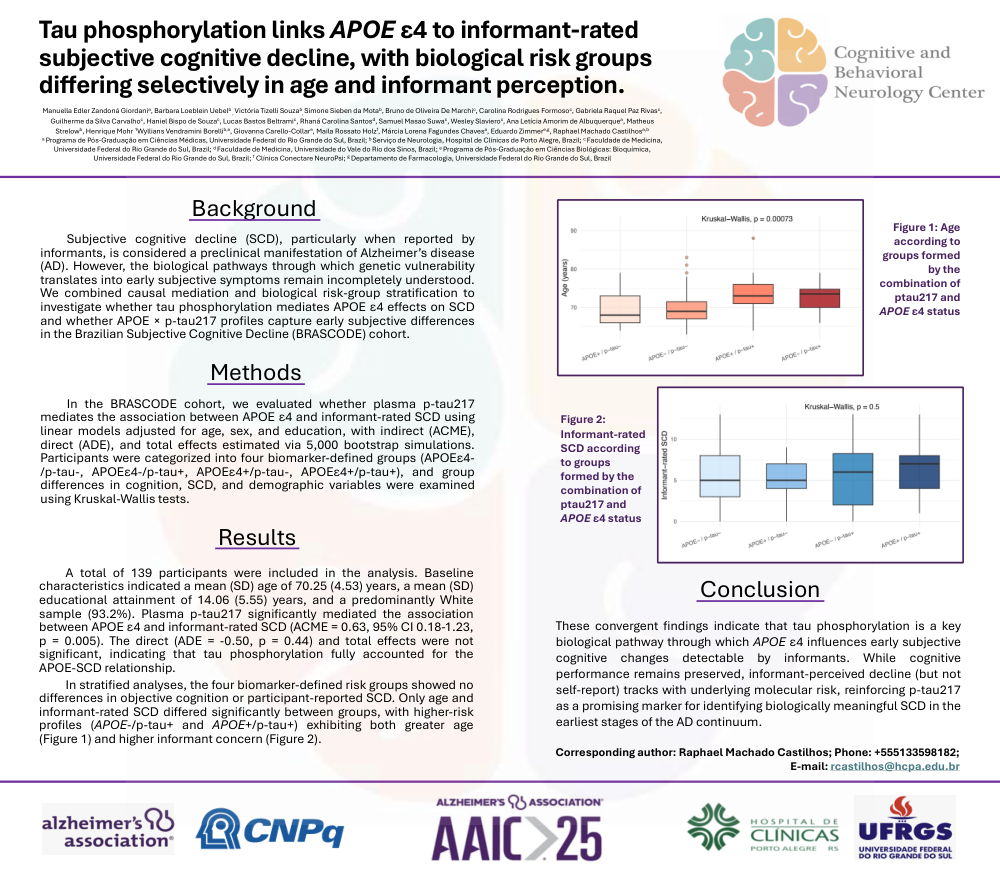
Background: Subjective cognitive decline (SCD), particularly when reported by informants, is considered a preclinical manifestation of Alzheimer’s disease (AD). However, the biological pathways through which genetic vulnerability translates into early subjective symptoms remain incompletely understood. We combined causal mediation and biological risk-group stratification to investigate whether tau phosphorylation mediates APOE ε4 effects on SCD and whether APOE × p-tau217 profiles capture early subjective differences in the Brazilian Subjective Cognitive Decline (BRASCODE) cohort.
Methods: In the BRASCODE cohort, we evaluated whether plasma p-tau217 mediates the association between APOE ε4 and informant-rated SCD using linear models adjusted for age, sex, and education, with indirect (ACME), direct (ADE), and total effects estimated via 5,000 bootstrap simulations. Participants were categorized into four biomarker-defined groups (APOEε4-/p-tau-, APOEε4-/p-tau+, APOEε4+/p-tau-, APOEε4+/p-tau+), and group differences in cognition, SCD, and demographic variables were examined using Kruskal-Wallis tests.
Results: A total of 139 participants were included in the analysis. Baseline characteristics indicated a mean (SD) age of 70.25 (4.53) years, a mean (SD) educational attainment of 14.06 (5.55) years, and a predominantly White sample (93.2%). Plasma p-tau217 significantly mediated the association between APOE ε4 and informant-rated SCD (ACME = 0.63, 95% CI 0.18-1.23, p = 0.005). The direct (ADE = -0.50, p = 0.44) and total effects were not significant, indicating that tau phosphorylation fully accounted for the APOE-SCD relationship. In stratified analyses, the four biomarker-defined risk groups showed no differences in objective cognition or participant-reported SCD. Only age and informant-rated SCD differed significantly between groups, with higher-risk profiles (APOE-/p-tau+ and APOE+/p-tau+) exhibiting both greater age (Figure 1) and higher informant concern (Figure 2).
Conclusion: These convergent findings indicate that tau phosphorylation is a key biological pathway through which APOE ε4 influences early subjective cognitive changes detectable by informants. While cognitive performance remains preserved, informant-perceived decline (but not self-report) tracks with underlying molecular risk, reinforcing p-tau217 as a promising marker for identifying biologically meaningful SCD in the earliest stages of the AD continuum.
Comments
Email is required but is not shown publicly.
Loading comments...