4,068 posters, 219 videos, 101 topics, 69 sessions, 14,365 authors, 6,128 institutions
ePostersLive by SciGen Technologies S.A. All rights reserved.
Alzheimer's Association International Conference 2026
July 12-15, 2026 | London, United Kingdom, and Online

2966
From Signal To Scale: Advancing Alzheimer’S Research With Digital Health Technologies
Poster Presenter
Authors
Affiliations
Part of Topic
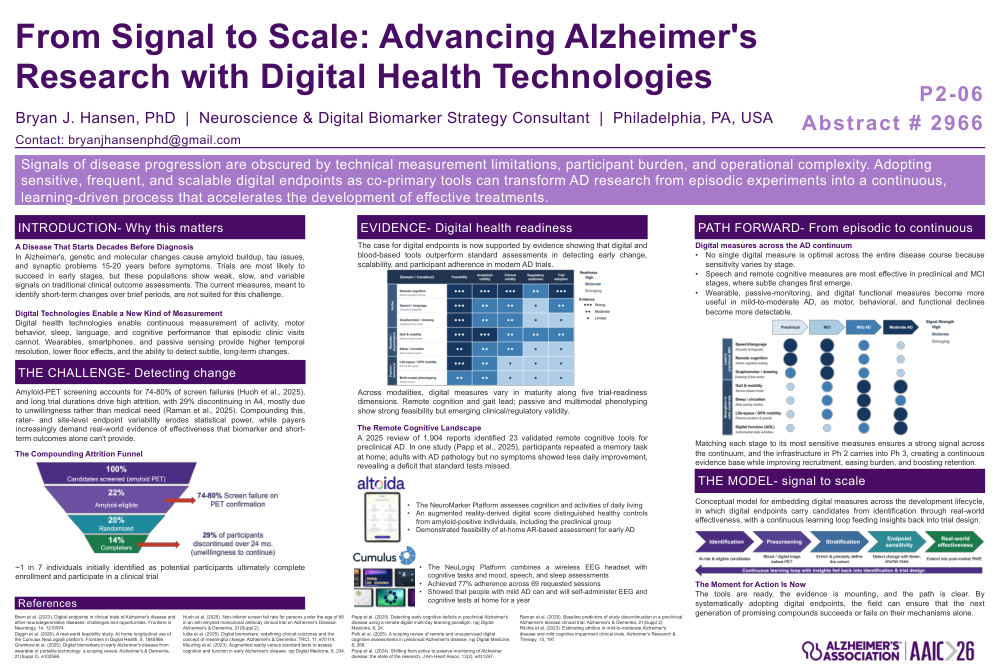
Neurodegenerative diseases gradually diminish a patient's sense of self, independence, and
ability to connect with others. In Alzheimer’s disease (AD), this decline starts with genetic and
molecular changes in brain regions well before clinical symptoms become evident. Digital health
technologies allow for direct measurement of neural activity, providing new insights into
different stages and manifestations of the disease. The success or failure of disease-modifying
trials increasingly relies not only on biological factors but also on the capacity to detect
meaningful change at scale. Challenges faced by sponsors include biomarker-based patient
stratification complicated by high screening failure rates, long trial durations that don’t match
the slow progression of the disease, and inconsistent efficacy endpoints across diverse global
sites. Furthermore, there is a growing demand for post-market evidence from healthcare
systems and payers.
Based on extensive experience from large pharma programs and across the industry, this
discussion underscores how signals of disease progression are often obscured by technical
measurement limitations, participant burden, and operational complexity, especially in early to
moderate stages. Adopting more sensitive, frequent, and scalable measures, including digital
endpoints used as co-primary tools, is now crucial. Early integration of these approaches can
streamline screening, improve data clarity, and create a continuum from clinical trials to real-
world effectiveness. This shift has the potential to transform AD research from episodic
experiments into a continuous, learning-driven process, ultimately speeding up the
development of effective treatments.
Comments
Email is required but is not shown publicly.
Loading comments...