4,068 posters, 219 videos, 101 topics, 69 sessions, 14,365 authors, 6,128 institutions
ePostersLive by SciGen Technologies S.A. All rights reserved.
Alzheimer's Association International Conference 2026
July 12-15, 2026 | London, United Kingdom, and Online

9647
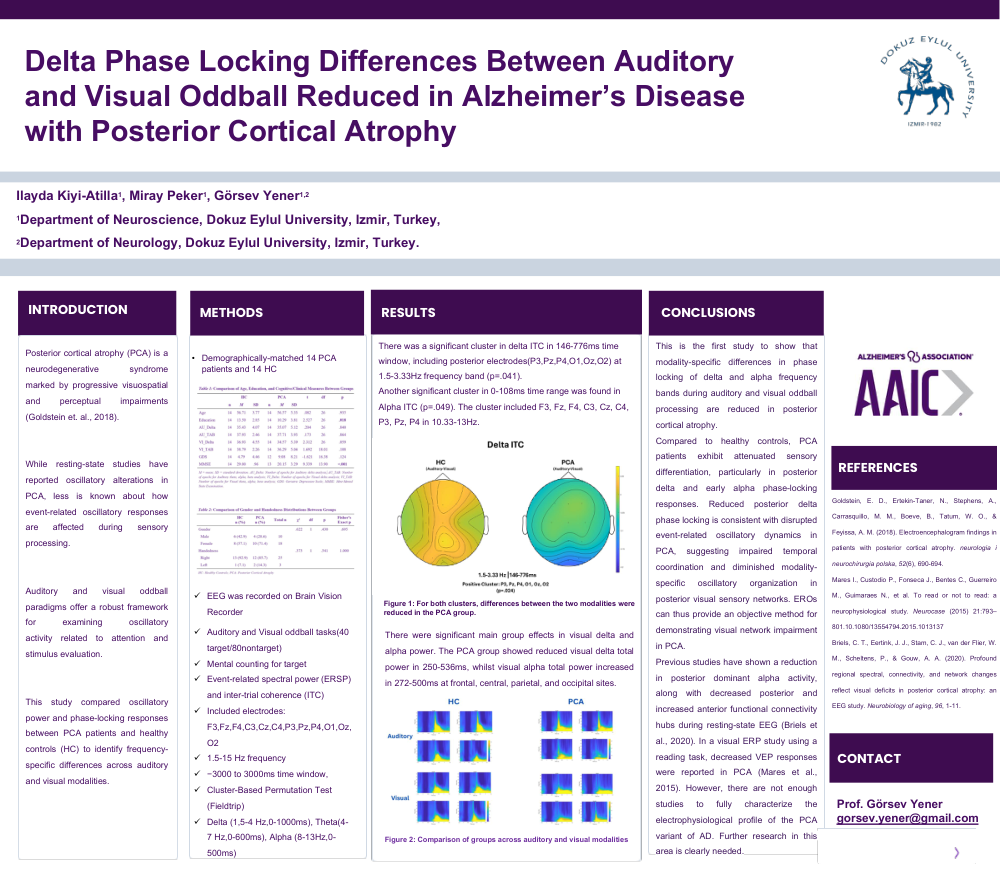
Delta Phase Locking Differences Between Auditory And Visual Oddball Reduced In Alzheimer’S Disease With Posterior Cortical Atrophy
Part of Topic
INTRODUCTION
Posterior cortical atrophy (PCA) is a neurodegenerative syndrome marked by progressive visuospatial and perceptual impairments (Goldstein et. al., 2018). While resting-state studies have reported oscillatory alterations in PCA, less is known about how event-related oscillatory responses are affected during sensory processing. Auditory and visual oddball paradigms offer a robust framework for examining oscillatory activity related to attention and stimulus evaluation. This study compared oscillatory power and phase-locking responses between PCA patients and healthy controls (HC) to identify frequency-specific differences across auditory and visual modalities.
METHOD
Demographically-matched 14 PCApatients and 14 HC
EEG was recorded on Brain VisionRecorder
Auditory and Visual oddball tasks(40target/80nontarget)
Mental counting for target
Event-related spectral power (ERSP)and inter-trial coherence (ITC)
Included electrodes:F3,Fz,F4,C3,Cz,C4,P3,Pz,P4,O1,Oz,O2
1.5-15 Hz frequency
−3000 to 3000ms time window,
Cluster-Based Permutation Test(Fieldtrip)
Delta (1,5-4 Hz,0-1000ms), Theta(4-7 Hz,0-600ms), Alpha (8-13Hz,0-500ms)
RESULTS
There was a significant cluster in delta ITC in 146-776ms timewindow, including posterior electrodes(P3,Pz,P4,O1,Oz,O2) at1.5-3.33Hz frequency band (p=.041). Another significant cluster in 0-108ms time range was found inAlpha ITC (p=.049). The cluster included F3, Fz, F4, C3, Cz, C4,P3, Pz, P4 in 10.33-13Hz. There were significant main group effects in visual delta and alpha power. The PCA group showed reduced visual delta total power in 250-536ms, whilst visual alpha total power increased in 272-500ms at frontal, central, parietal, and occipital sites.
CONCLUSION
This is the first study to show that modality-specific differences in phase locking of delta and alpha frequency bands during auditory and visual oddball processing are reduced in posterior cortical atrophy.
Compared to healthy controls, PCA patients exhibit attenuated sensory differentiation, particularly in posterior delta and early alpha phase-locking responses. Reduced posterior delta phase locking is consistent with disrupted event-related oscillatory dynamics in PCA, suggesting impaired temporal coordination and diminished modality-specific oscillatory organization in posterior visual sensory networks. EROs can thus provide an objective method for demonstrating visual network impairment in PCA.
Previous studies have shown a reduction in posterior dominant alpha activity, along with decreased posterior and increased anterior functional connectivity hubs during resting-state EEG (Briels et al., 2020). In a visual ERP study using a reading task, decreased VEP responses were reported in PCA (Mares et al., 2015). However, there are not enough studies to fully characterize the electrophysiological profile of the PCA variant of AD. Further research in this area is clearly needed.
Comments
Email is required but is not shown publicly.
Loading comments...