4,068 posters, 219 videos, 101 topics, 69 sessions, 14,365 authors, 6,128 institutions
ePostersLive by SciGen Technologies S.A. All rights reserved.
Alzheimer's Association International Conference 2026
July 12-15, 2026 | London, United Kingdom, and Online

2055
The Biological Scaling Of Alzheimer's Disease Neuropathological Changes Across Primate Species
Poster Presenter
Authors
Clara Toussaint, Erwan Bézard, Maël Lemoine, Vincent Planche
Affiliations
Institut des Maladies Neurodégénératives, CNRS UMR 5293, Univ.Bordeaux, Bordeaux F- 33000, France - ImmunoConcEpT, CNRS UMR5164, Univ. Bordeaux, Bordeaux F-33000, France, Institut des Maladies Neurodégénératives, CNRS UMR 5293, Univ.Bordeaux, Bordeaux F- 33000, France, ImmunoConcEpT, CNRS UMR5164, Univ. Bordeaux, Bordeaux F-33000, France, Centre Mémoire Ressources Recherches, Service de Neurologie des Maladies Neurodégénératives, Pôle de Neurosciences Cliniques, CHU de Bordeaux, Bordeaux F-33000, France
Part of Topic
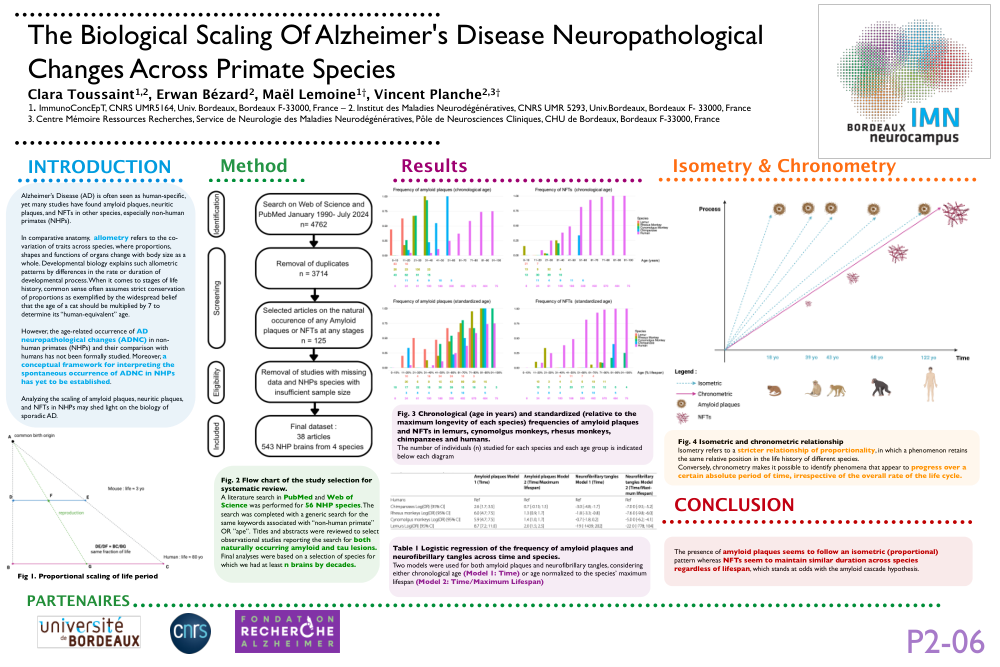
Alzheimer’s Disease (AD) is often seenas human-specific, yet many studieshave found amyloid plaques (AP), neuritic plaques, and NFTs in otherspecies, especially non-humanprimates (NHPs).
The amyloid cascade hypothesisproposes that AP accumulation drives NFT progression.
Our framework centers on isometry: wepropose that pathological processes, like physiological ones, follow isometricscaling.
Analyzing the scaling of AP, neuriticplaques, and NFTs in NHPs may shed light on the biology of sporadic AD.
The presence of AP seems to follow an isometric (proportional) pattern whereas NFTs seem to maintainsimilar duration across speciesregardless of lifespan, which stands at odds with the amyloid cascade hypothesis.
Comments
Email is required but is not shown publicly.
Loading comments...