4,068 posters, 219 videos, 101 topics, 69 sessions, 14,365 authors, 6,128 institutions
ePostersLive by SciGen Technologies S.A. All rights reserved.
Alzheimer's Association International Conference 2026
July 12-15, 2026 | London, United Kingdom, and Online

688
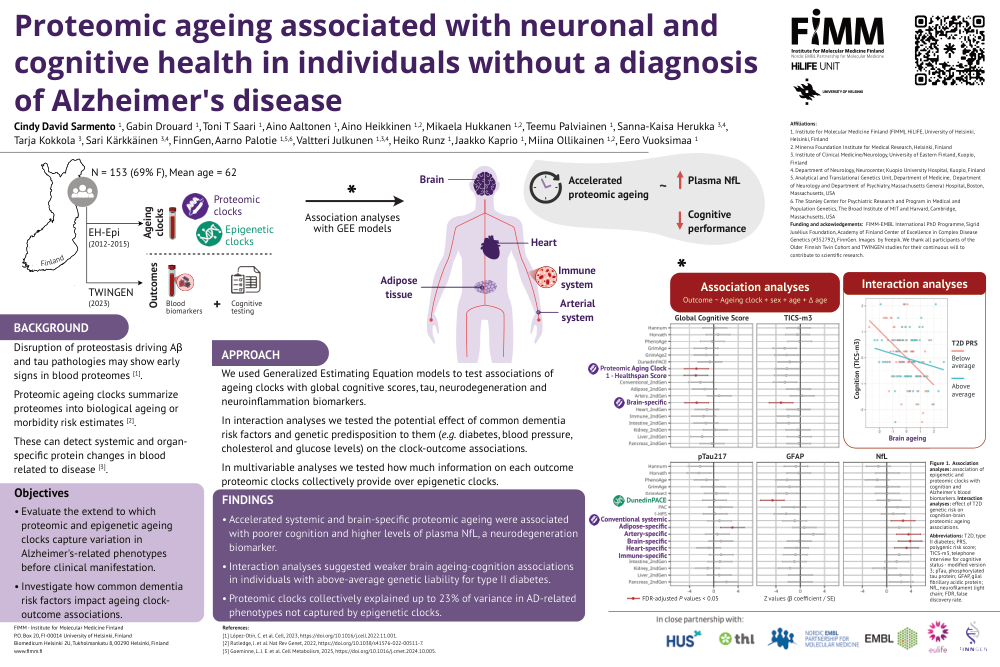
Proteomic Ageing Associated With Neuronal And Cognitive Health In Individuals Without A Diagnosis Of Alzheimer’s Disease
Poster Presenter
Authors
Cindy David Sarmento, Gabin Drouard, Toni T Saari, Aino Aaltonen, Aino Heikkinen, Mikaela Hukkanen, Teemu Palviainen, Sanna-Kaisa Herukka, Tarja Kokkola, Sari Kärkkäinen, FinnGen -, Aarno Palotie, Valtteri Julkunen, Heiko Runz, Jaakko Kaprio, Miina Ollikainen, Eero Vuoksimaa
Affiliations
Institute for Molecular Medicine Finland (FIMM), University of Helsinki, Institute for Molecular Medicine Finland (FIMM), University of Helsinki; Minerva Foundation Institute for Medical Research, Institute of Clinical Medicine/Neurology, University of Eastern Finland; Department of Neurology, Neurocenter, Kuopio University Hospital, Institute of Clinical Medicine/Neurology, University of Eastern Finland, -, Institute for Molecular Medicine Finland (FIMM), University of Helsinki; Analytical and Translational Genetics Unit, Massachusetts General Hospital; The Stanley Center for Psychiatric Research, The Broad Institute of MIT and Harvard, Institute for Molecular Medicine Finland (FIMM), University of Helsinki; Institute of Clinical Medicine/Neurology, University of Eastern Finland; Department of Neurology, Neurocenter, Kuopio University Hospital
Part of Topic
Background
• Disruption of proteostasis driving Aβ and tau pathologies may show early signs in blood proteomes [1].
• Proteomic ageing clocks summarize proteomes into biological ageing or morbidity risk estimates [2].
• These can detect systemic and organ-specific protein changes in blood related to disease [3].
Objectives
• Evaluate the extent to which proteomic and epigenetic ageing clocks capture variation in Alzheimer's-related phenotypes before clinical manifestation.
• Investigate how common dementia risk factors impact ageing clock-outcome associations.
Approach
• We used Generalized Estimating Equation models to test associations of ageing clocks with global cognitive scores, tau, neurodegeneration and neuroinflammation biomarkers.
• In interaction analyses we tested the potential effect of common dementia risk factors and genetic predisposition to them (e.g. diabetes, blood pressure, cholesterol and glucose levels) on the clock-outcome associations.
• In multivariable analyses we tested how much information on each outcome proteomic clocks collectively provide over epigenetic clocks.
Findings
• Accelerated systemic and brain-specific proteomic ageing were associated with poorer cognition and higher levels of plasma NfL, a neurodegeneration biomarker.
• Interaction analyses suggested weaker brain ageing-cognition associations in individuals with above-average genetic liability for type II diabetes.
• Proteomic clocks collectively explained up to 23% of variance in AD-related phenotypes not captured by epigenetic clocks.
References
[1] López-Otín, C. et al. Cell, 2023, https://doi.org/10.1016/j.cell.2022.11.001.
[2] Rutledge, J. et al. Nat Rev Genet, 2022, https://doi.org/10.1038/s41576-022-00511-7.
[3] Goeminne, L. J. E. et al. Cell Metabolism, 2025, https://doi.org/10.1016/j.cmet.2024.10.005.
Comments
Email is required but is not shown publicly.
Loading comments...