4,068 posters, 219 videos, 101 topics, 69 sessions, 14,365 authors, 6,128 institutions
ePostersLive by SciGen Technologies S.A. All rights reserved.
Alzheimer's Association International Conference 2026
July 12-15, 2026 | London, United Kingdom, and Online

2459
Blood Biomarkers Of Alzheimer’S Disease And Progression Of Brain Atrophy And Cerebrovascular Burden In Cognitively Healthy Older Adults
Poster Presenter
Authors
Martina Valletta, Davide Liborio Vetrano, Erika J Laukka, Grégoria Kalpouzos, Javier Oltra, Debora Rizzuto, Marco Canevelli, Claudia Fredolini, Chengxuan Qiu, Bengt Winblad, Laura Fratiglioni, Giulia Grande
Affiliations
Aging Research Center, Department of Neurobiology, Care Sciences and Society, Karolinska Institutet, Aging Research Center and Division of Clinical Geriatrics, Department of Neurobiology, Care Sciences and Society, Karolinska Institutet, Department of Human Neuroscience, Sapienza University, Affinity Proteomics Stockholm, Science for Life Laboratory, Royal Institute of Technology (KTH), Division of Neurogeriatrics, Department of Neurobiology, Care Sciences and Society, Karolinska Institutet
Part of Topic
Aim: To examine the associations between blood biomarkers of AD and longitudinal changes in markers of brain atrophy and cerebrovascular burden in community-dwelling, cognitively unimpaired, older adults.
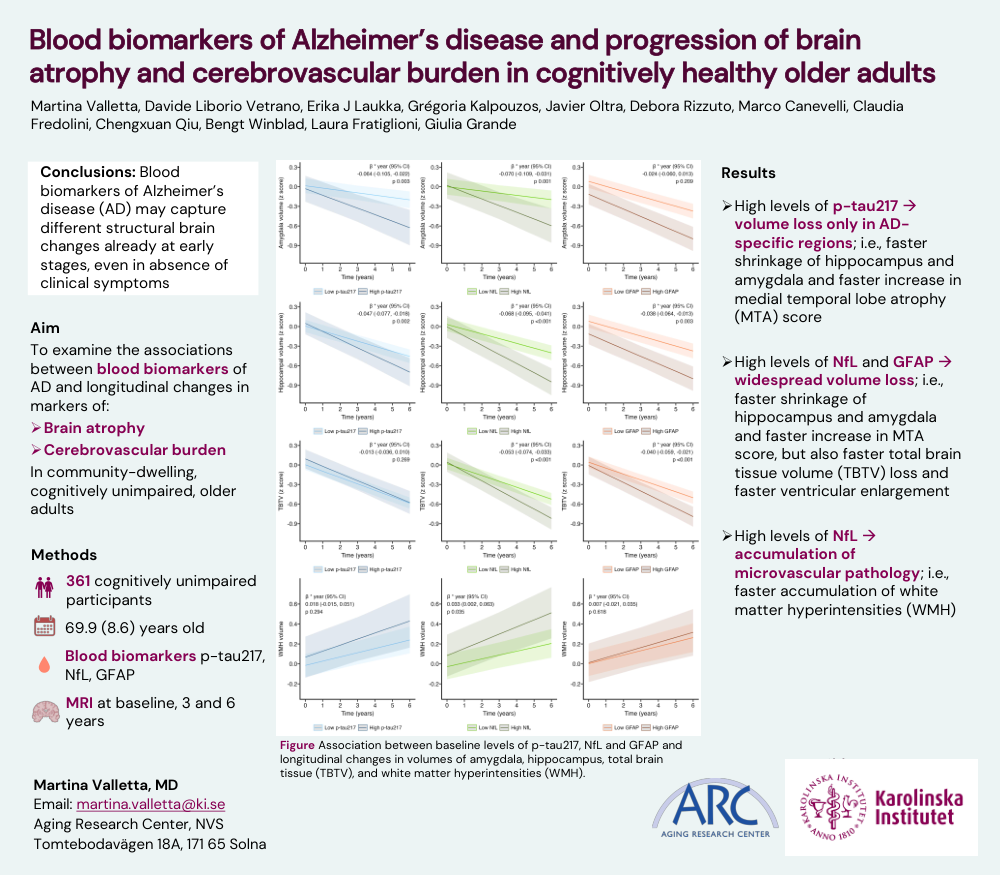
Results: 1) High levels of p-tau217 were associated with volume loss only in AD-specific regions; i.e., faster shrinkage of hippocampus and amygdala and faster increase in medial temporal lobe atrophy (MTA) score. 2) High levels of NfL and GFAP were associated with widespread volume loss; i.e., faster shrinkage of hippocampus and amygdala and faster increase in MTA score, but also faster total brain tissue volume (TBTV) loss and faster ventricular enlargement. 3) High levels of NfL were also associated with accumulation of microvascular pathology; i.e., faster accumulation of white matter hyperintensities (WMH).
Conclusions: Blood biomarkers of Alzheimer’s disease (AD) may capture different structural brain changes already at early stages, even in absence of clinical symptoms.
Comments
Email is required but is not shown publicly.
Loading comments...