4,068 posters, 219 videos, 101 topics, 69 sessions, 14,365 authors, 6,128 institutions
ePostersLive by SciGen Technologies S.A. All rights reserved.
Alzheimer's Association International Conference 2026
July 12-15, 2026 | London, United Kingdom, and Online

8883
Optimized Dried Plasma Spot Workflow Increases Biomarker Detectability For Alzheimer's Disease Research
Poster Presenter
Authors
You-Rim Lee, Xuemei Zeng, Marissa F. Farinas, Madelyn K. Pierce, Nya Nicholson, Ann D. Cohen, Oscar L. Lopez, Thomas K. Karikari
Affiliations
Department of Psychiatry, School of Medicine, University of Pittsburgh, Pittsburgh, PA, USA, University of Pittsburgh Alzheimer's Disease Research Center (ADRC), Pittsburgh, PA, USA, University of Pittsburgh School of Medicine, Pittsburgh, PA, USA
Part of Topic
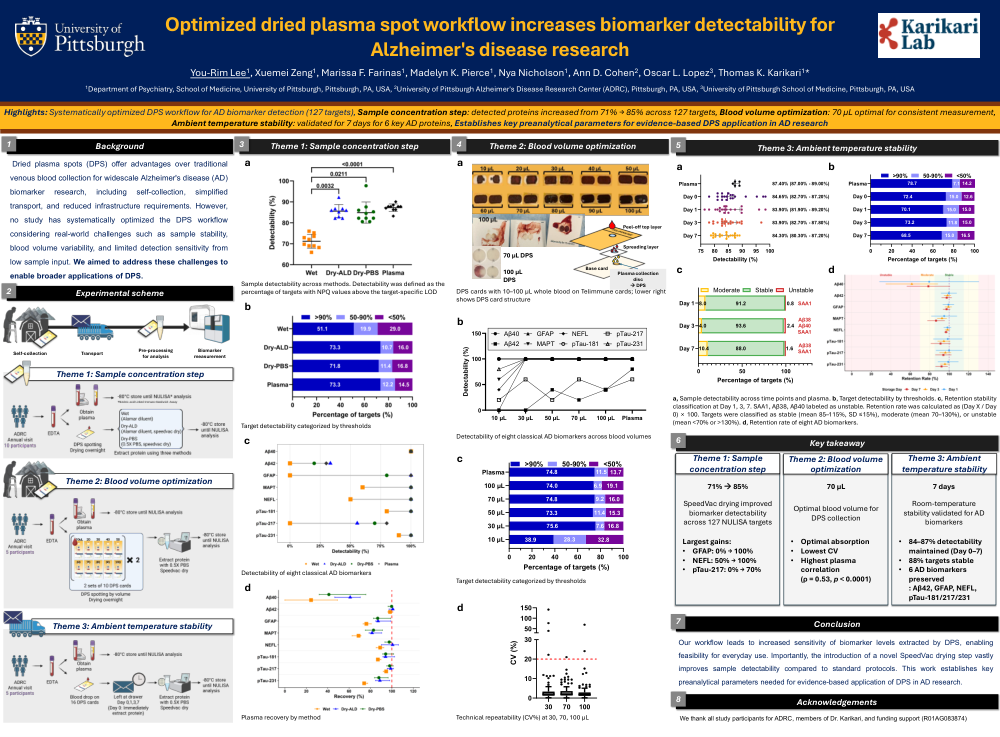
Background: Dried plasma spots (DPS) offer advantages over traditional venous blood collection for widescale Alzheimer's disease (AD) biomarker research, including self-collection capability, simplified transport, and reduced infrastructure requirements. However, no study has systematically optimized the DPS workflow considering real-world challenges such as sample stability, blood volume variability, and limited detection sensitivity from low sample input. We aimed to systematically address these challenges to enable broader clinical and research applications of DPS.
Method: Three independent experiments were conducted. Matched plasma and DPS samples were prepared from participants from the University of Pittsburgh Alzheimer's Disease Research Center. For the stability assessment, DPS cards were stored at room temperature for 0, 1, 3, and 7 days prior to protein extraction. For blood volume optimization, 10–100 µL of whole blood was applied onto Telimmune DPS cards. To improve sensitivity, we evaluated the use of SpeedVac for sample concentration. Total protein concentration was measured using BCA assay and 127 neurodegenerative biomarkers were analyzed using Nucleic Acid-Linked Immuno-Sandwich Assay (NULISA)seq CNS Disease Panel. Recovery rate (Day0/Plasma) and retention rate (DayX/Day0) were calculated for stability assessment.
Results: In the stability experiment, total protein concentration remained stable through Day 7. NULISA showed good reproducibility (median CV ~5%) and detectability (84–87%) across time points. Recovery rate analysis showed 84% of targets (107/127) had acceptable recovery from plasma, and ~80% maintained acceptable retention through Day 7. Among 8 classical AD biomarkers, 6 remained stable: Aβ42, GFAP, NEFL, pTau-181, pTau-217, and pTau-231. In the blood volume experiment, 70 µL showed optimal absorption, the lowest CV in total protein analysis, and highest correlation with EDTA plasma (ρ=0.53, p<0.0001). SpeedVac drying significantly improved biomarker detectability from 71% (using the manufacturer's standard protocol) to 85%, with notable improvements for GFAP (0→100%), NEFL (50→100%), and pTau-217 (0→70%), while correlation with plasma was maintained (ρ=0.54, p<0.0001).
Conclusion: Our workflow leads to increased sensitivity of biomarker levels extracted by DPS, enabling feasibility for everyday use. Importantly, the introduction of a novel SpeedVac drying step vasty improves sample detectability compared to standard protocols. This work establishes key preanalytical parameters needed for evidence-based application of DPS in AD research.
Comments
Email is required but is not shown publicly.
Loading comments...