4,068 posters, 219 videos, 101 topics, 69 sessions, 14,365 authors, 6,128 institutions
ePostersLive by SciGen Technologies S.A. All rights reserved.
Alzheimer's Association International Conference 2026
July 12-15, 2026 | London, United Kingdom, and Online

3826
Plasma Biomarker Trajectories In Alzheimer's Clinical Development: A 17-year Prospective Study
Part of Topic
Abstract:
Background: Long-term trajectories of plasma biomarkers relative to clinical symptom onset in Alzheimer‘s disease (AD) remain scarce. AD features a prolonged preclinical phase, with a cascade of pathological changes initiating decades prior to the onset of clinical symptoms. Because plasma tests are significantly more accessible, cost-effective, and less invasive than cerebrospinal fluid or neuroimaging methods, they create unprecedented opportunities for scalable screening, making it crucial to understand how these markers evolve across the disease course.
Methods: We analyzed 17-year longitudinal data from 195 initially cognitively unimpaired participants in the BIOCARD study. Plasma biomarker trajectories were modeled as a function of years from the estimated onset of mild cognitive impairment symptoms using generalized additive mixed models. This approach allowed us to analyze the longitudinal trajectories for key biomarkers including the Aβ42/Aβ40 ratio, p-tau181, p-tau181/Aβ42, NfL, GFAP, sTREM2, and YKL-40.
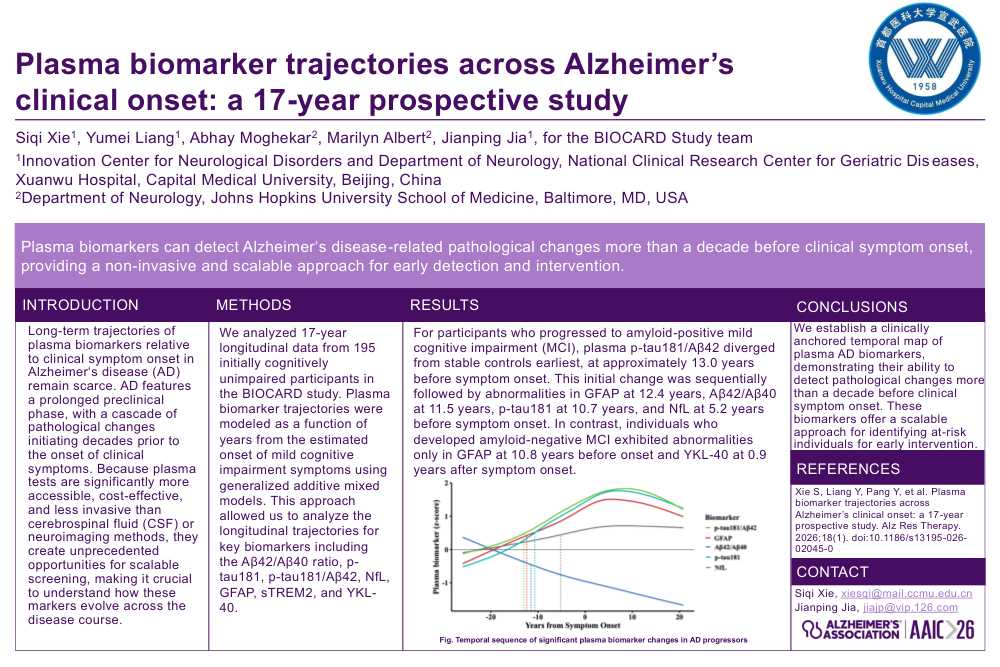
Results: For participants who progressed to amyloid-positive mild cognitive impairment (MCI), plasma p-tau181/Aβ42 diverged from stable controls earliest, at approximately 13.0 years before symptom onset. This initial change was sequentially followed by abnormalities in GFAP at 12.4 years, Aβ42/Aβ40 at 11.5 years, p-tau181 at 10.7 years, and NfL at 5.2 years before symptom onset. In contrast, individuals who developed amyloid-negative MCI exhibited abnormalities only in GFAP at 10.8 years before onset and YKL-40 at 0.9 years after symptom onset.
Conclusion: We establish a clinically anchored temporal map of plasma AD biomarkers, demonstrating their ability to detect pathological changes more than a decade before clinical symptom onset. These biomarkers offer a scalable approach for identifying at-risk individuals for early intervention.
Comments
Email is required but is not shown publicly.
Loading comments...