4,068 posters, 219 videos, 101 topics, 69 sessions, 14,365 authors, 6,128 institutions
ePostersLive by SciGen Technologies S.A. All rights reserved.
Alzheimer's Association International Conference 2026
July 12-15, 2026 | London, United Kingdom, and Online

2992
Plasma Proteomics Identifies Novel Biomarkers Of Amyloid Pathology In Alzheimer’s Disease
Poster Presenter
Authors
Affiliations
Part of Topic
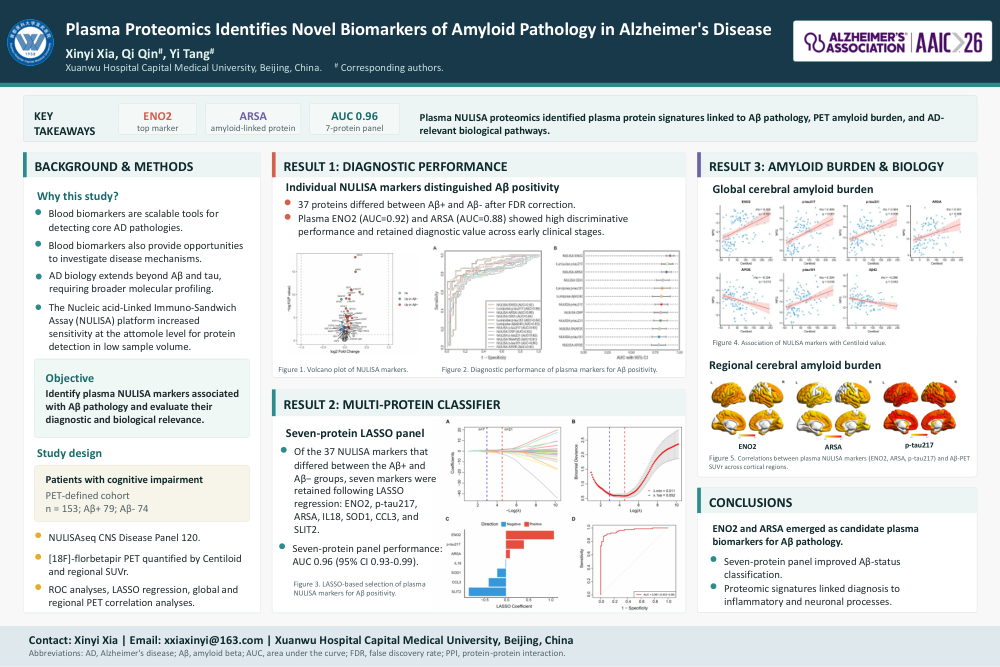
Background: Advances in proteomic technologies enable sensitive plasma-based profiling for early detection and mechanistic understanding of Alzheimer’s disease (AD). We evaluated the NULISAseq central nervous system (CNS) panel in individuals with cognitive impairment to identify amyloid-associated plasma biomarkers.
Methods: Plasma biomarkers were quantified in 153 participants (79 Aβ+ and 74 Aβ-). Plasma Aβ42, p-tau181, p-tau217, and p-tau/Aβ42 ratios were additionally measured using Lumipulse and Simoa. Based on differential markers, a multi-protein panel was constructed, and associations with amyloid burden, cognition, and demographic factors were examined. Bioinformatic analyses were further performed.
Results: Core AD biomarkers showed strong concordance across NULISAseq, Lumipulse, and Simoa platforms. Thirty-seven proteins differed between Aβ+ and Aβ- groups after false discovery rate correction. ENO2 and ARSA demonstrated high discriminatory performance for amyloid pathology, including early stages, and correlated with cerebral amyloid burden. A seven-protein panel derived from LASSO regression achieved excellent classification of Aβ status (AUC = 0.96, 95% CI: 0.93–0.98) with internal cross-validation. Enrichment analyses indicated that these markers are involved in neuroinflammatory pathways, while protein-protein interaction analysis highlighted tau-centered networks and suggested additional mechanisms beyond tau pathology.
Conclusions: We identified ENO2 and ARSA as novel plasma biomarkers of AD with high diagnostic value. These findings provide biological insights into disease mechanisms, suggesting processes beyond classical AD pathology.
Comments
Email is required but is not shown publicly.
Loading comments...