4,068 posters, 219 videos, 101 topics, 69 sessions, 14,365 authors, 6,128 institutions
ePostersLive by SciGen Technologies S.A. All rights reserved.
Alzheimer's Association International Conference 2026
July 12-15, 2026 | London, United Kingdom, and Online

4700
Wearable-derived Digital Phenotypes Of Emotion Regulation Reveal Markers Of Resilience And Vulnerability Relevant To Dementia Risk
Poster Presenter
Authors
Marta Alvarez-Ambrosio, Gabrielle Cattaneo, Paloma Chausa, Diego Moreno-Blanco, Gemma Albi-Villuendas, Ignacio Oropesa, Patricia Sánchez-González, Javier Solana-Sanchez, Enrique J Gómez
Affiliations
Biomedical Engineering and Telemedicine Centre, ETSI Telecomunicación, Center for Biomedical Technology, Universidad Politécnica de Madrid, Madrid, Spain, Institut Guttmann, Institut Universitari de Neurorehabilitació adscrit a la UAB, Barcelona, Spain
Part of Topic
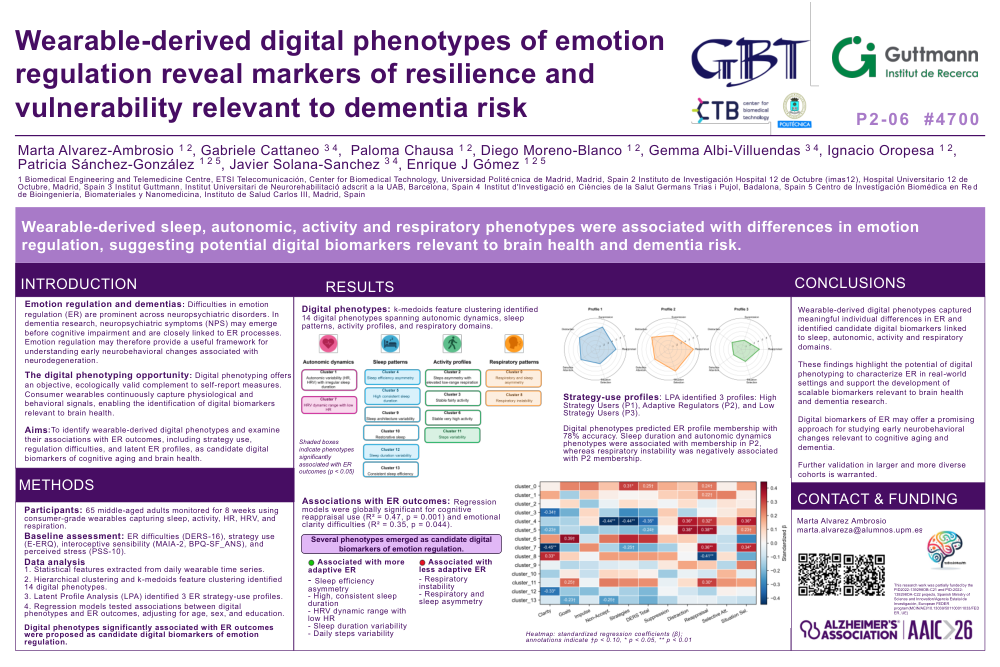
Neuropsychiatric symptoms (NPS) are prevalent across the dementia continuum and may emerge before overt cognitive impairment. Because many NPS involve affective and behavioral disturbances closely related to emotion regulation (ER), digital phenotyping using consumer-grade wearables offers an opportunity to identify digital biomarkers of ER from physiological and behavioral signals. Sixty-five middle-aged adults were monitored for eight weeks using wearables capturing sleep, activity, heart rate, heart rate variability, and respiration. Digital phenotypes were derived through hierarchical and k-medoids feature clustering, and their associations with ER outcomes were examined using regression models. Fourteen digital phenotypes spanning sleep, autonomic, activity, and respiratory domains were identified. Several phenotypes distinguished between different ER strategy-use profiles with 78% accuracy and were significantly associated with cognitive reappraisal, emotional clarity difficulties, and other ER outcomes, supporting their role as candidate digital biomarkers of emotion regulation. Overall, wearable-derived digital phenotypes capture meaningful individual differences in emotion regulation and highlight the potential of digital phenotyping to characterize emotional functioning in real-world settings. These findings support the development of scalable digital biomarkers relevant to brain health and dementia research.
Comments
Email is required but is not shown publicly.
Loading comments...