4,068 posters, 219 videos, 101 topics, 69 sessions, 14,365 authors, 6,128 institutions
ePostersLive by SciGen Technologies S.A. All rights reserved.
Alzheimer's Association International Conference 2026
July 12-15, 2026 | London, United Kingdom, and Online

4161
Brain Health Prediction In Older Adults Via Digital Speech Biomarkers
Poster Presenter
Authors
Ivan Caro, Gonzalo Pérez, Joaquín Valdez Bisé, Franco Ferrante, Lara Gauder, Alejandro Sosa Welford, Joaquín Ponferrada, Luciana Ferrer, Agustín Ibañez, Andrea Slachevsky, Adolfo García
Affiliations
Consejo Nacional de Investigaciones Científicas y Técnicas (CONICET), Buenos Aires, Argentina; Cognitive Neuroscience Center, University of San Andrés, Victoria, Buenos Aires, Argentina, Consejo Nacional de Investigaciones Científicas y Técnicas (CONICET), Buenos Aires, Argentina; Cognitive Neuroscience Center, University of San Andrés, Victoria, Buenos Aires, Argentina; Universidad de Buenos Aires, Buenos Aires, Argentina, Department of Psychiatry, School of Medicine, Pontificia Universidad Católica de Chile, Santiago, Chile, University of Buenos Aires, Ciudad Autonoma de Buenos Aires, CABA, Argentina, Cognitive Neuroscience Center, University of San Andrés, Victoria, Buenos Aires, Argentina, Institute of Computer Science, University of Buenos Aires, Buenos Aires, Argentina, Cognitive Neuroscience Center, University of San Andrés, Victoria, Buenos Aires, Argentina; Latin American Brain Health Institute (BrainLat), Universidad Adolfo Ibáñez, Santiago, Región Metropolitana, Chile; Global Brain Health Institute, Dublín, Dublín, Ireland;Department of Biophysics, School of Medicine, Istanbul Medipol University, 34815 Istanbul, Türkiye; Barcelonaβeta Brain Research Center (BBRC), Pasqual Maragall Foundation, 08005 Barcelona, Spain, Neurology Service, Department of Medicine, Clínica Alemana, Universidad del Desarrollo, Santiago, Chile; Memory and Neuropsychiatric Center (CMYN), Neurology Department, Hospital del Salvador and Faculty of Medicine, University of Chile, Santiago, Chile; Neuropsychology and Clinical Neuroscience Laboratory (LANNEC), Physiopathology Department – ICBM, Faculty of Medicine, Universidad de Chile, Santiago, Chile; Geroscience Center for Brain Health and Metabolism (GERO), Santiago, Chile, Cognitive Neuroscience Center, University of San Andrés, Victoria, Buenos Aires, Argentina; Latin American Brain Health Institute (BrainLat), Universidad Adolfo Ibáñez, Santiago, Chile; Universidad de Santiago de Chile, Santiago, Chile
Part of Topic
Brain Health Prediction in Older Adults via Digital Speech Biomarkers
Background:
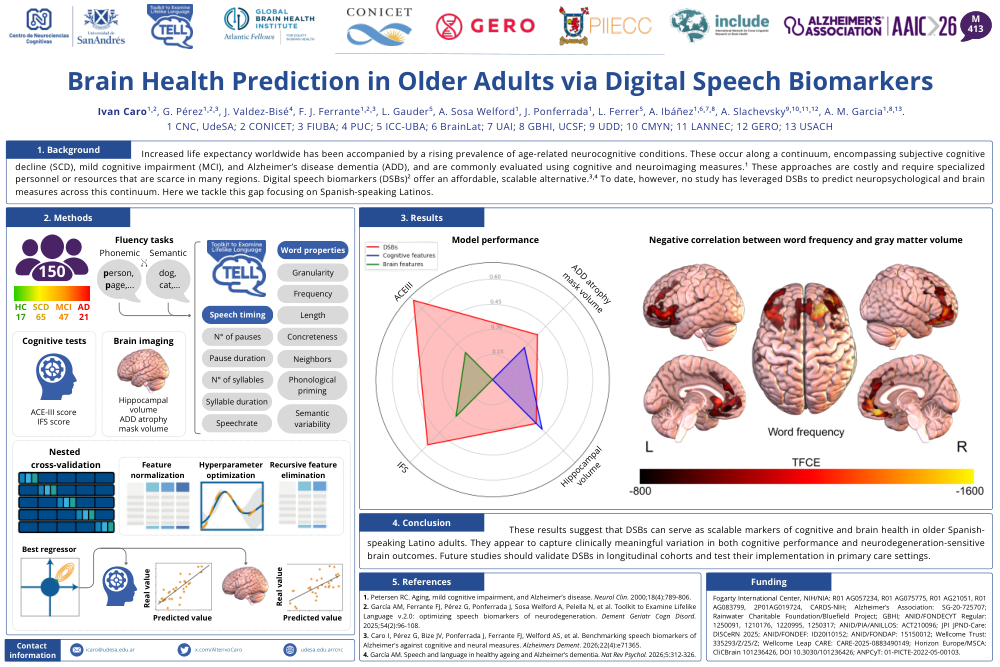
Increased life expectancy worldwide has been accompanied by a rising prevalence of age-related neurocognitive conditions. These occur along a continuum, encompassing subjective cognitive decline (SCD), mild cognitive impairment (MCI), and Alzheimer’s disease dementia (ADD), and are commonly evaluated using cognitive and neuroimaging measures. These approaches are costly and require specialized personnel or resources that are scarce in many regions. Digital speech biomarkers (DSBs) offer an affordable, scalable alternative. To date, however, no study has leveraged DSBs to predict neuropsychological and brain measures across this continuum. Here we tackle this gap focusing on Spanish-speaking Latinos.
Methods:
Participants spanning the SCD–MCI–ADD continuum (n = 150; 17 healthy controls, 55 with SCD, 57 with MCI, 21 with ADD) completed brief phonemic and semantic fluency tasks, standardized cognitive and executive function testing (Addenbrooke’s Cognitive Examination–III [ACE-III], INECO Frontal Screening [IFS]), and MRI protocols. DSBs features were extracted from the fluency tasks using the TELL app; cognitive features were derived from ACE-III and IFS scores; and brain features were computed from the volumes of dementia-sensitive regions. Machine learning models were trained using DSBs and brain features separately to predict ACE-III and IFS scores, and using DSBs and cognitive features separately to predict hippocampal volume and an ADD-related atrophy mask. Model performance was quantified by age-adjusted partial Pearson correlations between predicted and observed values. To investigate neural correlates, multiple regression analyses were conducted between DSBs and gray matter volume.
Results:
DSBs features outperformed brain features in predicting ACE-III (r = .67 vs. .23) and IFS scores (r = .55 vs. .31). They also outperformed cognitive features in predicting ADD mask volume (r = .38 vs. .27), but not in predicting hippocampal volume (r = .37 vs. .42). Word frequency was negatively correlated with prefrontal cortex volume.
Conclusion:
DSBs capture both cognitive performance and MRI-derived measures of brain health across the SCD–MCI–ADD continuum, surpassing standard cognitive and imaging measures. By offering a scalable, objective, time-efficient, and affordable alternative to gold-standard assessments, they support more equitable approaches to dementia detection and monitoring worldwide.
Comments
Email is required but is not shown publicly.
Loading comments...