4,068 posters, 219 videos, 101 topics, 69 sessions, 14,365 authors, 6,128 institutions
ePostersLive by SciGen Technologies S.A. All rights reserved.
Alzheimer's Association International Conference 2026
July 12-15, 2026 | London, United Kingdom, and Online

6175
Digital Rhythmic Tapping Biomarkers For Early Mci Screening: A Micro-behavioral Analysis
Poster Presenter
Authors
Part of Topic
Digital Rhythmic Tapping Biomarkers For Early MCI Screening: A Micro-behavioral Analysis
Authors: Goeun Shim1,2, Whani Kim2, Byung Hun Yun1,2, Hyun Jeong Ko2, So Yoon Park2, Jin Sung Kim3, Yu Young Kim1,2, Sang Kwon Lim2, Su Bin Jeong2, Geon Ha Kim4, Jin Woo Kim1,2 , Jee Hang Lee3,5
Affiliations: 1Yonsei University, Seoul, Korea, Republic of, 2HAII Corp., Seoul, Korea, Republic of, 3Sangmyung University, Seoul, Korea, Republic of, 4Department of Neurology, Ewha Womans University College of Medicine, Seoul, Korea, Republic of. , 5Institute for Advanced Intelligence Study, Daejeon, Republic of Korea
Background
-
Motor timing deficits quantified through finger tapping tasks, have emerged as early markers of neurodegenerative diseases.
-
Digital assessment captures hundreds of micro-behavioral features—such as reaction time, inter-tap interval (ITI) variability, and rhythm entrainment—that traditional tests cannot detect.
-
These abnormalities reflect frontal-striatal and cerebellar dysfunction, which are compromised early in Alzheimer's disease and related dementias.
-
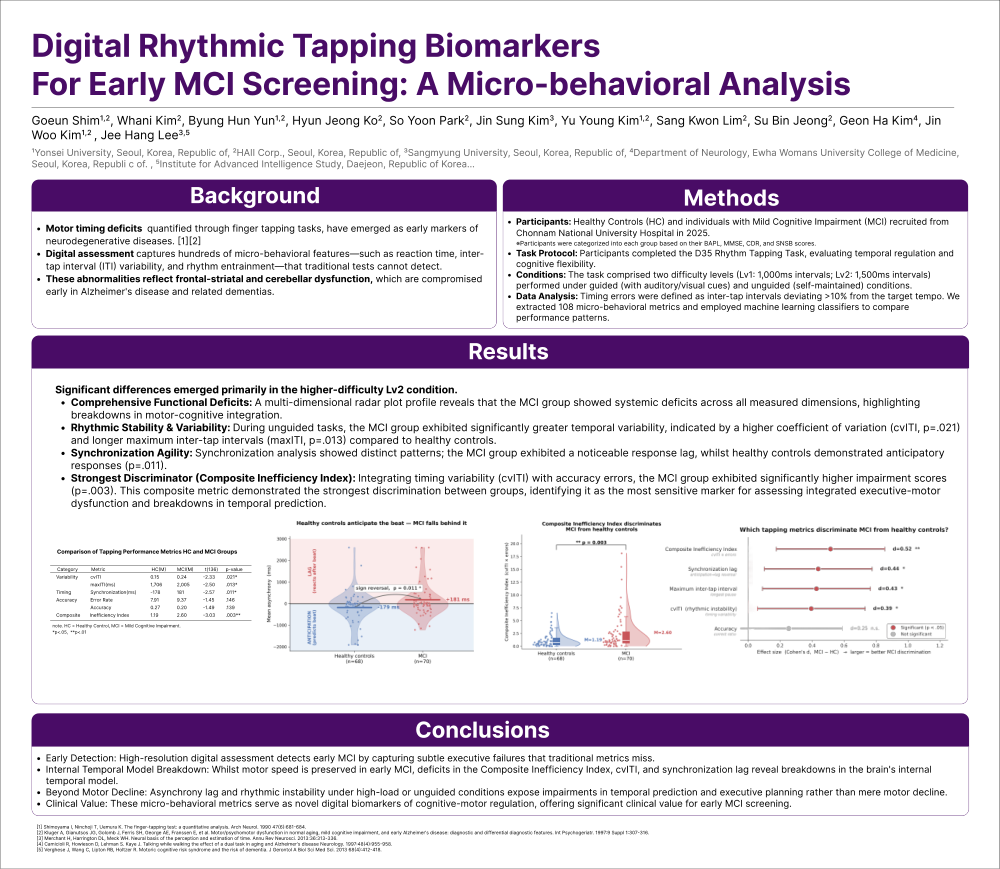
Significant differences emerged primarily in the higher-difficulty Lv2 condition.
Methods
-
Participants: Healthy Controls (HC) and individuals with Mild Cognitive Impairment (MCI) recruited from Chonnam National University Hospital in 2025. Participants were categorized into each group based on their BAPL, MMSE, CDR, and SNSB scores.
-
Task Protocol: Participants completed the D35 Rhythm Tapping Task, evaluating temporal regulation and cognitive flexibility.
-
Conditions: The task comprised two difficulty levels (Lv1: 1,000ms intervals; Lv2: 1,500ms intervals) performed under guided (with auditory/visual cues) and unguided (self-maintained) conditions.
-
Data Analysis: Timing errors were defined as inter-tap intervals deviating >10% from the target tempo. We extracted 108 micro-behavioral metrics and employed machine learning classifiers to compare performance patterns.
Results
-
Comprehensive Functional Deficits: A multi-dimensional radar plot profile reveals that the MCI group showed systemic deficits across all measured dimensions, highlighting breakdowns in motor-cognitive integration.
-
Rhythmic Stability & Variability: During unguided tasks, the MCI group exhibited significantly greater temporal variability, indicated by a higher coefficient of variation (cvITI, p=.021) and longer maximum inter-tap intervals (maxITI, p=.013) compared to healthy controls.
-
Synchronization Agility: Synchronization analysis showed distinct patterns; the MCI group exhibited a noticeable response lag, whilst healthy controls demonstrated anticipatory responses (p=.011).
-
Strongest Discriminator (Composite Inefficiency Index): Integrating timing variability (cv|T|) with accuracy errors, the MCI group exhibited significantly higher impairment scores (p=.003). This composite metric demonstrated the strongest discrimination between groups, identifying it as the most sensitive marker for assessing integrated executive-motor dysfunction and breakdowns in temporal prediction.
Conclusions
-
Early Detection: High-resolution digital assessment detects early MCI by capturing subtle executive failures that traditional metrics miss.
-
Internal Temporal Model Breakdown: Whilst motor speed is preserved in early MCI, deficits in the Composite Inefficiency Index, cvITI, and synchronization lag reveal breakdowns in the brain's internal temporal model.
-
Beyond Motor Decline: Asynchrony lag and rhythmic instability under high-load or unguided conditions expose impairments in temporal prediction and executive planning rather than mere motor decline.
-
Clinical Value: These micro-behavioral metrics serve as novel digital biomarkers of cognitive-motor regulation, offering significant clinical value for early MCI screening.
Comments
Email is required but is not shown publicly.
Loading comments...