4,068 posters, 219 videos, 101 topics, 69 sessions, 14,365 authors, 6,128 institutions
ePostersLive by SciGen Technologies S.A. All rights reserved.
Alzheimer's Association International Conference 2026
July 12-15, 2026 | London, United Kingdom, and Online

7128
Association Between Plasma Amyloid Beta Results And Two-year Clinical Outcomes In A Memory Clinic Cohort
Poster Presenter
Authors
Joseph Kass, Valory Pavlik, Roy Lin, Shayla Yonce, Laxmi Gaudel
Affiliations
Part of Topic
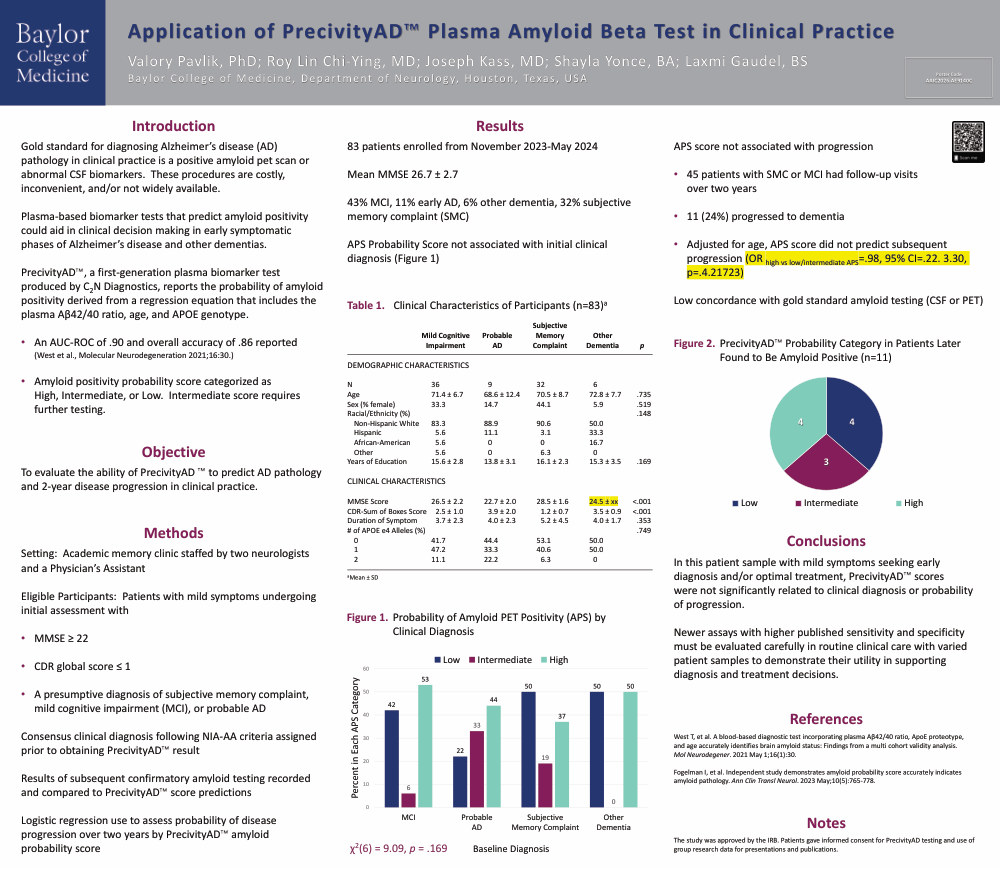
Application of PrecivityAD™ Plasma Amyloid Beta Test in Clinical Practice
Valory Pavlik, Ph.D., Chi-Ying, Roy Lin, M.D., Joseph Kass M.D., Shayla Yonce, B.A., Laxmi Gaudel, B.S.,
Baylor College of Medicine
Introduction
Gold standard for diagnosing Alzheimer’s disease (AD) pathology in clinical practice is a positive amyloid pet scan or abnormal CSF biomarkers. These procedures are costly, inconvenient, and/or not widely available.
•Plasma-based biomarker tests that predict amyloid positivity could aid in clinical decision making in early symptomatic phases of Alzheimer’s disease and other dementias.
•PrecivityAD™, a first generation plasma biomarker test produced by C2N Diagnostics, reports the probability of amyloid positivity derived from a regression equation that includes the plasma Aβ42/40 ratio, age, and APOE genotype.
•An AUC-ROC of .90 and overall accuracy of .86 reported (West et al., Molecular Neurodegeneration 2021;16:30.)
•Amyloid positivity probability score categorized as High, Intermediate, or Low. Intermediate score requires further testing.
Objective
To evaluate the ability of PrecivityAD™to predict AD pathology and 2-year disease progression in clinical practice
Methods
•Setting: Academic memory clinic staffed by two neurologists and a Physician’s Assistant
•Eligible Participants:Patients with mild symptoms undergoing initial assessment with
oMMSE ≥22
oCDR global score ≤ 1
oA presumptive diagnosis of subjective memory complaint, mild cognitive impairment (MCI), or probable AD
•Consensus clinical diagnosis following NIA-AA criteria assigned prior to obtaining PrecivityAD™result
•Results of subsequent confirmatory amyloid testing recorded and compared to PrecivityAD™score predictions
•Logisitcregression use to assess probability of disease progression over two years by PrecivityAD™ amyloid probability score
Results
83 patients enrolled from November 2023-May 2024
•Mean MMSE 26.7 ±2.7
•43% MCI, 11% early AD, 6% other dementia, 32% subjective memory complaint (SMC)
Conclusions
•In this patient sample with mild symptoms seeking early diagnosis and/or optimal treatment, PrecivityAD™ scores were not significantly related to clinical diagnosis or probability of progression.
•Newer assays with higher published sensitivity and specificity must be evaluated carefully in routine clinical care with varied patient samples to demonstrate their utility in supporting diagnosis and treatment decisions.
References
West T. et al.: A blood-based diagnostic test incorporating plasma Aβ42/40 ratio, ApoEproteotype, and age accurately identifies brain amyloid status: findings from a multi cohort validity analysis. Molecular Neurodegeneration. 2021:16:30.
Fogelman I. et al.: Independent study demonstrates amyloid probability score accurately indicates amyloid pathology. Annals of Clinical and Translational Neurology 2023; 10(5): 765–778
Notes
The study was approved by the IRB. Patients gave informed consent for PrecivityAD testing and use of group research data for presentations and publications
Baylor College of Medicine, Department of Neurology, Houston, Texas
Comments
Email is required but is not shown publicly.
Loading comments...