4,068 posters, 219 videos, 101 topics, 69 sessions, 14,365 authors, 6,128 institutions
ePostersLive by SciGen Technologies S.A. All rights reserved.
Alzheimer's Association International Conference 2026
July 12-15, 2026 | London, United Kingdom, and Online

8748
Plasma Ptau217 And Alzheimer’S Disease: Diagnostic Insights From Admixed Latin American Populations
Poster Presenter
Authors
Affiliations
Part of Topic
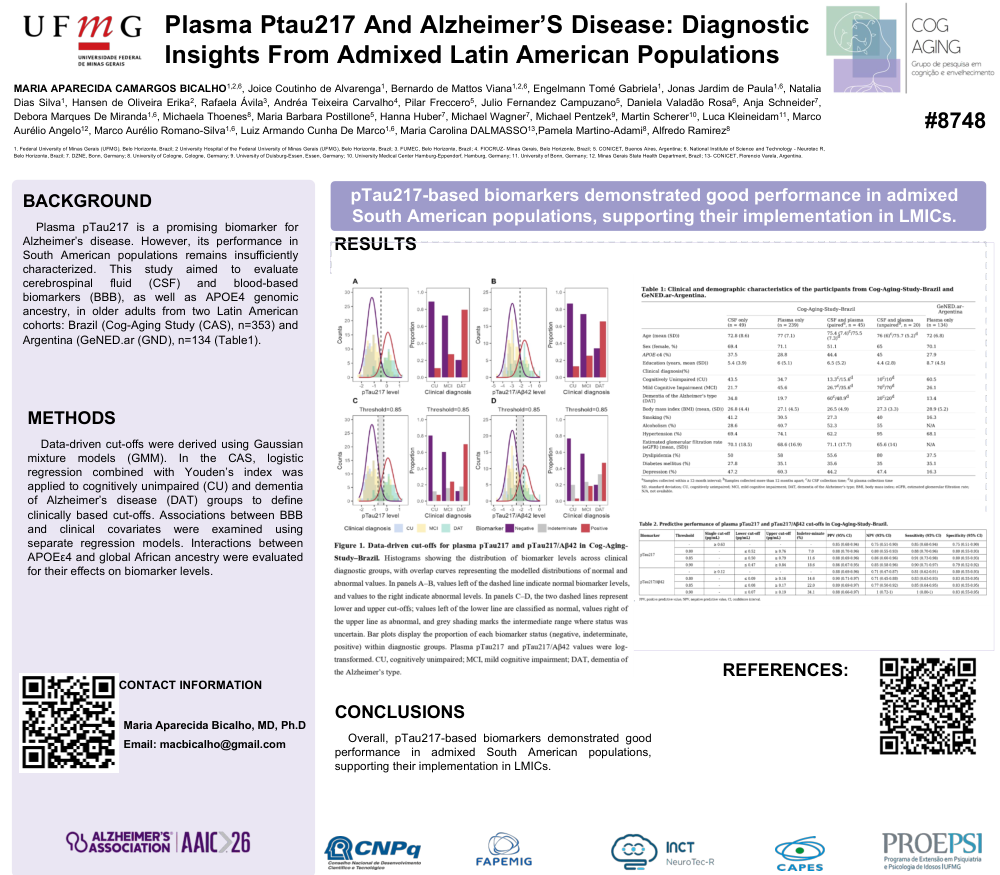
Background: Plasma pTau217 is a promising biomarker for Alzheimer’s disease; however, its performance in South American populations remains insufficiently characterized. This study aimed to evaluate cerebrospinal fluid (CSF) and blood-based biomarkers (BBB), as well as APOE4 genomic ancestry, in older adults from two Latin American cohorts: Brazil (Cog-Aging Study (CAS), n=353) and Argentina (GeNED.ar (GND), n=134(Table1).
Methods: Data-driven cut-offs were derived using Gaussian mixture models (GMM). In the CAS, logistic regression combined with Youden’s index was applied to cognitively unimpaired (CU) and dementia of Alzheimer’s disease (DAT) groups to define clinically based cut-offs. Associations between BBB and clinical covariates were examined using separate regression models. Interactions between APOEε4 and global African ancestry were evaluated for their effects on biomarker levels.
Results: GMM was applied to participants with available CSF samples (CU=28; MCI=36; DAT=47), yielding cut-offs of 0.12 and 70.63pg/mL for the Aβ42/Aβ40 ratio and pTau181, respectively. Comparison between data-driven and clinically based cut-offs showed consistent classification: at least 85% of CU participants classified as A−T− and approximately 87% of DAT classified as A+. GMM was applied to BBB (CU=92; MCI=139; DAT=73) to derive cut-offs for pTau217 and the pTau217/Aβ42 ratio. BBB showed high concordance with clinical diagnosis, with 86% of CU classified as normal and 65% of DAT as abnormal. Using a two-cut-off strategy across probability thresholds of ≥0.80, ≥0.85, and ≥0.90, agreement with clinical diagnosis remained consistently high: pTau217 correctly classified 80% of CU participants as negative and 70% of DAT participants as positive. The pTau217/Aβ42 ratio showed lower performance, classifying 80% of CU as negative and 50% of DAT as positive. In paired CSF samples (A−, n=16; A+, n = 27), the two-cut-off strategy at a ≥0.85 probability threshold demonstrated the best performance(Table2, Figure1). In the CAS, the presence of at least one APOE-ε4 allele, lower body mass index, and lower estimated glomerular filtration rate were associated with higher pTau217 levels, while higher education additionally influenced biomarker levels in the GND. African ancestry modified the APOE effect only on CSF biomarkers.
Conclusion: Overall, pTau217-based biomarkers demonstrated good performance in admixed South American populations, supporting their implementation in LMICs.
Comments
Email is required but is not shown publicly.
Loading comments...