4,068 posters, 219 videos, 101 topics, 69 sessions, 14,365 authors, 6,128 institutions
ePostersLive by SciGen Technologies S.A. All rights reserved.
Alzheimer's Association International Conference 2026
July 12-15, 2026 | London, United Kingdom, and Online

7109
Longitudinal Plasma Proteomic Remodeling Precedes MRI-defined Small Vessel Disease And Dementia Risk.
Poster Presenter
Authors
Part of Topic
Background:
qSmall vessel disease (SVD) is a major contributor to vascular cognitive impairment and dementia (VCID).
qMultiple studies have identified plasma proteins that associate with brain magnetic resonance imaging (MRI) derived markers of SVD.
qHowever for many biological processes, disease risk is better reflected by within-person change over time rather than static levels, and few studies have interrogated changes in the plasma proteome over time for associations with SVD.
Study Population and Design:
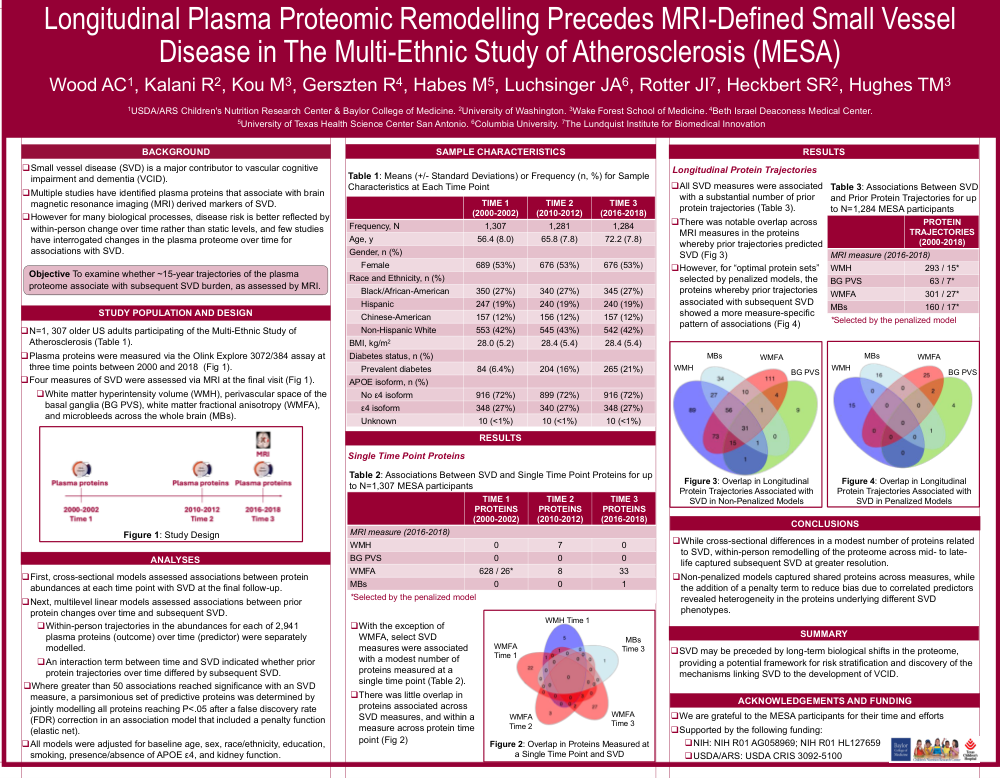
qN=1, 307 older US adults participating of the Multi-Ethnic Study of Atherosclerosis (Table 1).
qPlasma proteins were measured via the Olink Explore 3072/384 assay at three time points between 2000 and 2018 (Fig 1).
qFour measures of SVD were assessed via MRI at the final visit (Fig 1).
qWhite matter hyperintensity volume (WMH), perivascular space of the basal ganglia (BG PVS), white matter fractional anisotropy (WMFA), and microbleeds across the whole brain (MBs).
Analyses:
qFirst, cross-sectional models assessed associations between protein abundances at each time point with SVD at the final follow-up.
qNext, multilevel linear models assessed associations between prior protein changes over time and subsequent SVD.
qWithin-person trajectories in the abundances for each of 2,941 plasma proteins (outcome) over time (predictor) were separately modelled.
qAn interaction term between time and SVD indicated whether prior protein trajectories over time differed by subsequent SVD.
qWhere greater than 50 associations reached significance with an SVD measure, a parsimonious set of predictive proteins was determined by jointly modelling all proteins reaching P<.05 after a false discovery rate (FDR) correction in an association model that included a penalty function (elastic net).
qAll models were adjusted for baseline age, sex, race/ethnicity, education, smoking, presence/absence of APOE ε4, and kidney function.
Results:
qWith the exception of WMFA, select SVD measures were associated with a modest number of proteins measured at a single time point (Table 2).
qThere was little overlap in proteins associated across SVD measures, and within a measure across protein time point (Fig 2)
qAll SVD measures were associated with a substantial number of prior protein trajectories (Table 3).
qThere was notable overlap across MRI measures in the proteins whereby prior trajectories predicted SVD (Fig 3)
qHowever, for “optimal protein sets” selected by penalized models, the proteins whereby prior trajectories associated with subsequent SVD showed a more measure-specific pattern of associations (Fig 4)
Conclusions:
qWhile cross-sectional differences in a modest number of proteins related to SVD, within-person remodelling of the proteome across mid- to late- life captured subsequent SVD at greater resolution.
qNon-penalized models captured shared proteins across measures, while the addition of a penalty term to reduce bias due to correlated predictors revealed heterogeneity in the proteins underlying different SVD phenotypes.
Summary:
qSVD may be preceded by long-term biological shifts in the proteome, providing a potential framework for risk stratification and discovery of the mechanisms linking SVD to the development of VCID.
Comments
Email is required but is not shown publicly.
Loading comments...