4,068 posters, 219 videos, 101 topics, 69 sessions, 14,365 authors, 6,128 institutions
ePostersLive by SciGen Technologies S.A. All rights reserved.
Alzheimer's Association International Conference 2026
July 12-15, 2026 | London, United Kingdom, and Online

568
Mortality Of Early-onset Dementia In A Thai Cohort At Siriraj Hospital, Thailand
Poster Presenter
Authors
Part of Topic
Mortality of early-onset dementia in a Thai cohort at Siriraj Hospital, Thailand
Vorapun Senanarong1, Chatchawan Rattanabannakit1, Natthamon Wongkom1, Pathitta Thitivichienlerd1, Wisarut Nanthasi1, Paphawadee Phoyoo1, Saowalak Hunnangkul2, Yudthaphon Vichianin3, Phillippus Scheltens4.
1Division of Neurology, Department of Medicine, Faculty of Medicine Siriraj Hospital, Mahidol University, Bangkok, Thailand
2Department of Health Research and Development, Faculty of Medicine Siriraj Hospital, Mahidol University, Bangkok, Thailand
3Department of Radiological Technology, Faculty of Medical Technology, Mahidol University, Bangkok, Thailand
4Head Director Dementia Fund & Partner EQT Life Sciences, the Netherlands
Corresponding authors: Vorapan Senanarong, Department of Medicine, Faculty of Medicine Siriraj Hospital, Mahidol University, Bangkok, Thailand. Tel: +6624197105. Email: vorapan.sen@mahidol.ac.th
Early-onset dementia (EOD), defined as onset before age 65, significantly increases mortality risk compared to the general population
Objectives: We followed EOD cohort to determine the mortality rate. We investigated biological and characteristically mortality risk factor of EOD cohort.
Method: 151individuals with EOD at EOD clinic and memory clinic at Siriraj hospital were follow up for 15 years. Baseline subject characteristics and blood (68) or cerebrospinal fluid (CSF) (82) biomarkers were recorded. MRI brain volume analysis had only performed only 59 subjects, the rest were waiting for the results.
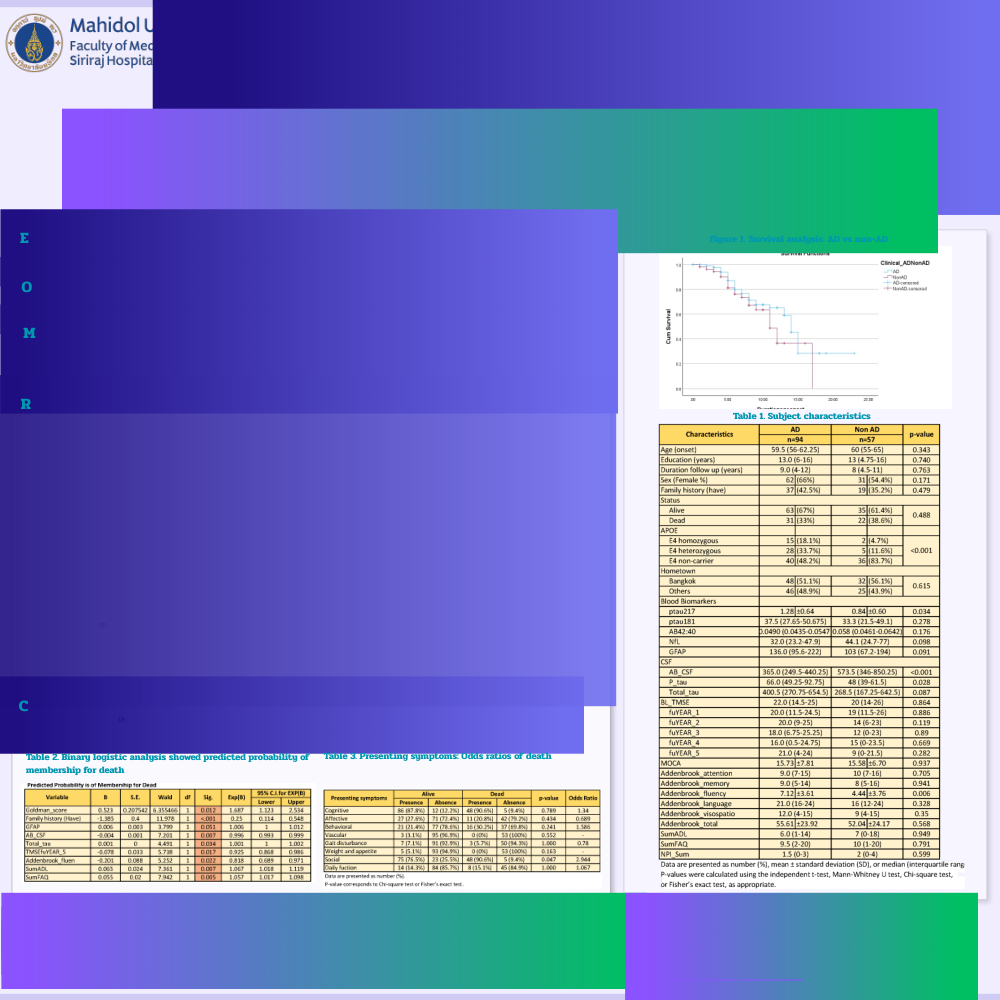
Results: Among 151EOD patients, 94 were Alzheimer disease (AD) dementia, 57 were non-AD dementia. After the diagnosis, 21 was transferred to manage at hospitals where the patients live. Mean follow up time was 8.13 years. At the last hospital visit or telephone follow up call in 2025, 98 are alive, and 53 were dead (35.09%). Mean survival after the diagnosis was 8.13 years. Mean survival time for AD group was 14.03 years while mean survival time for non-AD group was 10.99 years (p=0.101). There were no statistically significant differences between those who are alive and those who were dead in age at onset, gender, duration after the diagnosis, ApoE4 status, AD or non-AD diagnosis, baseline (BL) Thai mental state exam (TMSE), BL neuropsychiatric problems, BL blood pTau217, BL blood AB42/40, and interim brain volume analysis. Those who presenting with social history issues (namely having a positive familial history of YOD, fear of having dementia, financial problems, jobloss, relationship problems, work problems, or worries from caregivers) have ORs of 2.94 (p=0.047) for death risk. There were significant difference at BL between the alive group and the dead group in blood BL CSF AB42 (p=0.008, OR=0.996), CSF total Tau(p=0.041, OR=0.001), BL activity of daily living scale scores(ADL)(p=0.007,OR=1.067), BL functional assessment questionnaire(FAQ) (p=0.005,OR=1.057), BL verbal fluency from ACE iii R (p=0.020, OR=0.817), TMSE at the 5th year follow up (p=0.017, OR=0.925). There was a trend of BL GFAP to be mortality risk (p=0.051, OR=1.006). Having family history of either EOD or LOD (Goldman score 1 or 2 or 3 or 3.5 vs 4) is also indicate mortality risk (p=0.002, OR=3.554). Limitations of our study are small cohort and single center. Multicenter study with data exploring health disparity should be included in future study.
Conclusion: Our study revealed that verbal fluency, clinical function, neuroinflammation, and global cognition at the 5th year were mortality risk in our EOD cohort.
Comments
Email is required but is not shown publicly.
Loading comments...