4,068 posters, 219 videos, 101 topics, 69 sessions, 14,365 authors, 6,128 institutions
ePostersLive by SciGen Technologies S.A. All rights reserved.
Alzheimer's Association International Conference 2026
July 12-15, 2026 | London, United Kingdom, and Online

482
BBDLB: A Novel Multiplex Plasma Extracellular Vesicle RNA Biomarker Assay For Improving Clinical Diagnosis Of Dementia With Lewy Bodies
Poster Presenter
Authors
Part of Topic
Key message: We have developed the first prototype plasma small extracellular vesicle (SEV) RNA diagnostic biomarker assay for DLB.
Introduction:
- There is an urgent clinical need for identifying blood-based biomarkers that aid distinguishing Dementia with Lewy Bodies (DLB) from dementia in Alzheimer’s Disease (AD), especially in the UK NHS mental health memory assessment services (MAS)1.
- People with DLB have high risk for developing antipsychotics induced serious adverse effects2.
- New anti-amyloid monoclonal antibodies that can treat AD do not have evidence for treating DLB3.
- Dopamine SPECT is the only DLB biomarker, available to most MAS. It is not widely used because of several feasibility issues. Most MAS cannot access CSF analysis.
- We have identified DLB associated miRNA that are differentially expressed in both post-mortem DLB brains and in blood-based SEV from people living with DLB4,5.
- We aimed to develop a multiplex RNA biomarker assay using the identified DLB associated miRNA.
Methods:
- We designed the customised BBDLB miRNA assay using the nCounter® (Bruker Spatial Biology, USA) technology that can detect SEV RNA as low as 200pg input6.
- The BBDLB assay includes 18 DLB associated miRNA probes, two reference miRNA, and 20 inbuilt probes for quality control and inter-plate calibration.
- We recruited people with DLB, AD, and people without cognitive impairment (N=90; n=30/group) from four UK NHS sites.
- We separated SEV from platelet-poor plasma using size exclusion chromatography and characterised the SEV using cryo-transmission electron microscopy.
- Considering the reference standard of DLB clinical diagnoses7, confirmed by consultant Old Age Psychiatrists with DLB expertise, we estimated the diagnostic accuracy of the BBDLB assay.
Results:
- We demonstrated the feasibility of measuring low input plasma SEV miRNA levels from clinically collected blood samples.
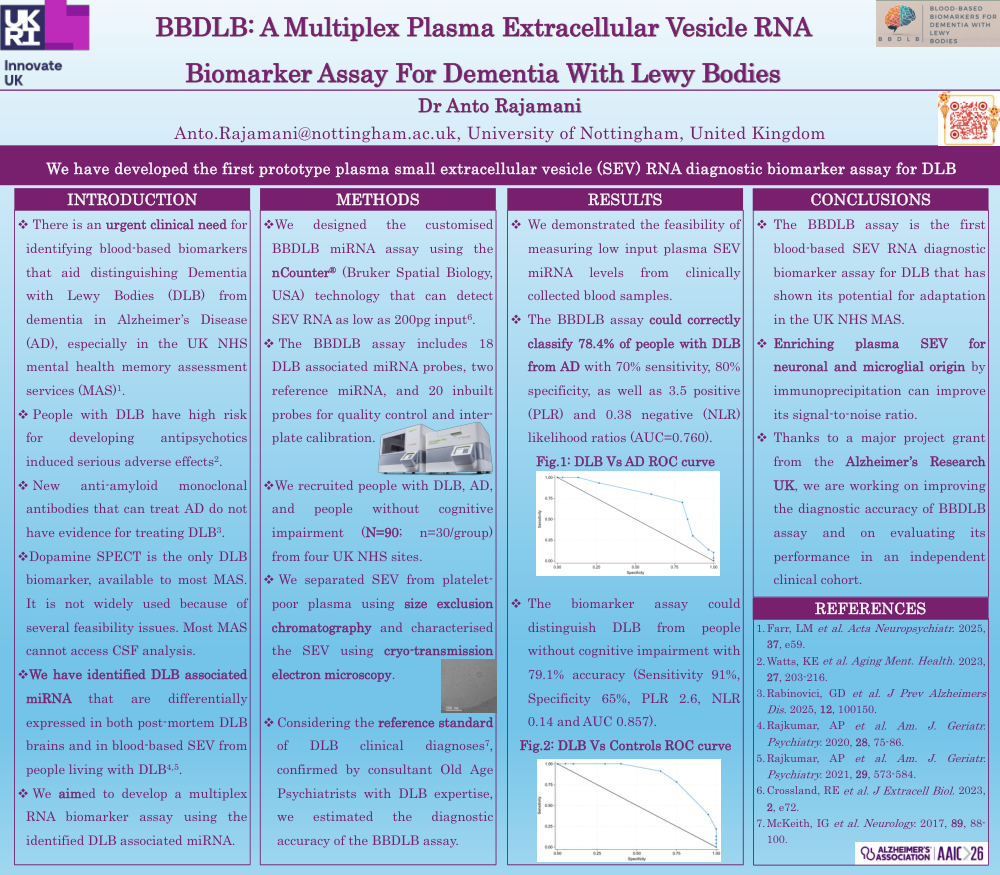
- The BBDLB assay could correctly classify 78.4% of people with DLB from AD with 70% sensitivity, 80% specificity, as well as 3.5 positive (PLR) and 0.38 negative (NLR) likelihood ratios (AUC=0.760).
- The biomarker assay could distinguish DLB from people without cognitive impairment with 79.1% accuracy (Sensitivity 91%, Specificity 65%, PLR 2.6, NLR 0.14 and AUC 0.857).
Conclusions:
- The BBDLB assay is the first blood-based SEV RNA diagnostic biomarker assay for DLB that has shown its potential for adaptation in the UK NHS MAS.
- Enriching plasma SEV for neuronal and microglial origin by immunoprecipitation can improve its signal-to-noise ratio.
- Thanks to a major project grant from the Alzheimer’s Research UK, we are working on improving the diagnostic accuracy of BBDLB assay and on evaluating its performance in an independent clinical cohort.
References:
- Farr, LM et al. Acta Neuropsychiatr. 2025, 37, e59.
- Watts, KE et al. Aging Ment. Health. 2023, 27, 203-216.
- Rabinovici, GD et al. J Prev Alzheimers Dis. 2025, 12, 100150.
- Rajkumar, AP et al. Am. J. Geriatr. Psychiatry. 2020, 28, 75-86.
- Rajkumar, AP et al. Am. J. Geriatr. Psychiatry. 2021, 29, 573-584.
- Crossland, RE et al. J Extracell Biol. 2023, 2, e72.
- McKeith, IG et al. Neurology. 2017, 89, 88-100.
Comments
Email is required but is not shown publicly.
Loading comments...