4,068 posters, 219 videos, 101 topics, 69 sessions, 14,365 authors, 6,128 institutions
ePostersLive by SciGen Technologies S.A. All rights reserved.
Alzheimer's Association International Conference 2026
July 12-15, 2026 | London, United Kingdom, and Online

6478
Nasal Secretions As A Non-invasive Biomarker Matrix For Alzheimer's Disease: A Feasibility Study
Poster Presenter
Authors
Part of Topic
Video
Title:
Nasal Secretions As A Non-invasive Biomarker Matrix For Alzheimer's Disease: A Feasibility
Study
Author Block:
Timo Grimmer1, Marion San Nicoló2, Oliver Goldhardt1, Patrick Sommer1, Hilary
Wunderlich2, Maria Babu2, Richard Metzler2, Sabine Mertzig2, Klaus Hallermayer2, Arno Schaepe2,
Harald Waltenberger3, Peter Kaspar4, Thomas Heydler2, Mareike Albert2.
1Neurology, Technical University of Munich, School of Medicine and Health, Munich, Germany,
2Noselab GmbH, Munich, Germany, 3Microcoat Biotechnologie GmbH, Bernried, Germany,
4Neurology, Noselab GmbH, Munich, Germany.
Abstract:
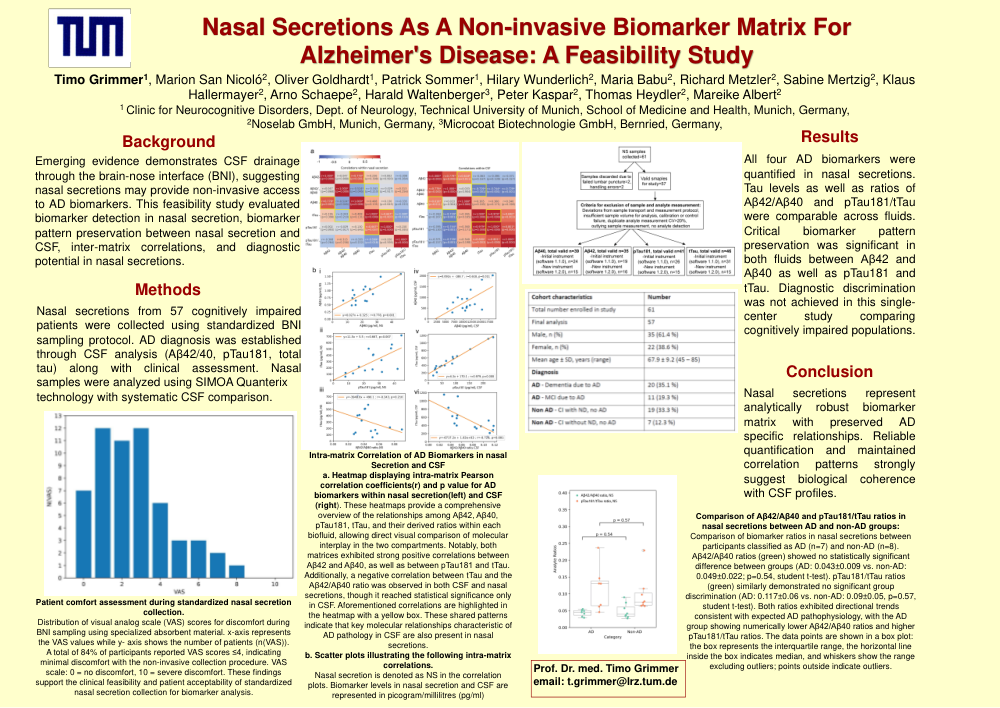
Background: Emerging evidence demonstrates CSF drainage through the brain-nose interface
(BNI), suggesting nasal secretions may provide non-invasive access to AD biomarkers. This feasibility
study evaluated biomarker detection in nasal secretion, biomarker pattern preservation between
nasal secretion and CSF, inter-matrix correlations, and diagnostic potential in nasal secretions.
Methods: Nasal secretions from 57 cognitively impaired patients were collected using standardized
BNI sampling protocol. AD diagnosis was established through CSF analysis (Aβ42/40, pTau181, total
tau) along with clinical assessment. Nasal samples were analyzed using SIMOA Quanterix
technology with systematic CSF comparison.
Results: All four AD biomarkers were quantified in nasal secretions. Tau levels as well as ratios of
Aβ42/Aβ40 and pTau181/tTau were comparable across fluids. Critical biomarker pattern preservation
was significant in both fluids between Aβ42 and Aβ40 as well as pTau181 and tTau. Diagnostic
discrimination was not achieved in this single-center study comparing cognitively impaired
populations.
Conclusion: Nasal secretions represent analytically robust biomarker matrix with preserved ADspecific
relationships. Reliable quantification and maintained correlation patterns strongly suggest
biological coherence with CSF profiles.
Comments
Email is required but is not shown publicly.
Loading comments...