4,068 posters, 219 videos, 101 topics, 69 sessions, 14,365 authors, 6,128 institutions
ePostersLive by SciGen Technologies S.A. All rights reserved.
Alzheimer's Association International Conference 2026
July 12-15, 2026 | London, United Kingdom, and Online

5142
Alzheimer’s Disease As A Disorder Of The Innate Immunity: A Unifying Mechanistic Framework
Poster Presenter
Authors
Part of Topic
Video
Alzheimer’s Disease As A Disorder Of The Innate Immunity: A Unifying Mechanistic Framework
Mohammad Walid, Rahma M. Ibrahim, Youssef Haitham, Aalaa K. Altokhy, Haneen B. El-Alfy, Mohammad Abdulhalim, Mohammed B. Goma'a, Arwa Ahmed
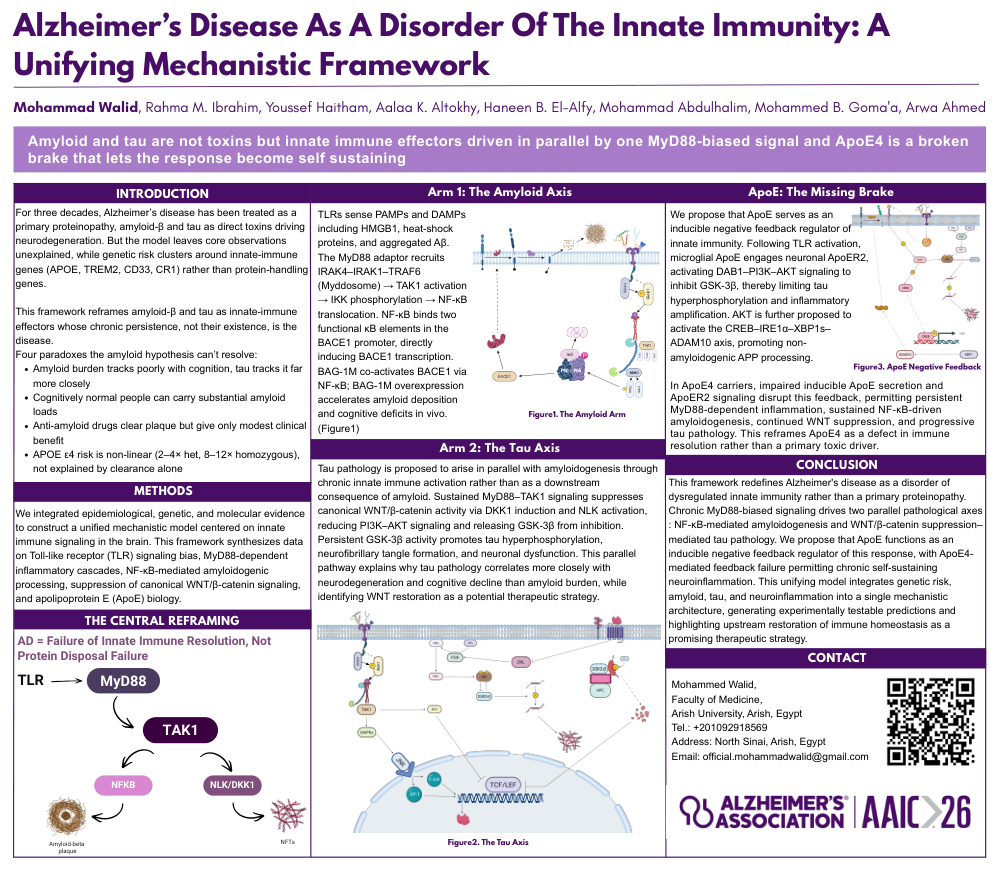
Amyloid and tau are not toxins but innate immune effectors driven in parallel by one MyD88-biased signal and ApoE4 is a broken brake that lets the response become self sustaining
Introduction
For three decades, Alzheimer’s disease has been treated as a primary proteinopathy, amyloid-β and tau as direct toxins driving neurodegeneration. But the model leaves core observations unexplained, while genetic risk clusters around innate-immune genes (APOE, TREM2, CD33, CR1) rather than protein-handling genes.
This framework reframes amyloid-β and tau as innate-immune effectors whose chronic persistence, not their existence, is the disease.
Four paradoxes the amyloid hypothesis can’t resolve:
Amyloid burden tracks poorly with cognition, tau tracks it far more closely
Cognitively normal people can carry substantial amyloid loads
Anti-amyloid drugs clear plaque but give only modest clinical benefit
APOE ε4 risk is non-linear (2–4× het, 8–12× homozygous), not explained by clearance alone
METHODS
We integrated epidemiological, genetic, and molecular evidence to construct a unified mechanistic model centered on innate immune signaling in the brain. This framework synthesizes data on Toll-like receptor (TLR) signaling bias, MyD88-dependent inflammatory cascades, NF-κB-mediated amyloidogenic processing, suppression of canonical WNT/β-catenin signaling, and apolipoprotein E (ApoE) biology.
THE CENTRAL REFRAMING
AD = Failure of Innate Immune Resolution, Not Protein Disposal Failure
Arm 1: The Amyloid Axis
TLRs sense PAMPs and DAMPs including HMGB1, heat-shock proteins, and aggregated Aβ. The MyD88 adaptor recruits IRAK4–IRAK1–TRAF6 (Myddosome) → TAK1 activation → IKK phosphorylation → NF-κB translocation. NF-κB binds two functional κB elements in the BACE1 promoter, directly inducing BACE1 transcription. BAG-1M co-activates BACE1 via NF-κB; BAG-1M overexpression accelerates amyloid deposition and cognitive deficits in vivo.
Arm 2: The Tau Axis
Tau pathology is proposed to arise in parallel with amyloidogenesis through chronic innate immune activation rather than as a downstream consequence of amyloid. Sustained MyD88–TAK1 signaling suppresses canonical WNT/β-catenin activity via DKK1 induction and NLK activation, reducing PI3K–AKT signaling and releasing GSK-3β from inhibition. Persistent GSK-3β activity promotes tau hyperphosphorylation, neurofibrillary tangle formation, and neuronal dysfunction. This parallel pathway explains why tau pathology correlates more closely with neurodegeneration and cognitive decline than amyloid burden, while identifying WNT restoration as a potential therapeutic strategy.
ApoE: The Missing Brake
We propose that ApoE serves as an inducible negative feedback regulator of innate immunity. Following TLR activation, microglial ApoE engages neuronal ApoER2, activating DAB1–PI3K–AKT signaling to inhibit GSK-3β, thereby limiting tau hyperphosphorylation and inflammatory amplification. AKT is further proposed to activate the CREB–IRE1α–XBP1s– ADAM10 axis, promoting nonamyloidogenic APP processing
In ApoE4 carriers, impaired inducible ApoE secretion and ApoER2 signaling disrupt this feedback, permitting persistent MyD88-dependent inflammation, sustained NF-κB-driven amyloidogenesis, continued WNT suppression, and progressive tau pathology. This reframes ApoE4 as a defect in immune resolution rather than a primary toxic driver
CONCLUSION
This framework redefines Alzheimer's disease as a disorder of dysregulated innate immunity rather than a primary proteinopathy. Chronic MyD88-biased signaling drives two parallel pathological axes: NF-κB-mediated amyloidogenesis and WNT/β-catenin suppression– mediated tau pathology. We propose that ApoE functions as an inducible negative feedback regulator of this response, with ApoE4- mediated feedback failure permitting chronic self-sustaining neuroinflammation. This unifying model integrates genetic risk, amyloid, tau, and neuroinflammation into a single mechanistic architecture, generating experimentally testable predictions and highlighting upstream restoration of immune homeostasis as a promising therapeutic strategy
CONTACT
Mohammed Walid,
Faculty of Medicine,
Arish University, Arish, Egypt
Tel.: +201092918569
Address: North Sinai, Arish, Egypt
Email: official.mohammadwalid@gmail.com
Comments
Email is required but is not shown publicly.
Loading comments...