4,068 posters, 219 videos, 101 topics, 69 sessions, 14,365 authors, 6,128 institutions
ePostersLive by SciGen Technologies S.A. All rights reserved.
Alzheimer's Association International Conference 2026
July 12-15, 2026 | London, United Kingdom, and Online

10683
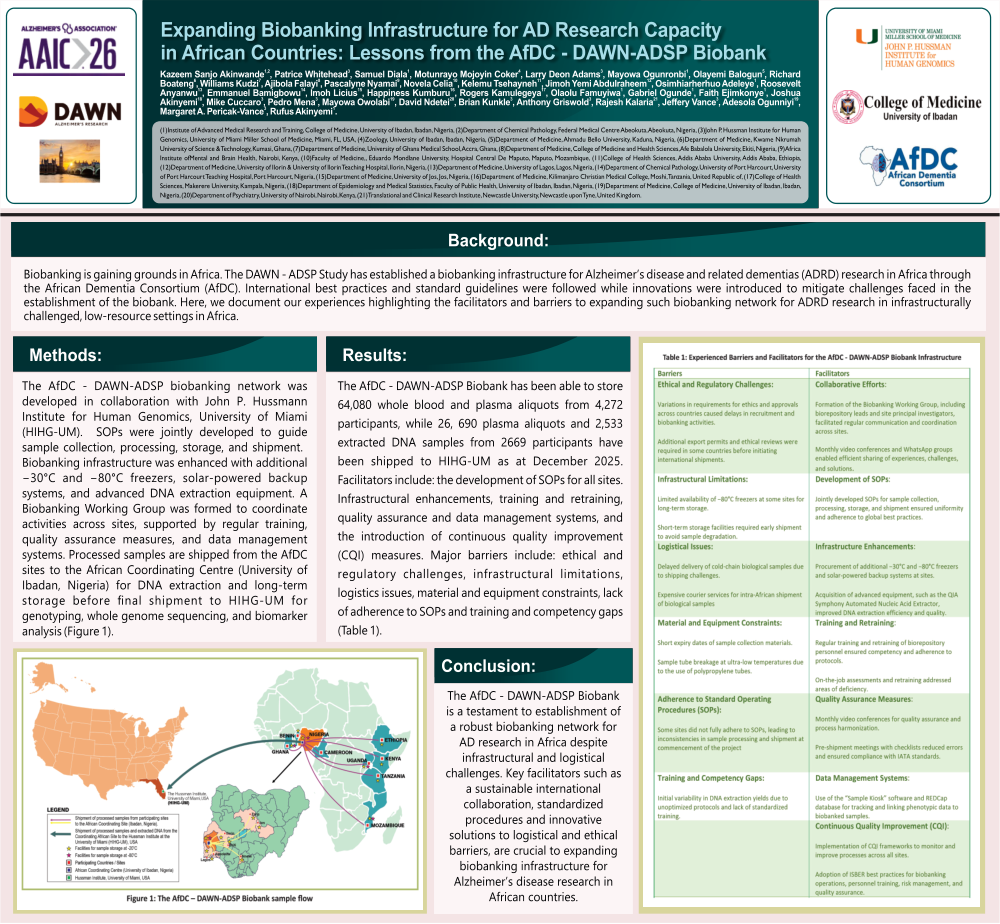
Expanding Biobanking Infrastructure For AD Research Capacity In African Countries: Lessons From The AfDC - DAWN-ADSP Biobank
Poster Presenter
Authors
Part of Topic
Background: Biobanking is gaining grounds in Africa. The DAWN - ADSP Study has established a biobanking infrastructure for Alzheimer’s disease and related dementias (ADRD) research in Africa through the African Dementia Consortium (AfDC). International best practices and standard guidelines were followed while innovations were introduced to mitigate challenges faced in the establishment of the biobank. Here, we document our experiences highlighting the facilitators and barriers to expanding such biobanking network for ADRD research in infrastructurally challenged, low-resource settings in Africa.
Methods: The AfDC - DAWN-ADSP biobanking network was developed in collaboration with John P. Hussmann Institute for Human Genomics, University of Miami (HIHG-UM). SOPs were jointly developed to guide sample collection, processing, storage, and shipment. Biobanking infrastructure was enhanced with additional −30°C and −80°C freezers, solar-powered backup systems, and advanced DNA extraction equipment. A Biobanking Working Group was formed to coordinate activities across sites, supported by regular training, quality assurance measures, and data management systems. Processed samples are shipped from the AfDC sites to the African Coordinating Centre (University of Ibadan, Nigeria) for DNA extraction and long-term storage before final shipment to HIHG-UM for genotyping, whole genome sequencing, and biomarker analysis (Figure 1).
Results: The AfDC - DAWN-ADSP Biobank has been able to store 64,080 whole blood and plasma aliquots from 4,272 participants, while 26, 690 plasma aliquots and 2,533 extracted DNA samples from 2669 participants have been shipped to HIHG-UM as at December 2025. Facilitators include: the development of SOPs for all sites. Infrastructural enhancements, training and retraining, quality assurance and data management systems, and the introduction of continuous quality improvement (CQI) measures. Major barriers include: ethical and regulatory challenges, infrastructural limitations, logistics issues, material and equipment constraints, lack of adherence to SOPs and training and competency gaps (Table 1).
Conclusion: The AfDC - DAWN-ADSP Biobank is a testament to establishment of a robust biobanking network for AD research in Africa despite infrastructural and logistical challenges. Key facilitators such as a sustainable international collaboration, standardized procedures and innovative solutions to logistical and ethical barriers, are crucial to expanding biobanking infrastructure for Alzheimer’s disease research in African countries.
Comments
Email is required but is not shown publicly.
Loading comments...