4,068 posters, 219 videos, 101 topics, 69 sessions, 14,365 authors, 6,128 institutions
ePostersLive by SciGen Technologies S.A. All rights reserved.
Alzheimer's Association International Conference 2026
July 12-15, 2026 | London, United Kingdom, and Online

8648
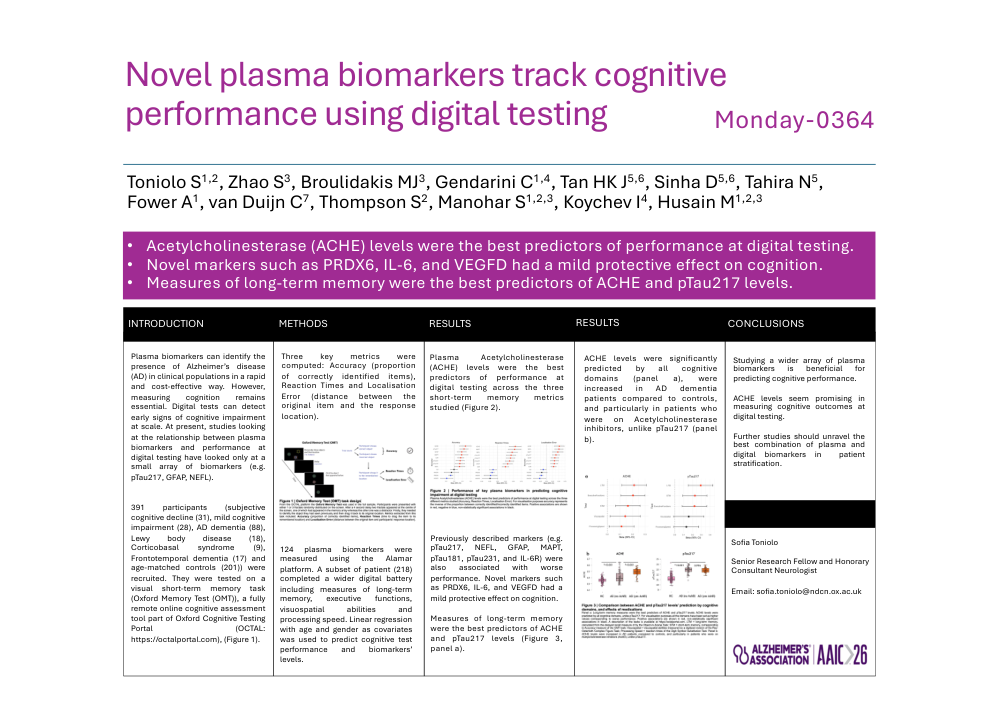
Novel Plasma Biomarkers Track Cognitive Performance Using Digital Testing
Poster Presenter
Part of Topic
Background: Plasma biomarkers can identify the presence of Alzheimer’s disease (AD) in clinical populations in a rapid and cost-effective way. However, measuring cognition remains essential. Digital tests can detect early signs of cognitive impairment at scale. At present, studies looking at the relationship between plasma biomarkers and performance at digital testing have looked only at a small array of biomarkers (e.g. pTau217, GFAP, NEFL).
Methods: 391 participants (subjective cognitive decline (31), mild cognitive impairment (28), AD dementia (88), Lewy body disease (18), Corticobasal syndrome (9), Frontotemporal dementia (17) and age-matched controls (201)) were recruited from the Oxford Centre for Cognitive Disorders and other memory centres across the UK taking part in the FAST study. They were tested on a visual short-term memory task (Oxford Memory Test (OMT)), a fully remote online cognitive assessment tool part of Oxford Cognitive Testing Portal (OCTAL: https://octalportal.com), (Figure 1). Three key metrics were computed: Accuracy (proportion of correctly identified items), Reaction Times and Localisation Error (distance between the original item and the response location). 124 plasma biomarkers were measured using the Alamar platform. A subset of patient (218) completed a wider digital battery including measures of long-term memory, executive functions, visuospatial abilities and processing speed. Linear regression with age and gender as covariates was used to predict cognitive test performance and biomarkers’ levels.
Results: Plasma Acetylcholinesterase (ACHE) levels were the best predictors of performance at digital testing across the three short-term memory metrics studied (Figure 2). Previously described markers (e.g. pTau217, NEFL, GFAP, MAPT, pTau181, pTau231, and IL-6R) were also associated with worse performance. Novel markers such as PRDX6, IL-6, and VEGFD had a mild protective effect on cognition. Measures of long-term memory were the best predictors of ACHE and pTau217 levels (Figure 3, panel a). ACHE levels were significantly predicted by all cognitive domains (panel a), were increased in AD dementia patients compared to controls, and particularly in patients who were on Acetylcholinesterase inhibitors, unlike pTau217 (panel b).
Conclusions: Studying a wider array of plasma biomarkers is beneficial for predicting cognitive performance. ACHE levels seem promising in measuring cognitive outcomes at digital testing.
Comments
Email is required but is not shown publicly.
Loading comments...