4,068 posters, 219 videos, 101 topics, 69 sessions, 14,365 authors, 6,128 institutions
ePostersLive by SciGen Technologies S.A. All rights reserved.
Alzheimer's Association International Conference 2026
July 12-15, 2026 | London, United Kingdom, and Online

10207
Associative Memory Deficits In Object-scene Memory Task Related To Early Tau In Cognitively Normal People
Part of Topic
Introduction
Memory deficit is common in aging and also a primary early symptom in Alzheimer’s disease (AD), strongly linked to tau in the temporal lobe, even in cognitively normal people. The objective of this project is to develop a novel memory testsensitively detecting memory deficits that can reflect the presence of tau in normal older people.
Methods
Participants: 41 cognitively normal older participants (>65 yrs; 20 F); 27 healthy young participants (<35 yrs; 14 F) as a reference group.
Tau: FTP PET was used to measure tau in older people, with partial volume correction. Tau positivity was defined based on 1.26 SUVR in Braak III/IV regions. Entorhinal and temporal-meta ROIs were used to measure early regional tau deposition in cognitively normal people.
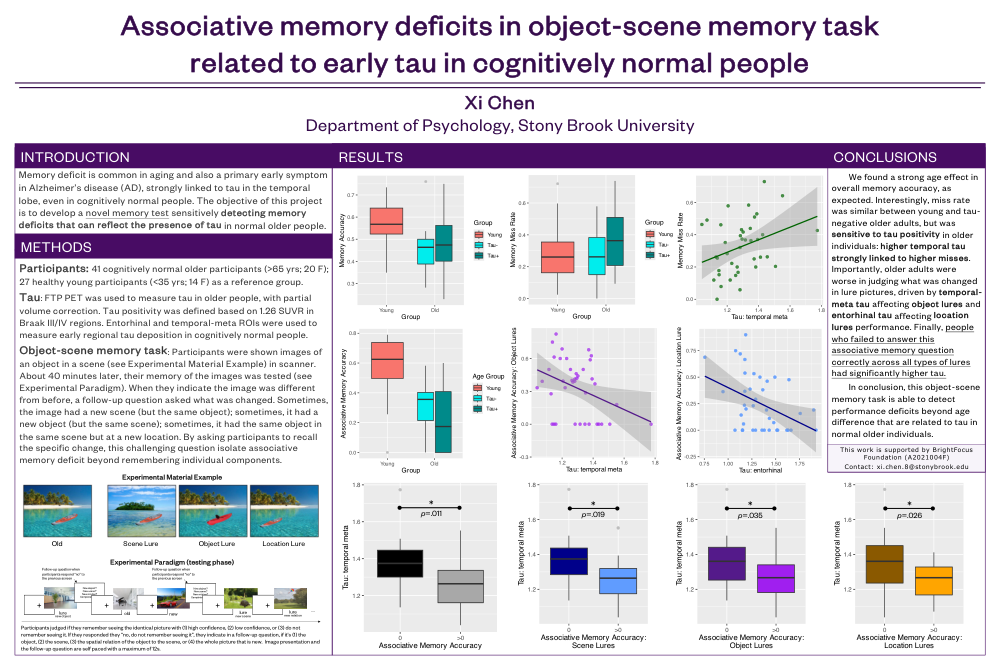
Object-scene memory task: Participants were shown images of an object in a scene (see Experimental Material Example) in scanner. About 40 minutes later, their memory of the images was tested (see Experimental Paradigm). When they indicate the image was different from before, a follow-up question asked what was changed. Sometimes, the image had a new scene (but the same object); sometimes, it had a new object (but the same scene); sometimes, it had the same object in the same scene but at a new location. By asking participants to recall the specific change, this challenging question isolate associative memory deficit beyond remembering individual components.
Results
There was a strong age effect in overall memory accuracy, as expected. Interestingly, miss rate was similar between young and tau-negative older adults, but was sensitive to tau positivity in older individuals: higher temporal tau strongly linked to higher misses. Importantly, older adults were worse in judging what was changed in lure pictures, driven by temporal-meta tau affecting object lures andentorhinal tau affecting location lures performance. Finally, people who failed to answer this associative memory question correctly across all types of lures had significantly higher tau.
Conclusions
This object-scene memory task is able to detect performance deficits beyond age difference that are related to tau in normal older individuals.
Comments
Email is required but is not shown publicly.
Loading comments...