4,068 posters, 219 videos, 101 topics, 69 sessions, 14,365 authors, 6,128 institutions
ePostersLive by SciGen Technologies S.A. All rights reserved.
Alzheimer's Association International Conference 2026
July 12-15, 2026 | London, United Kingdom, and Online

4057
Nanoscale Chirality Regulates Amyloid-ί42 Proteostasis By Restoring Autophagy-lysosomal Function
Poster Presenter
Part of Topic
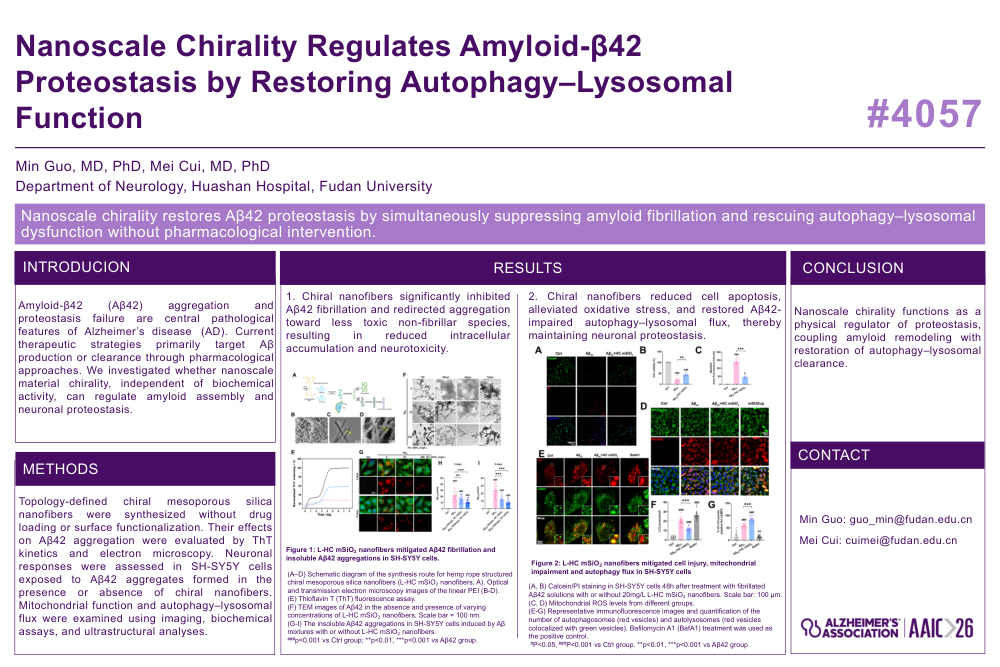
Nanoscale Chirality Regulates Amyloid-β42 Proteostasis by Restoring Autophagy–Lysosomal Function
Background:
Amyloid-β42 (Aβ42) aggregation and failure of neuronal proteostasis are central pathological features of Alzheimer’s disease (AD). While most therapeutic strategies focus on pharmacological inhibition of Aβ42 production or enhancement of intracellular clearance, whether physical properties of materials—independent of biochemical activity—can coordinately regulate amyloid assembly and neuronal proteostasis remains unclear.
Methods:
We engineered topology-defined chiral mesoporous silica nanofibers with precisely controlled helical architecture, without drug loading or surface functionalization. The impact of nanoscale chirality on Aβ42 aggregation was assessed using thioflavin T kinetics and electron microscopy. Neuronal responses were evaluated in SH-SY5Y cells exposed to Aβ42 aggregates formed in the presence or absence of chiral nanofibers. Mitochondrial function and autophagy–lysosomal flux were examined using confocal imaging, biochemical assays, and ultrastructural analyses.
Results:
Chiral nanofibers robustly inhibited Aβ42 fibrillation, reducing β-sheet–rich aggregate formation by approximately 70% and redirecting aggregation toward smaller, non-fibrillar assemblies. These topology-modulated Aβ42 species exhibited markedly reduced intracellular accumulation and neurotoxicity. In neuronal cells, chiral nanofibers preserved mitochondrial membrane potential, suppressed mitochondrial oxidative stress, and maintained mitochondrial ultrastructure. Notably, nanoscale chirality restored autophagy–lysosomal flux disrupted by Aβ42, as evidenced by reduced LC3-II and p62 accumulation, enhanced autophagosome–lysosome fusion, preserved lysosomal membrane integrity, and normalized lysosomal acidification. Importantly, nanofibers alone did not induce cytotoxicity or excessive autophagy, indicating moderate and non-stressful engagement of cellular clearance pathways.
Conclusions:
This study demonstrates that nanoscale material chirality alone can physically regulate Aβ42 proteostasis by simultaneously suppressing amyloid fibrillation and restoring autophagy–lysosomal function. By decoupling biological regulation from pharmacological intervention, our findings establish topology as a minimal physical variable capable of modulating AD-relevant cellular pathways, providing a conceptually distinct framework for targeting amyloid-associated neurodegeneration.
Comments
Email is required but is not shown publicly.
Loading comments...