4,068 posters, 219 videos, 101 topics, 69 sessions, 14,365 authors, 6,128 institutions
ePostersLive by SciGen Technologies S.A. All rights reserved.
Alzheimer's Association International Conference 2026
July 12-15, 2026 | London, United Kingdom, and Online

7046
Harnessing Human Ipsc-microglia To Target Amyloid And Tau Pathology In Vivo
Poster Presenter
Authors
Darren Carlen-Jones, Jean Paul Chadarevian, Hayk Davtyan, Alina Chadarevian, Joia Capocchi, Lauren Le, Jasmine Nguyen, Kimiya Mansour, Adrian Escobar, Talar Chadarevian, Michael Mgerian, Sepideh Kiani Shabestari, Christina Tu, William Carlen-Jones, Ghazaleh Eskandari-Sedighi, Jonathan Hasselmann, Robert Spitale, Mathew Blurton-Jones
Affiliations
Part of Topic
Harnessing Human iPSC-Microglia to target Amyloid-β and Tau Pathology in vivo
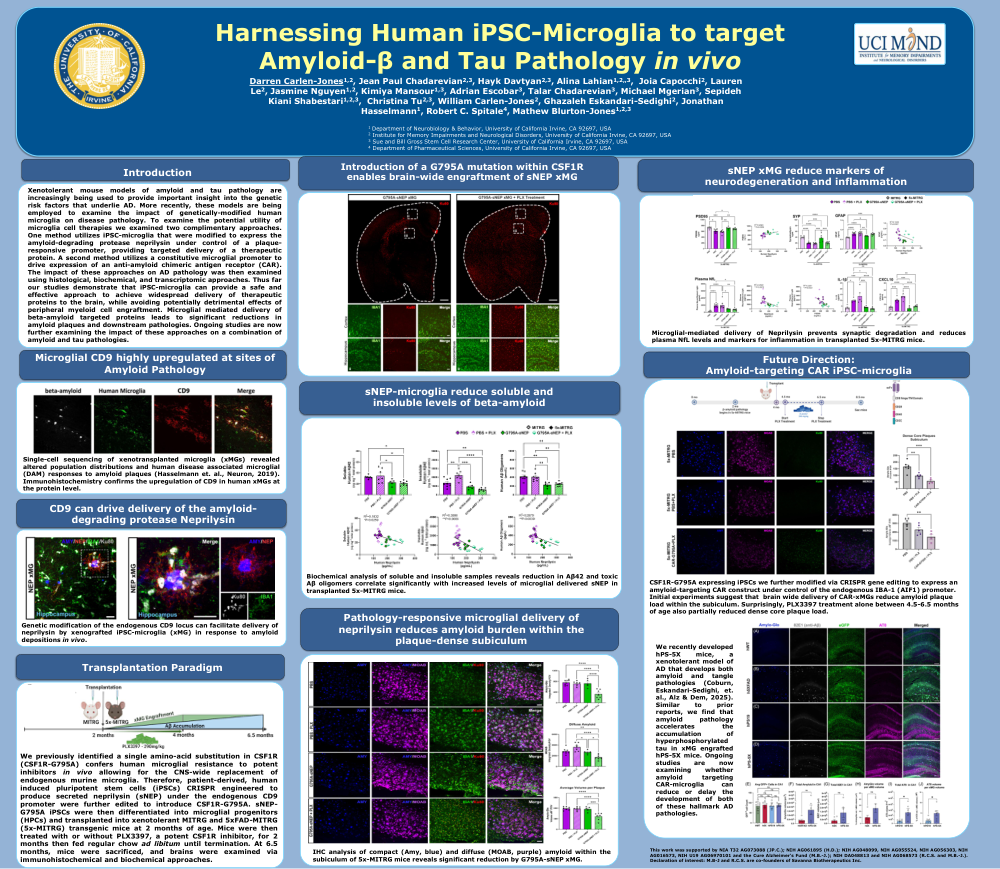
Xenotolerant mouse models of amyloid and tau pathology are increasingly being used to provide important insight into the genetic risk factors that underlie AD. More recently, these models are being employed to examine the impact of genetically-modified human microglia on disease pathology. To examine the potential utility of microglia cell therapies we examined two complimentary approaches. One method utilizes iPSC-microglia that were modified to express the amyloid-degrading protease neprilysin under control of a plaque-responsive promoter, providing targeted delivery of a therapeutic protein. A second method utilizes a constitutive microglial promoter to drive expression of an anti-amyloid chimeric antigen receptor (CAR). The impact of these approaches on AD pathology was then examined using histological, biochemical, and transcriptomic approaches. Thus far our studies demonstrate that iPSC-microglia can provide a safe and effective approach to achieve widespread delivery of therapeutic proteins to the brain, while avoiding potentially detrimental effects of peripheral myeloid cell engraftment. Microglial mediated delivery of beta-amyloid targeted proteins leads to significant reductions in amyloid plaques and downstream pathologies. Ongoing studies are now further examining the impact of these approaches on a combination of amyloid and tau pathologies.
Comments
Email is required but is not shown publicly.
Loading comments...