4,068 posters, 219 videos, 101 topics, 69 sessions, 14,365 authors, 6,128 institutions
ePostersLive by SciGen Technologies S.A. All rights reserved.
Alzheimer's Association International Conference 2026
July 12-15, 2026 | London, United Kingdom, and Online

1354
Mapping Peripheral Immune Alterations Along The Alzheimer’S Disease Continuum In Down Syndrome At Single-cell Resolution
Poster Presenter
Authors
Part of Topic
Assessing peripheral inflammation at single-cell resolution in people with Down syndrome across Alzheimer's disease progression
Valle-Tamayo N 1,2, Álvarez-Sánchez E1,2, Muñoz L 1,2, Escudero S 1,2, Aumatell J 1,2, Maria Carmona-Iragui 1,2, Laura Videla 1,2, Daniel Alcolea 1,2, Lleó A1,2 , Fortea J 1,2, Dols Icardo Oriol 1,2
1Sant Pau Memory Unit - Hospital de la Santa Creu i Sant Pau - Biomedical Research Institute Sant Pau, Barcelona, Spain
2CIBERNED, Network Center for Biomedical Research in Neurodegenerative Diseases, National Institute of Health Carlos III, Madrid, Spain
Introduction: People with Down syndrome (DS) develop progressive Alzheimer’s disease (AD) neuropathology from an early age, making this population critical for studying the early mechanisms underlying AD progression. Despite their high risk, individuals with DS remain an underrepresented and often neglected population in AD research. Furthermore, chromosome 21 encodes several immune-related genes, contributing to the high prevalence of autoimmune disorders and signs of chronic inflammation in DS, even in the absence of clinically diagnosed autoimmunity [1,2]. Peripheral immune system alterations are a known feature of AD and previous studies have identified immune system changes associated with this neurodegenerative disease [3]. However, no study has comprehensively examined peripheral immune alterations in individuals with DS across the AD continuum (DSAD) at single-cell resolution, including both preclinical (aDS) and clinically diagnosed AD dementia (dDS) stages.
Methods: Cognitively unimpaired healthy controls (HC, n=13) with negative CSF AD biomarker and neurodegeneration (plasma NfL) profiles from the SPIN cohort [4], along with 45 individuals with DS (23 with aDS and 22 with dDS) from the DABNI cohort [5], matched by age and sex, were included. Peripheral blood mononuclear cells (PBMC) were isolated using Ficoll density gradient centrifugation and cryopreserved until library preparation (10xGenomics) and sequencing (>40,000 reads/cell). Raw sequencing reads were processed with CellRanger v9.0.1 and mapped to the GRCh38 human genome. PBMC were annotated using Azimuth and a multimodal PBMC reference atlas. Cellular proportions were calculated using propeller function (speckle R package). Differential gene expression was analyzed using MAST R package. Cell-cell interaction patterns were inferred using CellChat (v2.1). Functional activity was quantified using the UCell algorithm, a rank-based enrichment method that provides robust scoring independent of library size and sparsity. We calculated gene-expression signatures to evaluate cellular senescence (SenMayo) [6], exhaustion, and cytotoxicity. Data were aggregated at the subject level to compare scores across groups. Subsequently, aggregated scores were associated with plasma NfL and pTau217 using linear regression models adjusted for age and sex.
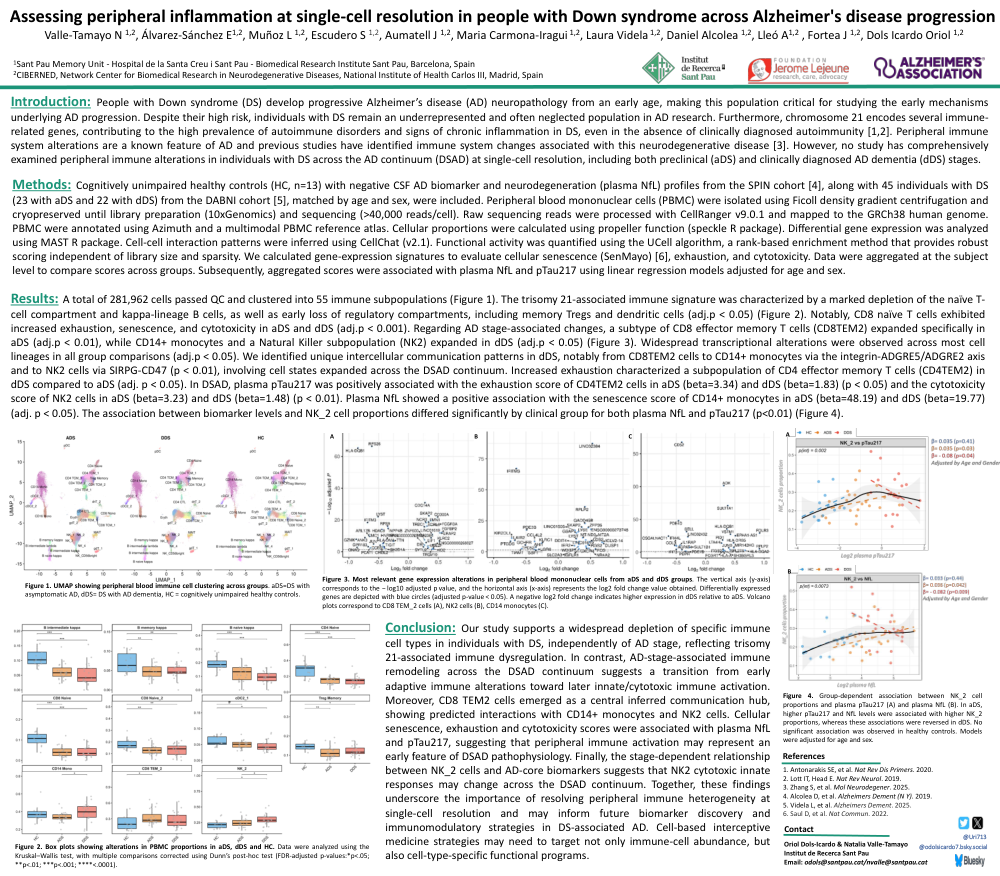
Results: A total of 281,962 cells passed QC and clustered into 55 immune subpopulations (Figure 1). The trisomy 21-associated immune signature was characterized by a marked depletion of the naïve T-cell compartment and kappa-lineage B cells, as well as early loss of regulatory compartments, including memory Tregs and dendritic cells (adj.p < 0.05) (Figure 2). Notably, CD8 naïve T cells exhibited increased exhaustion, senescence, and cytotoxicity in aDS and dDS (adj.p < 0.001). Regarding AD stage-associated changes, a subtype of CD8 effector memory T cells (CD8TEM2) expanded specifically in aDS (adj.p < 0.01), while CD14+ monocytes and a Natural Killer subpopulation (NK2) expanded in dDS (adj.p < 0.05) (Figure 3). Widespread transcriptional alterations were observed across most cell lineages in all group comparisons (adj.p < 0.05). We identified unique intercellular communication patterns in dDS, notably from CD8TEM2 cells to CD14+ monocytes via the integrin-ADGRE5/ADGRE2 axis and to NK2 cells via SIRPG-CD47 (p < 0.01), involving cell states expanded across the DSAD continuum. Increased exhaustion characterized a subpopulation of CD4 effector memory T cells (CD4TEM2) in dDS compared to aDS (adj. p < 0.05). In DSAD, plasma pTau217 was positively associated with the exhaustion score of CD4TEM2 cells in aDS (beta=3.34) and dDS (beta=1.83) (p < 0.05) and the cytotoxicity score of NK2 cells in aDS (beta=3.23) and dDS (beta=1.48) (p < 0.01). Plasma NfL showed a positive association with the senescence score of CD14+ monocytes in aDS (beta=48.19) and dDS (beta=19.77) (adj. p < 0.05). The association between biomarker levels and NK_2 cell proportions differed significantly by clinical group for both plasma NfL and pTau217 (p<0.01) (Figure 4).
Conclusion: Our study supports a widespread depletion of specific immune cell types in individuals with DS, independently of AD stage, reflecting trisomy 21-associated immune dysregulation. In contrast, AD-stage-associated immune remodeling across the DSAD continuum suggests a transition from early adaptive immune alterations toward later innate/cytotoxic immune activation. Moreover, CD8 TEM2 cells emerged as a central inferred communication hub, showing predicted interactions with CD14+ monocytes and NK2 cells. Cellular senescence, exhaustion and cytotoxicity scores were associated with plasma NfL and pTau217, suggesting that peripheral immune activation may represent an early feature of DSAD pathophysiology. Finally, the stage-dependent relationship between NK_2 cells and AD-core biomarkers suggests that NK2 cytotoxic innate responses may change across the DSAD continuum. Together, these findings underscore the importance of resolving peripheral immune heterogeneity at single-cell resolution and may inform future biomarker discovery and immunomodulatory strategies in DS-associated AD. Cell-based interceptive medicine strategies may need to target not only immune-cell abundance, but also cell-type-specific functional programs.
Comments
Email is required but is not shown publicly.
Loading comments...