4,068 posters, 219 videos, 101 topics, 69 sessions, 14,365 authors, 6,128 institutions
ePostersLive by SciGen Technologies S.A. All rights reserved.
Alzheimer's Association International Conference 2026
July 12-15, 2026 | London, United Kingdom, and Online

1703
Resveratrol-induced Wnt/β-catenin Activation Drives Adult Neurogenic Rescue In Experimental Models For Alzheimer’S Disease.
Poster Presenter
Authors
Affiliations
Part of Topic
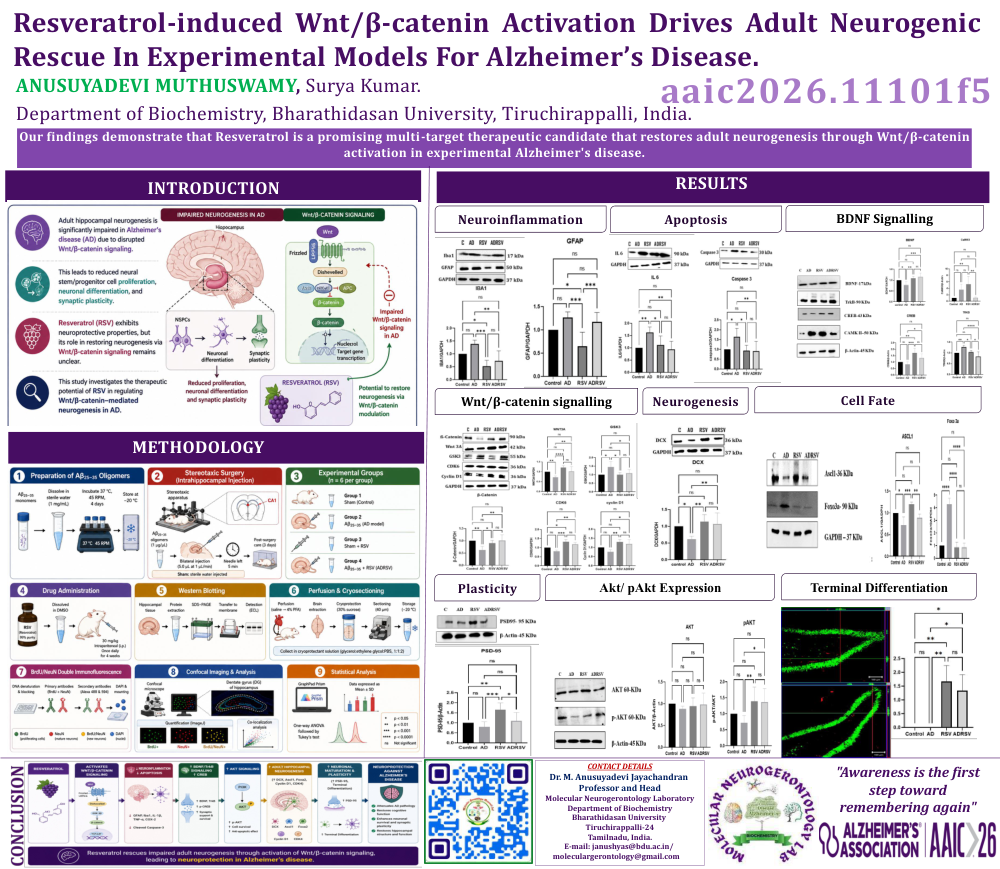
Alzheimer's disease (AD) is a progressive neurodegenerative disorder characterized by amyloid-β (Aβ) accumulation, neuroinflammation, oxidative stress, synaptic dysfunction, and impaired adult hippocampal neurogenesis, ultimately leading to cognitive decline. Among the signaling pathways involved in neurogenesis, the Wnt/β-catenin pathway plays a critical role in regulating neural stem cell proliferation, neuronal differentiation, and synaptic plasticity, but its activity is significantly disrupted during AD progression. In the present study, we investigated whether resveratrol, a naturally occurring polyphenolic compound with well-established antioxidant and neuroprotective properties, could restore adult hippocampal neurogenesis by modulating Wnt/β-catenin signaling in an experimental model of Alzheimer's disease.
Our findings demonstrated that Aβ administration induced a pathological state characterized by enhanced neuroinflammation, increased apoptosis, and impaired neurogenic signaling. The significant elevation of GFAP, IBA1, IL-6, and Caspase-3 indicates activation of astrocytes and microglia together with apoptotic cell death, whereas the marked suppression of Wnt/β-catenin signaling, evidenced by reduced expression of Wnt3a, β-catenin, Cyclin D1, and CDK6, along with increased GSK3β expression, suggests disruption of neural stem cell proliferation and neuronal differentiation. These molecular alterations collectively contribute to impaired adult hippocampal neurogenesis associated with Aβ-induced neurotoxicity.
Resveratrol treatment effectively attenuated neuroinflammation and apoptosis while restoring Wnt/β-catenin signaling, indicating recovery of the molecular pathways regulating neurogenesis. The enhanced expression of neurogenesis-associated proteins, including DCX, Ascl1, and Foxa2, further suggests improved neural stem cell proliferation, neuronal lineage commitment, and neuronal differentiation. These findings indicate that activation of Wnt/β-catenin signaling is a central mechanism through which resveratrol promotes regeneration of the adult hippocampus under neurodegenerative conditions.
Furthermore, resveratrol significantly upregulated the BDNF/TrkB/CREB signaling pathway, increased the synaptic plasticity marker PSD-95, activated Akt phosphorylation, and promoted terminal neuronal differentiation, indicating enhanced neuronal survival, synaptic integrity, and functional maturation. The coordinated activation of neurogenic and neurotrophic signaling pathways suggests that resveratrol supports both neuronal development and synaptic remodeling, thereby improving the structural and functional integrity of hippocampal neuronal networks.
Collectively, these findings demonstrate that resveratrol exerts robust neuroprotective effects by activating Wnt/β-catenin-mediated neurogenic signaling while simultaneously suppressing neuroinflammation and apoptosis. This coordinated multi-target mechanism highlights the therapeutic potential of resveratrol for restoring impaired adult hippocampal neurogenesis, enhancing neuronal survival and synaptic plasticity, and ultimately slowing the progression of Alzheimer's disease.
Comments
Email is required but is not shown publicly.
Loading comments...