4,068 posters, 219 videos, 101 topics, 69 sessions, 14,365 authors, 6,128 institutions
ePostersLive by SciGen Technologies S.A. All rights reserved.
Alzheimer's Association International Conference 2026
July 12-15, 2026 | London, United Kingdom, and Online

1365
Targeting Lipid Remodeling, Circular RNAs And Autophagy To Modulate Amyloid-ί Dynamics In Alzheimer’s Disease
Poster Presenter
Part of Topic
Abstract:
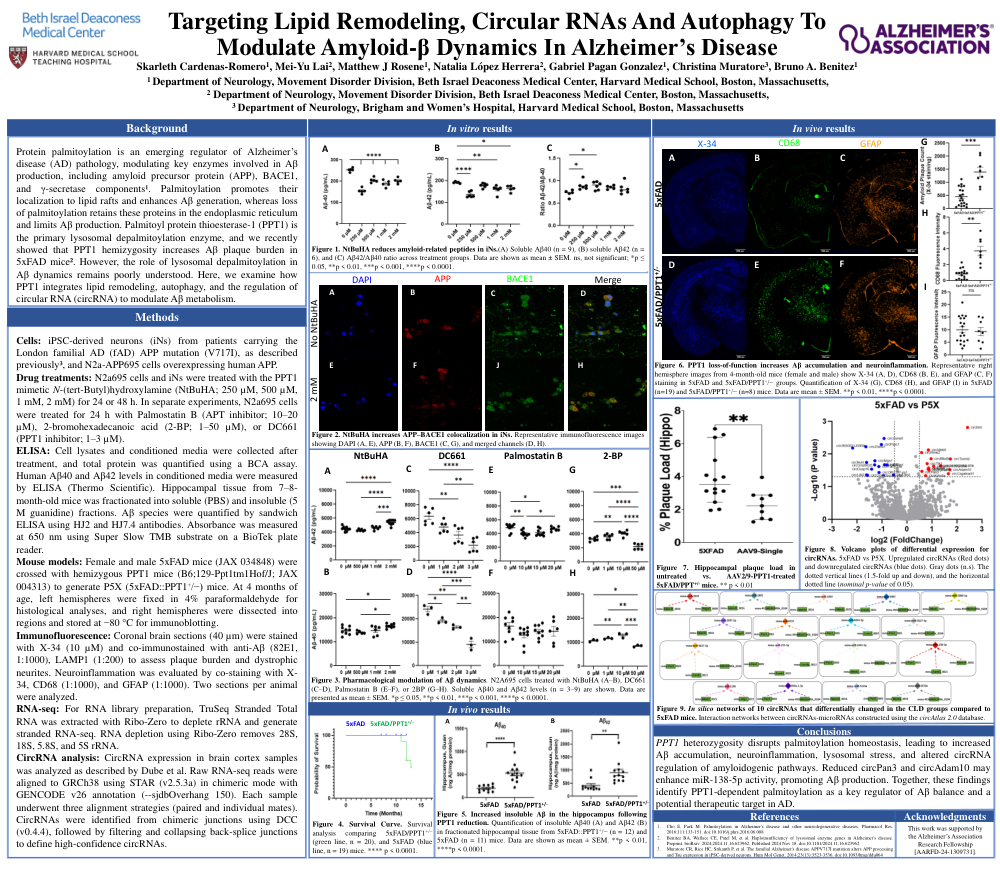
Background: Autophagy and lysosomal membrane dynamics are essential for neuronal proteostasis and clearance of amyloid-β (Aβ). Disruption of these pathways contributes to Alzheimer’s disease (AD), where lipid modifications critically regulate amyloidogenic processing. S-palmitoylation controls protein trafficking within lipid rafts, promoting β- and γ-secretase-dependent Aβ generation. Palmitoyl-protein thioesterase-1 (PPT1) is a lysosomal depalmitoylating enzyme that removes thioester-linked palmitate during autophagic degradation. We previously showed that PPT1 hemizygosity increases plaque burden in 5xFAD mice. Here, we examine how PPT1 integrates lipid remodeling, autophagy, and circular RNA (circRNA) regulation to modulate Aβ metabolism.
Methods: Amyloidogenic processing was modeled using N2A695 cells and human iPSC-derived neurons carrying familial APP mutations. Cells were treated with modulators of the palmitoylation cycle, including the PPT1 mimetic NtBuHA, palmitoylation inhibitor 2-bromopalmitate, acyl-protein thioesterase inhibitor Palmostatin B, and lysosomal flux inhibitor DC661. APP trafficking, lysosomal markers, and autophagy proteins were assessed by immunocytochemistry, and secreted Aβ40/42 was quantified by ELISA. In vivo, we analyzed 5xFAD:PPT1⁺/⁻ mice, NtBuHA-treated 5xFAD mice, and AAV9-PPT1-overexpressing 5xFAD mice. Amyloid burden, lysosomal integrity, and glial activation were assessed histologically and biochemically. Cortical palmitome proteomics, bulk RNA-seq, circRNA profiling, and single-cell RNA-seq analyses were performed.
Results: PPT1 activation significantly reduced Aβ40 and Aβ42 secretion in human neurons, accompanied by altered APP trafficking toward lysosomal compartments. In contrast, disruption of palmitoylation dynamics produced compartment-specific effects on Aβ generation. 5xFAD/PPT1⁺/⁻ mice exhibited increased plaque burden, elevated soluble Aβ, reduced survival, and marked lysosomal stress and neuroinflammation, whereas PPT1 overexpression reduced hippocampal amyloid pathology. Proteomic analysis revealed dysregulation of vesicle trafficking, lipid metabolism, and synaptic pathways. CircRNA profiling revealed significant alterations in circRNAs associated with autophagy and amyloid processing, supporting miRNA sponge functions with in silico analyses. Single-cell RNA-seq demonstrated cell-type-specific PPT1 expression associated with autophagy and lipid metabolism programs.
Conclusion: PPT1-mediated lysosomal depalmitoylation is a central regulator of lipid remodeling, autophagy, and Aβ metabolism in AD. Loss of PPT1 disrupts lysosomal homeostasis and circRNA networks, accelerating amyloid pathology, while restoring PPT1 activity reduces proteotoxic stress. Targeting PPT1 or circRNA-miRNA interactions represents a promising therapeutic strategy for AD.
Comments
Email is required but is not shown publicly.
Loading comments...