4,068 posters, 219 videos, 101 topics, 69 sessions, 14,365 authors, 6,128 institutions
ePostersLive by SciGen Technologies S.A. All rights reserved.
Alzheimer's Association International Conference 2026
July 12-15, 2026 | London, United Kingdom, and Online

2948
Development Of A Human Reactive Astrocyte Drug Discovery Platform To Evaluate Neuroinflammation
Poster Presenter
Authors
Part of Topic
Development Of A Human Reactive Astrocyte Drug Discovery Platform To Evaluate Neuroinflammation
Anna-Lena Zepernick, Tara J. Bowen, Eve Corrie, Matthieu Trigano, Robert Pedley, Emma V. Jones.
Background
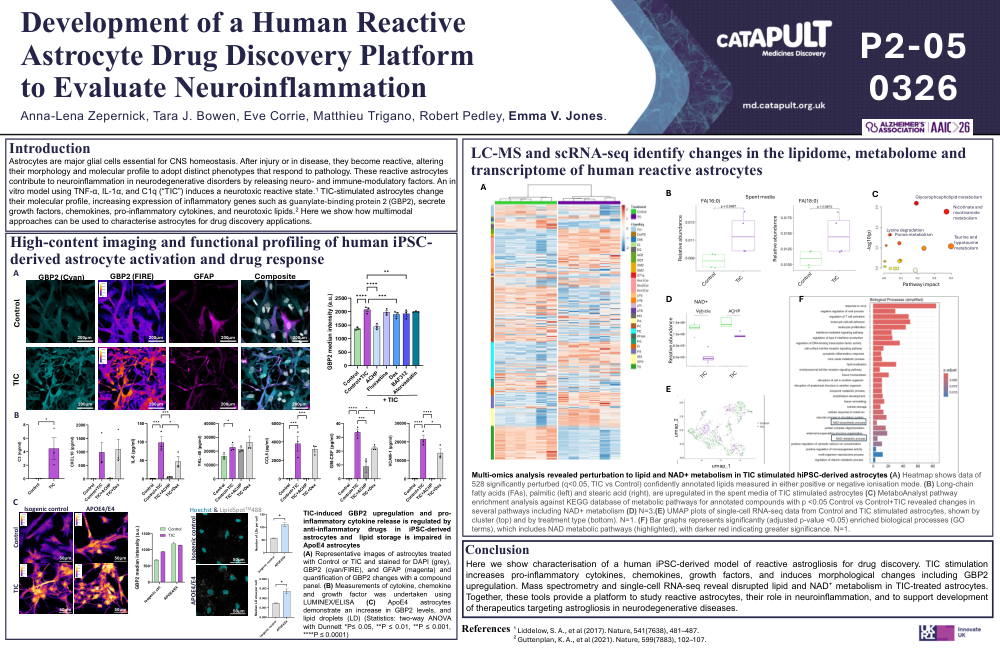
Astrocytes play a pivotal role in central nervous system (CNS) injury or in disease, for example Alzheimer’s, Huntington’s and Parkinson’s disease. These key cells undergo a transformation to become ‘reactive’ and change their phenotype including their morphology, molecular profile and function. Reactive astrocytes participate in neuroinflammatory processes occurring in neurodegenerative diseases through secretion of neuro- and immune-modulatory factors. Modelling this aspect of pathology has recently been described in the literature where an in vitro reactive astrocyte model was developed using a stimulation cocktail of TNF-α, IL-1α, and Complement 1q (‘TIC’), which drives a neurotoxic state. TIC-induced astrocytes have been shown to secrete growth factors, chemokines and pro-inflammatory cytokines, as well as neurotoxic lipids. At MDC, we have used a suite of techniques to interrogate this aspect of neuroinflammation in drug discovery assays.
Methods
iPSC-derived human astrocytes were cultured for one week prior to TIC stimulation. Astrocyte phenotype was evaluated using immunocytochemistry and high content imaging, and media was collected and analysed using multiplex cytokine analysis (Luminex). The lipidome and metabolome were analysed using untargeted liquid chromatography-coupled mass spectrometry analysis.
Results
Here, we show characterisation of a human iPSC-derived model of reactive astrogliosis for application in drug discovery research. We demonstrate that TIC stimulation induces an increase in secreted pro-inflammatory cytokines, chemokines, growth factors, neurotoxic lipids as well as changes in morphological features including GBP2 expression. In addition, using multi-omic analysis we show significant changes in the reactive astrocyte lipidome, metabolome and transcriptome.
Conclusion
Together these innovative tools provide a platform to study reactive astrocytes, and their contribution to neuroinflammation. These biomarkers detected in astrocyte culture have translational relevance, as some of these factors have been previously described to be neurotoxic in clinical samples. Modelling this key aspect of pathology aims to assist with development of novel therapeutics to target astrogliosis in neurodegenerative disease.
Comments
Email is required but is not shown publicly.
Loading comments...