4,068 posters, 219 videos, 101 topics, 69 sessions, 14,365 authors, 6,128 institutions
ePostersLive by SciGen Technologies S.A. All rights reserved.
Alzheimer's Association International Conference 2026
July 12-15, 2026 | London, United Kingdom, and Online

1710
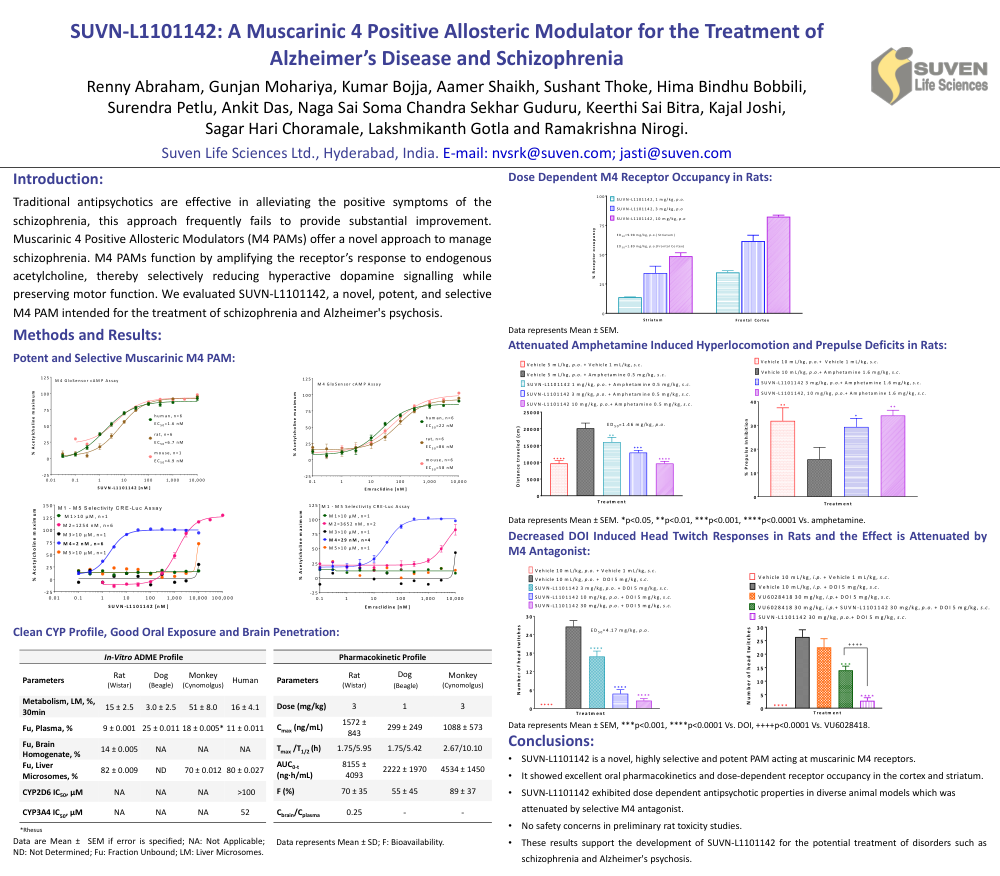
SUVN-l1101142: A Muscarinic 4 Positive Allosteric Modulator For The Treatment Of Alzheimer’s Disease And Schizophrenia
Poster Presenter
Part of Topic
Introduction:
Targeting muscarinic M4 acetylcholine receptors (M4) with positive allosteric modulators (PAMs) is an emerging area with significant potential. Given that direct agonism of the M4 receptor is associated with a higher likelihood of side effects, PAMs offer an alternative therapeutic strategy with a potentially improved safety profile. SUVN-L1101142, an M4 PAM, was characterized for its efficacy in the treatment of psychosis-like symptoms in various animal models.
Methods:
The effect of SUVN-L1101142 on the allosteric site of the muscarinic M4 and M2 receptors was characterized using the GloSensor cAMP assay, and on other muscarinic receptor subtypes (M1, M3, and M5) using the CRE-Luc reporter gene assay. The receptor occupancy of SUVN-L1101142 was evaluated in rats. The antipsychotic effects of SUVN-L1101142 were assessed in an amphetamine-induced hyperlocomotion test and in a 2,5-dimethoxy-4-iodoamphetamine (DOI)-induced head twitch model in rats. To ascertain whether the effect observed in the DOI-induced head twitch test was due to activity at the M4 receptor, an M4 antagonist was administered. The likelihood of SUVN-L1101142 eliciting motor side effects was systematically investigated as part of a safety assessment to rule out potential adverse effects on the motor system. A preliminary toxicity study of SUVN-L1101142 was conducted in rats.
Results:
SUVN-L1101142 was found to be a selective M4 PAM with >500-fold selectivity over other muscarinic receptor subtypes. SUVN-L1101142 attenuated both amphetamine-induced hyperlocomotion and DOI-induced head twitch. The efficacy observed with SUVN-L1101142 was blocked by an M4 receptor antagonist, indicating that the observed efficacy was mediated through M4 receptors. SUVN-L1101142 reversed time delay induced memory deficits in a social recognition task in rats. There was no propensity to induce motor side effects at the tested doses. The observation from the amphetamine-induced hyperlocomotion assay correlated well with the occupancy at the allosteric site of muscarinic M4 receptors. Preliminary toxicity studies in rats did not show any concerns for further development.
Conclusion:
SUVN-L1101142 has the potential to be a new therapeutic option for the treatment of various neuropsychiatric aspects associated with AD and other dementias, including schizophrenia
Comments
Email is required but is not shown publicly.
Loading comments...