4,068 posters, 219 videos, 101 topics, 69 sessions, 14,365 authors, 6,128 institutions
ePostersLive by SciGen Technologies S.A. All rights reserved.
Alzheimer's Association International Conference 2026
July 12-15, 2026 | London, United Kingdom, and Online

2186
Development Of A Detection Method For Alpha-synuclein Fibrils Using MALDI-TOF MS
Poster Presenter
Authors
Affiliations
Part of Topic
Background
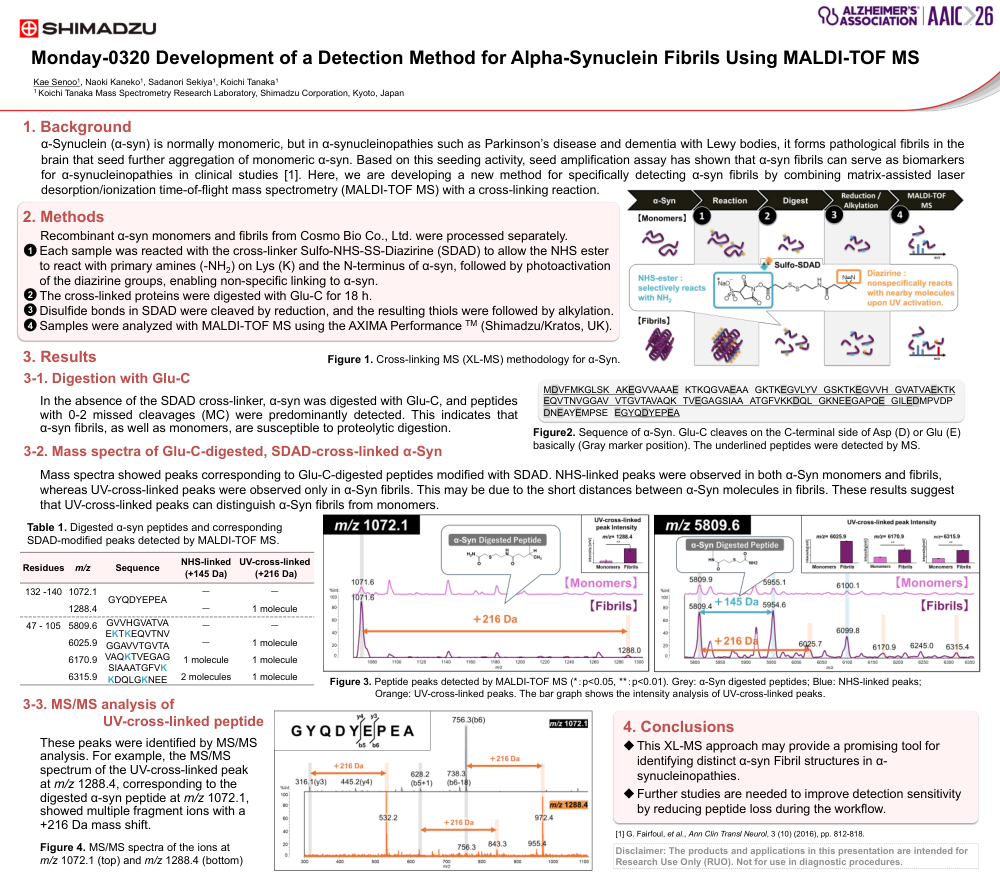
α-synuclein (α-syn) typically exists as a monomer, however, its aggregation and fibril formation appear in the brains of patients with α-synucleinopathy (Parkinson's disease, Lewy body dementia, etc.). α-syn aggregates and fibrils are widely known to exhibit seed activity that converts α-syn monomers into abnormal aggregates and fibrils. The seed amplification assay (SAA), which is based on this activity, has shown significant potential for a biomarker (BM) for α-synucleinopathy in clinical studies. In this study, we aimed to develop a new method to specifically detect α-syn fibrils with the combination of matrix-assisted laser desorption ionization-time-of-flight mass spectrometry (MALDI-TOF MS) and cross-linking reaction.
Methods
Recombinant α-syn monomers or fibrils were reacted with the cross-linker, Sulfo-NHS-SS-Diazirine (SDAD), at room temperature through NHS reaction, and followed by photoactivation of diazirines with UV light (365 nm). The cross-linked proteins were treated with enzymatic digestion, and then the disulfide bonds in the cross-linkers were cleaved by reduction and alkylation. These samples were desalted prior to MALDI-TOF MS (Shimadzu/Kratos, UK) analysis.
Results
In the digestion reaction of α-syn without the cross-linkers, digested peptides with missed cleavages 0 to 2 were predominantly detected, which indicated that α-syn fibrils as well as monomers can be cleaved by a protease. In the cross-linked proteins, the mass spectra showed peaks of the digested peptides bound to cross-linkers through NHS reaction and UV reaction. Among these, we found specific peaks detected only in α-syn fibrils, not in monomers, and confirmed that the measured mass of these peaks matched to the theoretical mass of the peptides linked to SDAD with UV reaction. However, there was a notable loss of digestion peptides in the cross-linked proteins of α-syn fibrils, which may be caused by an adsorption or aggregation through the hydrophobic SDAD.
Conclusions
We developed the novel detection method using MALDI-TOF MS to distinguish the structures of α-syn monomers or fibrils. This methodology may provide a promising simple tool for identifying different α-syn aggregate structures in α-synucleinopathy. Further study is necessary for the improvement of detection sensitivity.
Comments
Email is required but is not shown publicly.
Loading comments...