4,068 posters, 219 videos, 101 topics, 69 sessions, 14,365 authors, 6,128 institutions
ePostersLive by SciGen Technologies S.A. All rights reserved.
Alzheimer's Association International Conference 2026
July 12-15, 2026 | London, United Kingdom, and Online

10796
Correlation Between Csf Biomarkers, Fat Percentage And Muscle Strength In Older Adults With Mild Cognitive Impairment
Poster Presenter
Part of Topic
Correlation between CSF biomarkers, fat percentage and muscle strength in older adults with Mild Cognitive Impairment
Beatriz Ramos Lucente¹, Thiago Mattos Frota de Souza², José Igor Vasconcelos de Oliveira², Marco Carlos Uchida², Liara Rizzi³, Marcio Luiz Figueiredo Balthazar¹, Isadora Cristina Ribeiro².
1- Universidade Estadual de Campinas – Faculdade de Ciências Médicas, 2- Universidade Estadual de Campinas - Faculdade de Educação Física, 3- Universidade da Califórnia – Centro de Memória e de Envelhecimento.
• Introduction: Mild cognitive impairment (MCI) refers to the condition between preserved cognition and dementia, a diagnosis in which individuals have unnatural cognitive loss and an increased risk of developing Alzheimer's disease (AD). Another factor that increases this risk is obesity (defined by body fat percentage - %BF), due to chronic inflammation, with studies pointing to cognitive improvement in this population through increased muscle strength.
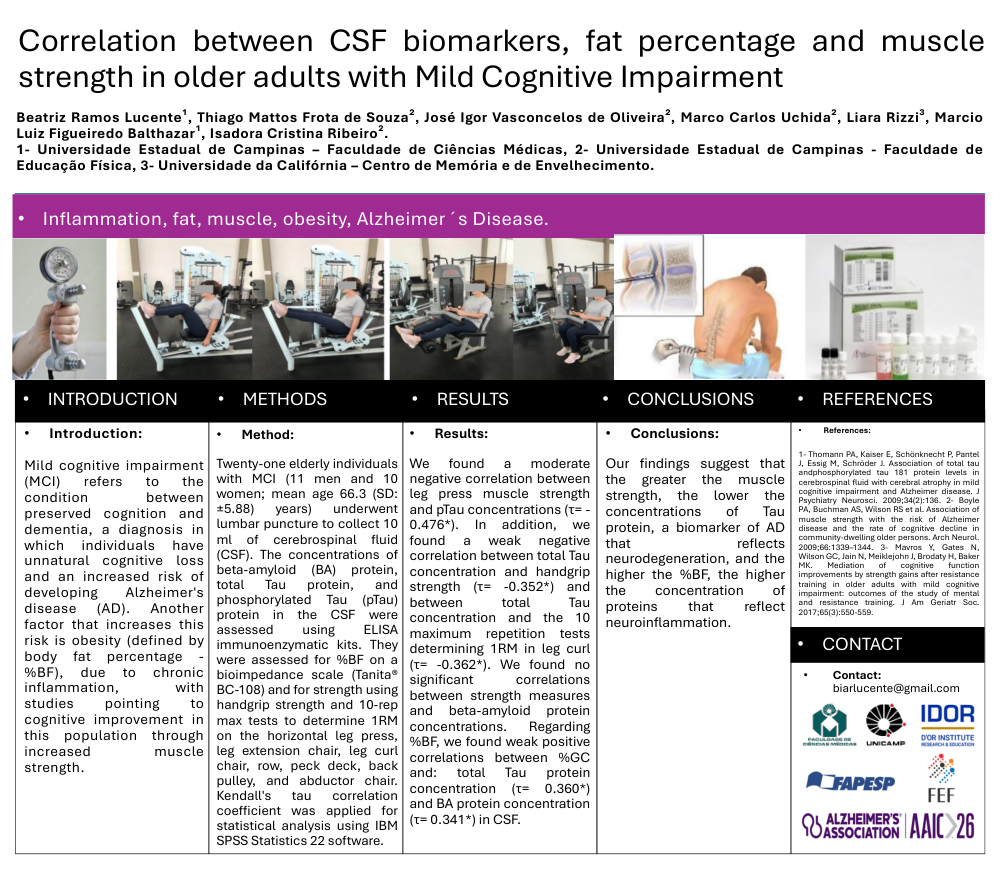
• Method: Twenty-one elderly individuals with MCI (11 men and 10 women; mean age 66.3 (SD: ±5.88) years) underwent lumbar puncture to collect 10 ml of cerebrospinal fluid (CSF). The concentrations of beta-amyloid (BA) protein, total Tau protein, and phosphorylated Tau (pTau) protein in the CSF were assessed using ELISA immunoenzymatic kits. They were assessed for %BF on a bioimpedance scale (Tanita® BC-108) and for strength using handgrip strength and 10-rep max tests to determine 1RM on the horizontal leg press, leg extension chair, leg curl chair, row, peck deck, back pulley, and abductor chair. Kendall's tau correlation coefficient was applied for statistical analysis using IBM SPSS Statistics 22 software.
• Results: We found a moderate negative correlation between leg press muscle strength and pTau concentrations (τ= - 0.476*). In addition, we found a weak negative correlation between total Tau concentration and handgrip strength (τ= -0.352*) and between total Tau concentration and the 10 maximum repetition tests determining 1RM in leg curl (τ= -0.362*). We found no significant correlations between strength measures and beta-amyloid protein concentrations. Regarding %BF, we found weak positive correlations between %GC and: total Tau protein concentration (τ= 0.360*) and BA protein concentration (τ= 0.341*) in CSF.
• Conclusions: Our findings suggest that the greater the muscle strength, the lower the concentrations of Tau protein, a biomarker of AD that reflects neurodegeneration, and the higher the %BF, the higher the concentration of proteins that reflect neuroinflammation.
• References:
1- Thomann PA, Kaiser E, Schönknecht P, Pantel J, Essig M, Schröder J. Association of total tau andphosphorylated tau 181 protein levels in cerebrospinal fluid with cerebral atrophy in mild cognitive impairment and Alzheimer disease. J Psychiatry Neurosci. 2009;34(2):136.
2- Boyle PA, Buchman AS, Wilson RS et al. Association of muscle strength with the risk of Alzheimer disease and the rate of cognitive decline in community-dwelling older persons. Arch Neurol. 2009;66:1339–1344.
3- Mavros Y, Gates N, Wilson GC, Jain N, Meiklejohn J, Brodaty H, Baker MK. Mediation of cognitive function improvements by strength gains after resistance training in older adults with mild cognitive impairment: outcomes of the study of mental and resistance training. J Am Geriatr Soc. 2017;65(3):550-559.
Comments
Email is required but is not shown publicly.
Loading comments...