4,068 posters, 219 videos, 101 topics, 69 sessions, 14,365 authors, 6,128 institutions
ePostersLive by SciGen Technologies S.A. All rights reserved.
Alzheimer's Association International Conference 2026
July 12-15, 2026 | London, United Kingdom, and Online

5440
Hsa_circ_lpar1 And Hsa_circ_axl As The Most Promising Circrnas To Be Validated As Biomarkers For Alzheimer's Disease: An In Silico Study.
Part of Topic
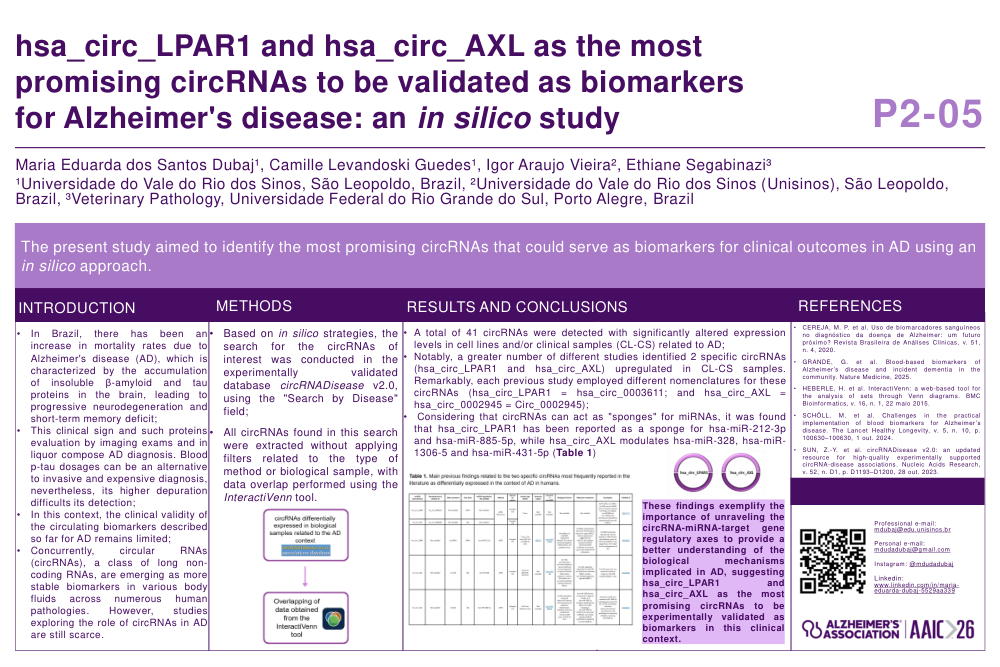
Background: In Brazil, there has been an increase in mortality rates due to Alzheimer's disease (AD), which is characterized by the accumulation of insoluble β-amyloid and tau proteins in the brain, leading to progressive neurodegeneration and short-term memory deficit. This clinical sign and such proteins evaluation by imaging exams and in liquor compose AD diagnosis. Blood p-tau dosages can be an alternative to invasive and expensive diagnosis, nevertheless, its higher depuration difficults its detection. In this context, the clinical validity of the circulating biomarkers described so far for AD remains limited. Concurrently, circular RNAs (circRNAs), a class of long non-coding RNAs, are emerging as more stable biomarkers in various body fluids across numerous human pathologies. However, studies exploring the role of circRNAs in AD are still scarce. The present study aimed to select the most promising circRNAs that could serve as biomarkers for clinical outcomes in AD.
Methods: Based on in silico strategies, the search for the circRNAs of interest was conducted in the experimentally validated database circRNADisease v2.0, using the "Search by Disease" field. All circRNAs found in this search were extracted without applying filters related to the type of method or biological sample, with data overlap performed using the InteractiVenn tool.
Results: Among the main preliminary results, a total of 41 circRNAs were detected with significantly altered expression levels in cell lines and/or clinical samples (CL-CS) related to AD. Notably, a greater number of different studies identified 2 specific circRNAs (hsa_circ_LPAR1 and hsa_circ_AXL) upregulated in CL-CS samples. Remarkably, each previous study employed different nomenclatures for these circRNAs (hsa_circ_LPAR1 = hsa_circ_0003611; and hsa_circ_AXL = hsa_circ_0002945 = Circ_0002945). Considering that circRNAs can act as "sponges" for miRNAs, it was found that hsa_circ_LPAR1 has been reported as a sponge for hsa-miR-212-3p and hsa-miR-885-5p, while hsa_circ_AXL modulates hsa-miR-328, hsa-miR-1306-5 and hsa-miR-431-5p .
Conclusion: These findings exemplify the importance of unraveling the circRNA-miRNA-target gene regulatory axes to provide a better understanding of the biological mechanisms implicated in AD, suggesting hsa_circ_LPAR1 and hsa_circ_AXL as the most promising circRNAs to be experimentally
Comments
Email is required but is not shown publicly.
Loading comments...