4,068 posters, 219 videos, 101 topics, 69 sessions, 14,365 authors, 6,128 institutions
ePostersLive by SciGen Technologies S.A. All rights reserved.
Alzheimer's Association International Conference 2026
July 12-15, 2026 | London, United Kingdom, and Online

464
Short-term High-fat Diet And Streptozotocin Administration Alter Hippocampal Memory, Neuronal, And Biochemical Functions
Poster Presenter
Authors
Juliet Nnenda Olayinka, Oluwole Akawa, Abiola Obisesan, Ifeoluwa Awogbindin, Scholastica Anadozie, Olushola Adewale
Affiliations
1Afe Babalola University, Department of Pharmacology and Therapeutics, College of Medicine and Health Sciences, Ado-Ekiti, Ekiti State, Nigeria., 2Afe Babalola University, Department of Pharmaceutical Chemistry, Ado-Ekiti, Ekiit State, Nigeria;, 3Afe Babalola University, Pharmaceutical Microbiology and Biotechnology, College of Pharmacy, Ado-Ekiti, Ekiti State, Nigeria, 4University of Victoria, School of Medical Sciences, Victoria, BC, Canada, 5Afe Babalola University, Biochemistry Program, Department of Chemical Sciences, College of Sciences, Ado-Ekiti, Nigeria
Part of Topic
Abstract
Background:
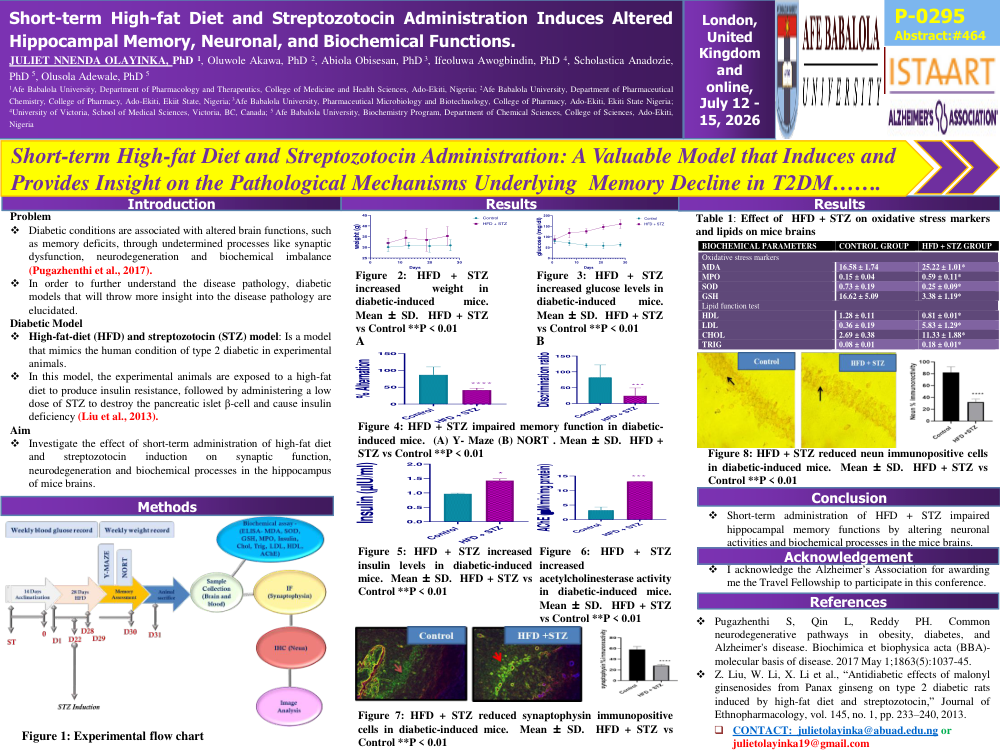
Diabetic conditions are associated with altered brain functions, such as cognitive deficits, through undetermined processes like synaptic dysfunction, neurodegeneration, and biochemical imbalance. The combination of high-fat diet and streptozotocin (HFD + STZ) is a model that mimics type 2 diabetic conditions in experimental animals. This model may be useful in throwing more insight into the disease's pathology. The study aimed at investigating the short-term effect of HFD + STZ on hippocampal memory and neuronal functions and biochemical changes in the mice's brains.
Methods:
Twenty male mice (n = 10) were divided into two groups: a control group and a diabetic group (HFD + STZ). The diabetic group was fed with HFD for 28 days. Thereafter, mice in this group were induced with STZ (50 mg/kg intraperitoneally) on day 22. Weight and blood glucose levels were taken weekly. Memory functions (Y-maze and novel object recognition test (NORT)) were performed. The hippocampus (CA1) was harvested for biochemical assays such as acetylcholinesterase activity, insulin tests, cholesterol, triglycerides, high-density lipoproteins (HDL), low-density lipoproteins (LDL), and oxidative stress (malondialdehyde, superoxide dismutase, glutathione, and myeloperoxidase) activities using enzyme-linked immunosorbent assay. Immunofluorescence and immunohistochemistry were used in determining the expressions of synaptophysin and NeuN in the brain, respectively.
Results:
Short-term administration of HFD + STZ significantly increased the weight, glucose, insulin, and acetylcholinesterase levels in the HFD + STZ-induced mice. Memory function was impaired in the HFD + STZ-induced mice. Malondialdehyde, myeloperoxidase, cholesterol, triglyceride, and LDL levels were significantly elevated, while HDL levels, superoxide dismutase, and glutathione levels were significantly reduced in the HFD + STZ-induced mice compared to the control. Synaptophysin and NeuN expressions were low in the brains of the HFD + STZ-induced mice compared to the control.
Conclusion:
Short-term administration of HFD + STZ impaired hippocampal memory functions, and the possible mechanisms could be altering neuronal activities, oxidative status, and lipid metabolism in the mice's brains.
Comments
Email is required but is not shown publicly.
Loading comments...