4,068 posters, 219 videos, 101 topics, 69 sessions, 14,365 authors, 6,128 institutions
ePostersLive by SciGen Technologies S.A. All rights reserved.
Alzheimer's Association International Conference 2026
July 12-15, 2026 | London, United Kingdom, and Online

2322
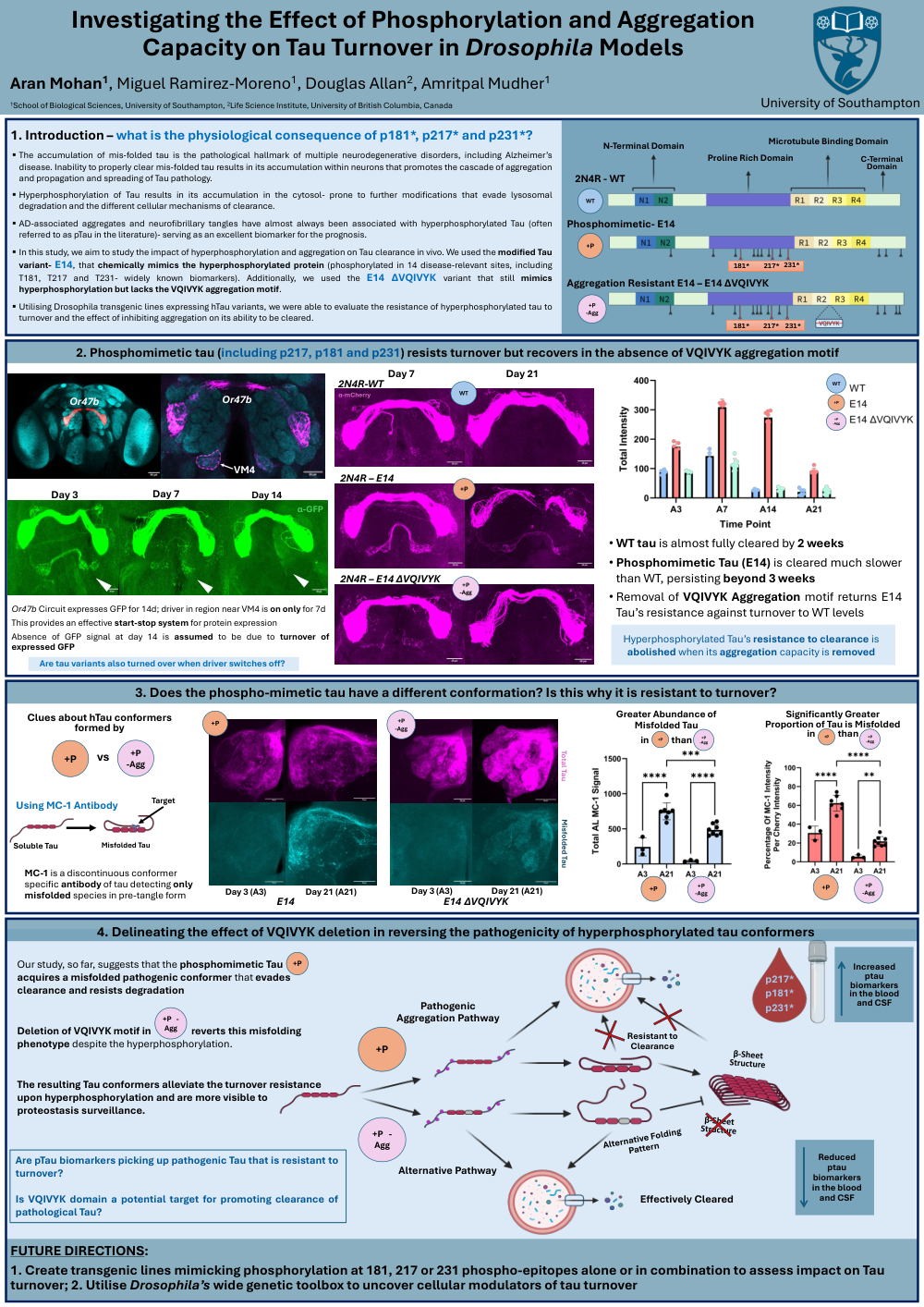
Investigating The Effect Of Phosphorylation And Aggregation Capacity On The Turnover Of Tau In Drosophila Models
Part of Topic
The accumulation of mis-folded tau is the pathological hallmark of multiple neurodegenerative disorders, including Alzheimer’s disease. Inability to properly clear mis-folded tau results in its accumulation within neurons that promotes the cascade of aggregation and propagation and spreading of Tau pathology. ▪Hyperphosphorylation of Tau results in its accumulation in the cytosol- prone to further modifications that evade lysosomal degradation and the different cellular mechanisms of clearance. ▪AD-associated aggregates and neurofibrillary tangles have almost always been associated with hyperphosphorylated Tau (often referred to as pTau in the literature)- serving as an excellent biomarker for the prognosis. ▪In this study, we aim to study the impact of hyperphosphorylation and aggregation on Tau clearance in vivo. We used the modified Tau variant- E14, that chemically mimics the hyperphosphorylated protein (phosphorylated in 14 disease-relevant sites, including T181, T217 and T231- widely known biomarkers). Additionally, we used the E14 ΔVQIVYK variant that still mimics hyperphosphorylation but lacks the VQIVYK aggregation motif. ▪Utilising Drosophila transgenic lines expressing hTau variants, we were able to evaluate the resistance of hyperphosphorylated tau to turnover and the effect of inhibiting aggregation on its ability to be cleared.
Or47b Circuit expresses GFP for 14d; driver in region near VM4 is on only for 7d This provides an effective start-stop system for protein expression Absence of GFP signal at day 14 is assumed to be due to turnover of expressed GFP
WT tau is almost fully cleared by 2 weeks •Phosphomimetic Tau (E14) is cleared much slower than WT, persisting beyond 3 weeks •Removal of VQIVYK Aggregation motif returns E14 Tau’s resistance against turnover to WT levels. Hyperphosphorylated Tau’s resistance to clearance is abolished when its aggregation capacity is removed
Our study, so far, suggests that the phosphomimetic Tau acquires a misfolded pathogenic conformer that evades clearance and resists degradation Deletion of VQIVYK motif in reverts this misfolding phenotype despite the hyperphosphorylation. The resulting Tau conformers alleviate the turnover resistance upon hyperphosphorylation and are more visible to proteostasis surveillance
Comments
Email is required but is not shown publicly.
Loading comments...