4,068 posters, 219 videos, 101 topics, 69 sessions, 14,365 authors, 6,128 institutions
ePostersLive by SciGen Technologies S.A. All rights reserved.
Alzheimer's Association International Conference 2026
July 12-15, 2026 | London, United Kingdom, and Online

489
Study On Serum Proteomic Changes In Patients With Cognitive Impairment Induced By High Altitude Hypobaric Hypoxia Environment
Poster Presenter
Authors
Part of Topic
Study On Serum Proteomic Changes In Patients With Cognitive Impairment Induced By High Altitude Hypobaric Hypoxia Environment
Weizhong ji, Jiangyan Pei (Department of Neurology, Qinghai Provincial People's Hospital, Xining, China)
Background
Exposure to the low-oxygen environment at high altitudes has a significant impact on cognitive function. Our research group previously conducted a proteomic study on mice exposed to high-altitude hypoxia, revealing relevant differentially expressed proteins in the high-altitude group compared to the plain group. Based on this, we propose the scientific hypothesis that differentially expressed proteins related to cognition may also exist in high-altitude populations.
Methods
Using the whole population sampling method, 30 participants each were selected from the plain (Xi’an, 400 m) and plateau (Xinghai Country, 3960 m) populations, basic information was collected, and Montreal Cognition Assessment (MoCA) scale was used for cognitive assessment; serum samples of the two groups were collected for detection of protein expression by mass spectrometry, and the differentially expressed proteins related to cognitive impairment were screened by bioinformatics and the screened differentially expressed proteins were corroborated by Enzyme-Linked Immunosorbent Assay (ELISA).
Results
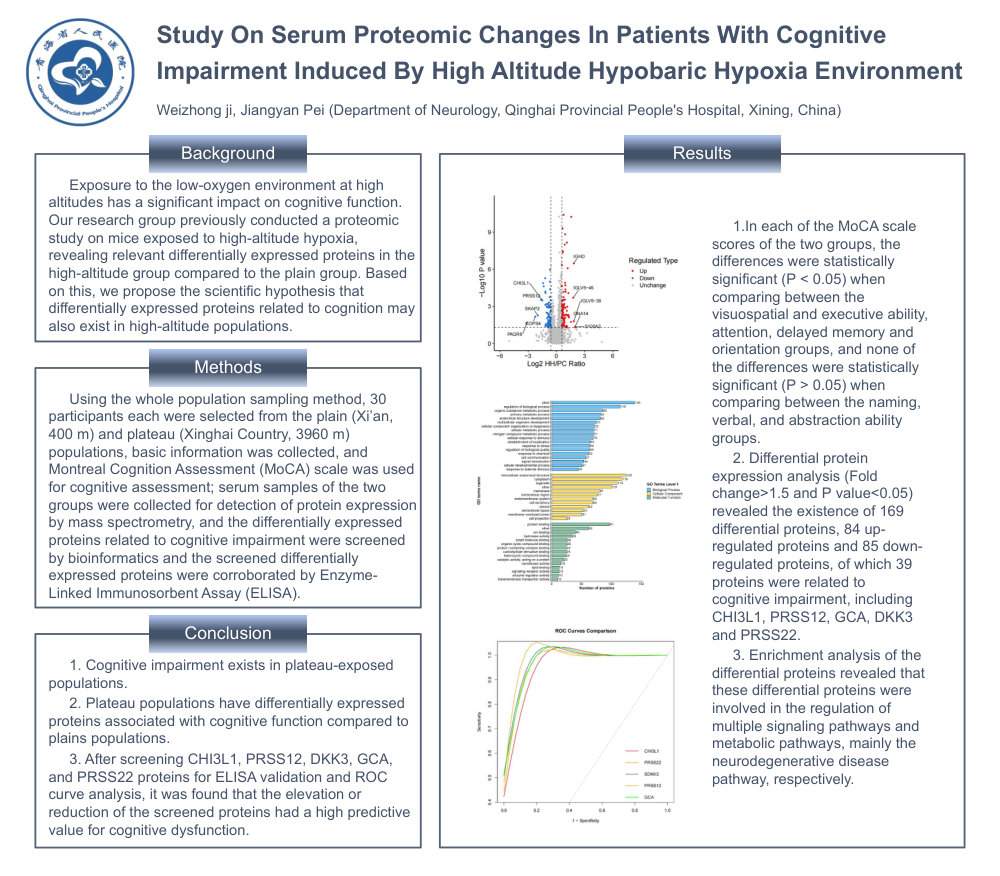
1.In each of the MoCA scale scores of the two groups, the differences were statistically significant (P < 0.05) when comparing between the visuospatial and executive ability, attention, delayed memory and orientation groups, and none of the differences were statistically significant (P > 0.05) when comparing between the naming, verbal, and abstraction ability groups.
2. Differential protein expression analysis (Fold change>1.5 and P value<0.05) revealed the existence of 169 differential proteins, 84 up-regulated proteins and 85 down-regulated proteins, of which 39 proteins were related to cognitive impairment, including CHI3L1, PRSS12, GCA, DKK3 and PRSS22.
3. Enrichment analysis of the differential proteins revealed that these differential proteins were involved in the regulation of multiple signaling pathways and metabolic pathways, mainly the neurodegenerative disease pathway, respectively.
Conclusion
1. Cognitive impairment exists in plateau-exposed populations.
2. Plateau populations have differentially expressed proteins associated with cognitive function compared to plains populations.
3. After screening CHI3L1, PRSS12, DKK3, GCA, and PRSS22 proteins for ELISA validation and ROC curve analysis, it was found that the elevation or reduction of the screened proteins had a high predictive value for cognitive dysfunction.
Comments
Email is required but is not shown publicly.
Loading comments...