4,068 posters, 219 videos, 101 topics, 69 sessions, 14,365 authors, 6,128 institutions
ePostersLive by SciGen Technologies S.A. All rights reserved.
Alzheimer's Association International Conference 2026
July 12-15, 2026 | London, United Kingdom, and Online

4033
Developmental Social Isolation In Drosophila Melanogaster:decoding The Sensory "hardware" And Behavioral "software"under Stress
Poster Presenter
Authors
Christine Gierke, Francisco Del Pino, Aracelly Vergara, Ignacio Salinas
Affiliations
Neurology & Neurosurgery Service Clinical Hospital University of Chile (HCUCH); Social Isolation Research Center (SIRC), Santiago Chile; ISOFLY Lab, NiBG Biomedical Sciences Institute (ICBM) Faculty of Medicine University of Chile; School of Psychology Diego Portales University (UDP) Santiago Chile., Social Isolation Research Center (SIRC), Santiago Chile; ISOFLY Lab, NiBG Biomedical Sciences Institute (ICBM) Faculty of Medicine University of Chile., Social Isolation Research Center (SIRC), Santiago Chile; ISOFLY Lab, NiBG Biomedical Sciences Institute (ICBM) Faculty of Medicine University of Chile
Part of Topic
Poster Title: Developmental Social Isolation in Drosophila Melanogaster: Decoding the Sensory "Hardware" and Behavioral "Software" Under Stress
Poster Number: #4033
Authors: Gierke, C., Del Pino, F., Vergara, A., & Salinas, I.
Abstract / Poster Summary
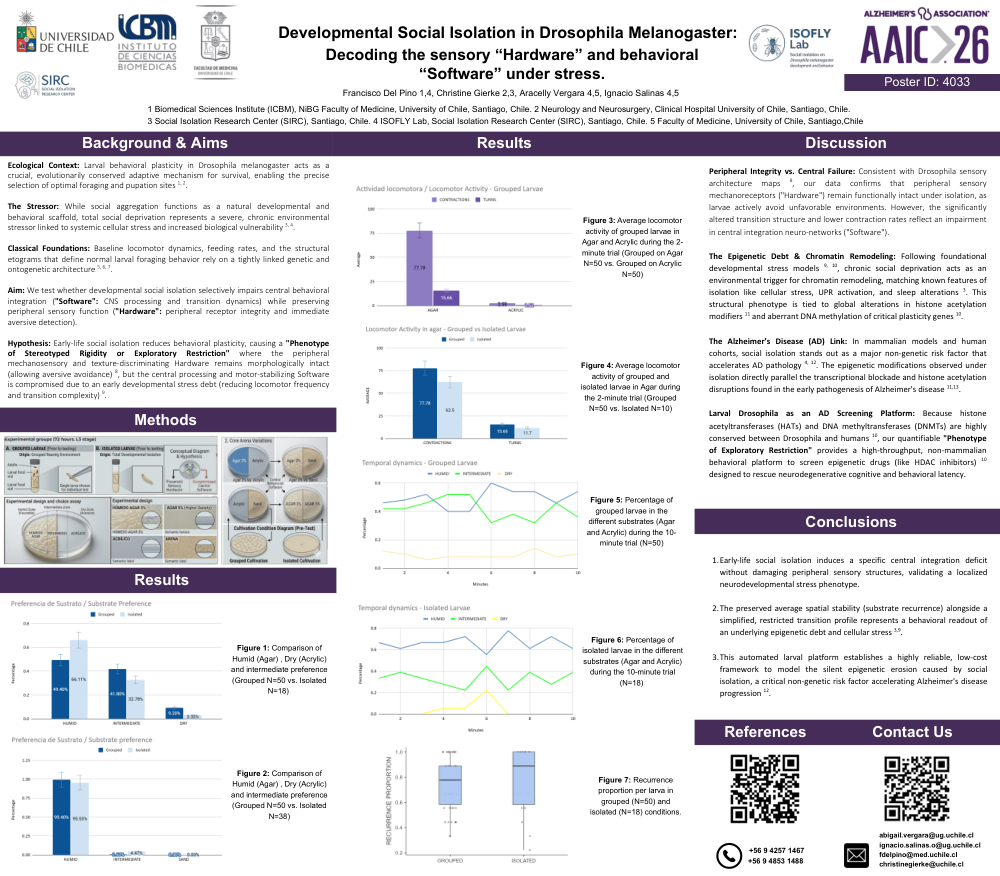
Background: While social aggregation acts as a natural developmental scaffold, total social deprivation represents a severe environmental stressor linked to biological vulnerability. This study investigates whether developmental social isolation selectively impairs central behavioral integration ("Software": CNS processing and transition dynamics) while preserving peripheral sensory function ("Hardware": receptor integrity and immediate detection).
Methods: Utilizing a high-throughput Drosophila melanogaster larval platform, larvae were reared under either grouped (N=50) or isolated (N=18) conditions. Sensory "Hardware" and central "Software" functionality were evaluated via behavioral assays tracking substrate preference and transition dynamics between humid (Agar) and dry (Acrylic) environments.
Results: Rearing conditions revealed a clear distinction between peripheral and central systems:
1) Preserved Sensory Hardware: Isolated larvae actively avoided unfavorable environments and retained normal immediate texture discrimination, confirming that peripheral sensory structures remain functionally intact.
2) Impaired Central Software: Isolated larvae displayed a significantly simplified, restricted transition profile and lower contraction rates, establishing a clear "Phenotype of Exploratory Restriction".
Conclusions: Early-life social isolation induces a specific central integration deficit without damaging peripheral structures, validating a localized neurodevelopmental stress phenotype. This automated larval platform provides a highly reliable, low-cost translational framework to model the silent epigenetic erosion caused by social isolation, a critical non-genetic risk factor that disrupts chromatin remodeling and accelerates Alzheimer’s disease progression.
Email: christinegierke@uchile.cl | fdelpino@med.uchile.cl | abigail.vergara@ug.uchile.cl | ignacio.salinas.o@ug.uchile.cl
Comments
Email is required but is not shown publicly.
Loading comments...