4,068 posters, 219 videos, 101 topics, 69 sessions, 14,365 authors, 6,128 institutions
ePostersLive by SciGen Technologies S.A. All rights reserved.
Alzheimer's Association International Conference 2026
July 12-15, 2026 | London, United Kingdom, and Online

1088
Multi-strain Probiotic Modulation Of The Gut-brain Axis Improves Metabolic And Cognitive Function In Hfd/stz Mice
Poster Presenter
Part of Topic
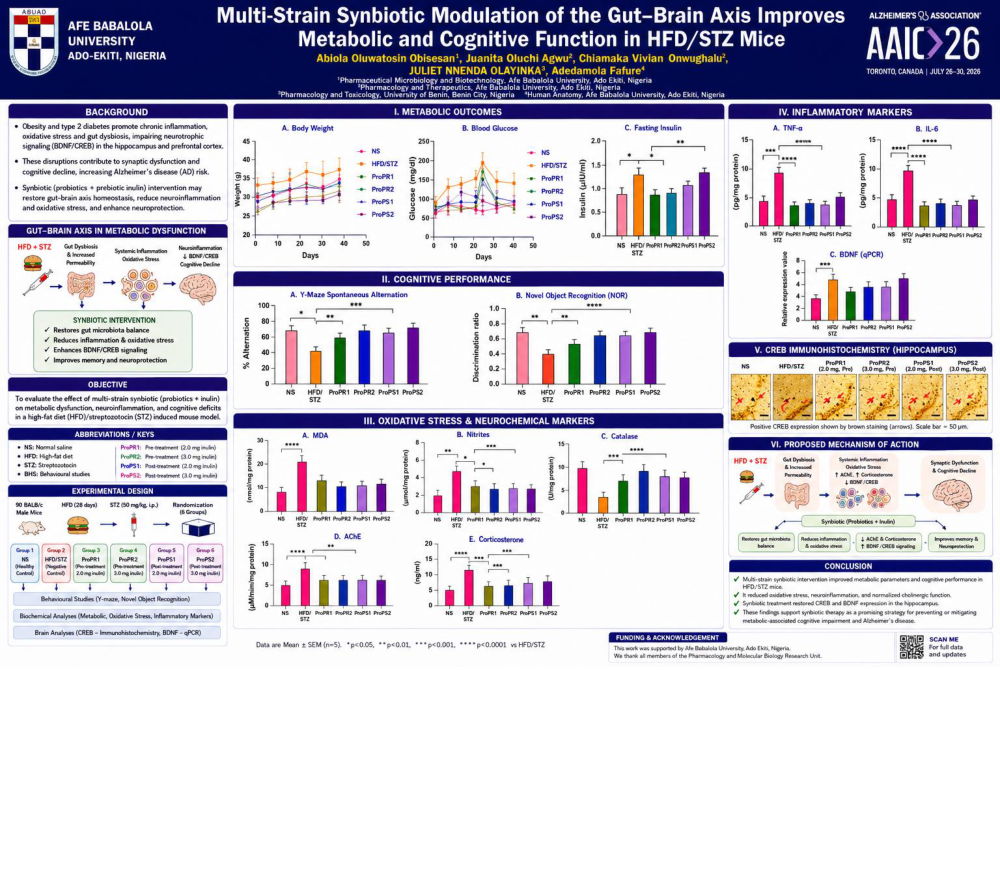
BACKGROUND: Obesity and type 2 diabetes are major risk factors for cognitive decline and Alzheimer's disease, partly through disruption of the gut–brain axis. Gut dysbiosis promotes chronic inflammation, oxidative stress, impaired insulin signalling, and neuronal dysfunction, all of which contribute to neurodegeneration. Multi-strain probiotics have emerged as promising therapeutic agents capable of restoring microbial homeostasis and modulating metabolic and neuroinflammatory pathways. This study investigated whether a multi-strain probiotic consortium could ameliorate metabolic dysfunction and cognitive impairment in a high-fat diet/streptozotocin (HFD/STZ)-induced mouse model.
EXPERIMENTAL DESIGN
Ninety BALB/c mice were randomly assigned to six groups: normal saline (NS), HFD/STZ disease control, pretreatment with multi-strain probiotics plus inulin (2.0 and 3.0 mg), and post-treatment with multi-strain probiotics plus inulin (2.0 and 3.0 mg). Behavioural assessments (Y-maze and Novel Object Recognition), metabolic analyses, oxidative stress biomarkers, inflammatory cytokines, immunohistochemistry, immunofluorescence, and RT-qPCR were performed to evaluate treatment effects.
KEY RESULTS
Metabolic Improvements
- Reduced fasting blood glucose and body weight gain.
- Improved lipid profile and insulin homeostasis.
Improved Cognitive Function
- Enhanced spontaneous alternation in the Y-maze.
- Improved recognition memory in the Novel Object Recognition test.
Reduced Oxidative Stress
- Decreased malondialdehyde (MDA) levels.
- Increased antioxidant enzyme activities (SOD, catalase, and GSH).
Reduced Neuroinflammation
- Lower TNF-α and IL-6 concentrations.
- Reduced microglial activation (Iba-1).
Neuroprotection
- Reduced acetylcholinesterase activity.
- Increased CREB and BDNF expression, indicating enhanced neuroplasticity.
CONCLUSIONA multi-strain probiotic consortium significantly improved metabolic dysfunction and cognitive performance in HFD/STZ-induced mice. The neuroprotective effects were associated with reduced oxidative stress and neuroinflammation, together with enhanced CREB–BDNF signalling, supporting gut–brain axis modulation as a promising strategy for preventing metabolic-associated cognitive decline.
TAKE-HOME MESSAGE: Multi-strain probiotics attenuate metabolic and neurobiological abnormalities associated with HFD/STZ-induced cognitive impairment through modulation of the gut–brain axis, highlighting their potential
Comments
Email is required but is not shown publicly.
Loading comments...