4,068 posters, 219 videos, 101 topics, 69 sessions, 14,365 authors, 6,128 institutions
ePostersLive by SciGen Technologies S.A. All rights reserved.
Alzheimer's Association International Conference 2026
July 12-15, 2026 | London, United Kingdom, and Online

573
Acute Oral Aluminum Oxide Nanoparticles Impair Recognition Memory And Alter Hippocampal MMP-9 And COX-2 Levels In Mice
Poster Presenter
Part of Topic
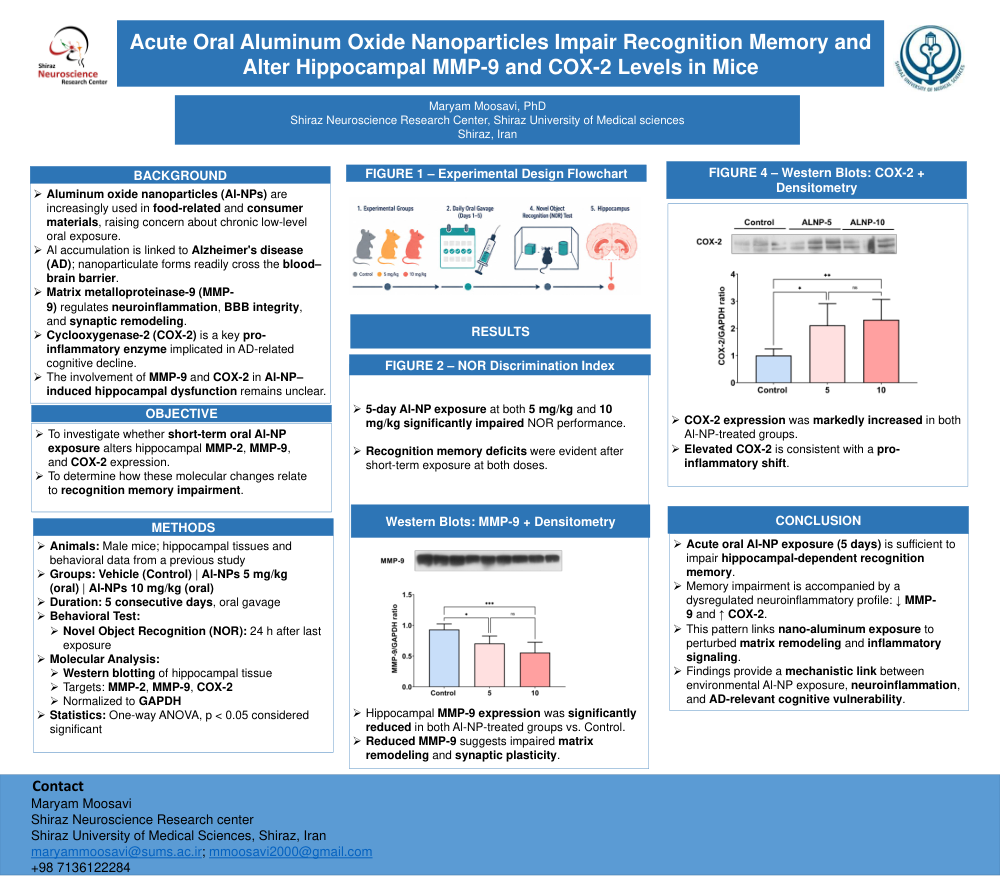
Acute Oral Aluminum Oxide Nanoparticles Impair Recognition Memory and Alter Hippocampal MMP-9 and COX-2 Levels in Mice
Background:
Aluminum oxide nanoparticles (Al-NPs) are increasingly used in food-related and consumer materials, raising concern about chronic low-level oral exposure and its impact on brain health. Al accumulation has been linked to Alzheimer’s disease (AD), and nanoparticulate forms readily cross the blood–brain barrier. Matrix metalloproteinase-9 (MMP-9) and cyclooxygenase-2 (COX-2) are key regulators of neuroinflammation, blood–brain barrier integrity, and synaptic remodeling, and have been implicated in AD-related cognitive decline. However, their involvement in Al-NP–induced hippocampal dysfunction remains unclear. This study investigated whether short-term oral Al-NP exposure alters hippocampal MMP-2, MMP-9, and COX-2 expression and how these changes relate to recognition memory impairment.
Methods:
Banked hippocampal tissues and behavioral data were obtained from male mice that had received vehicle or aluminum oxide nanoparticles (5 or 10 mg/kg, oral gavage) for 5 consecutive days in a previous study. Novel object recognition (NOR) was used to assess hippocampal-dependent recognition memory 24 h after the last exposure. Hippocampal protein levels of MMP-2, MMP-9, and COX-2 were quantified by Western blotting and normalized to GAPDH. Group differences were analyzed using one-way ANOVA with p < 0.05 considered statistically significant.
Results:
Five-day Al-NP exposure at both 5 and 10 mg/kg significantly impaired NOR performance, indicating recognition memory deficits. At the molecular level, hippocampal MMP-9 expression was significantly reduced in both Al-NP-treated groups compared with controls, whereas COX-2 expression was markedly increased, consistent with a pro-inflammatory shift. MMP-2 levels showed no robust alteration across groups. The pattern of decreased MMP-9 and elevated COX-2 coincided with the presence of NOR deficits.
Conclusion:
Acute oral exposure to aluminum oxide nanoparticles is sufficient to induce hippocampal-dependent recognition memory impairment accompanied by a dysregulated neuroinflammatory profile characterized by reduced MMP-9 and increased COX-2. These findings suggest that even short-term Al-NP exposure can perturb hippocampal matrix remodeling and inflammatory signaling, providing a mechanistic link between environmental nano-aluminum exposure, neuroinflammation, and AD-relevant cognitive vulnerability.
Comments
Email is required but is not shown publicly.
Loading comments...