4,068 posters, 219 videos, 101 topics, 69 sessions, 14,365 authors, 6,128 institutions
ePostersLive by SciGen Technologies S.A. All rights reserved.
Alzheimer's Association International Conference 2026
July 12-15, 2026 | London, United Kingdom, and Online

10608
Gut Microbial Taxa Associations With Cognitive Functional Measures In Patients With Alzheimer’s Disease
Poster Presenter
Authors
Part of Topic
Gut microbial taxa associations with cognitive functional measures in patients with Alzheimer’s Disease
Smita S. Ghare1,2,3,5,6, Vasuk Gautam1,5,6, Brandon C. Dennis5,6, Paula M. Chilton1,2,5,6, Jiyeon Lee1,2,5,6, Fengyuan Li1,2,5,6, Irina Smolenkova5,6, Ashley Ezzo5,6, Tasha M Santiago-Rodriguez4, Petrosino Joseph4, Lisa B.E.Shields5,6, Marti Gardner6, Gerald Dryden1,7, Christopher B Shields5,6, and Shirish Barve1,2,3,5,6
1Department of Medicine, 2UofL Alcohol Research Center, 3UofL Hepatobiology COBRE, University of Louisville, School of Medicine, Louisville, KY 40202; 4Baylor College of Medicine, 5Norton Neuroscience Institute, 6Norton Healthcare, Louisville, KY 40202, 7Robley Rex VA Medical Center, Louisville, KY40206 .
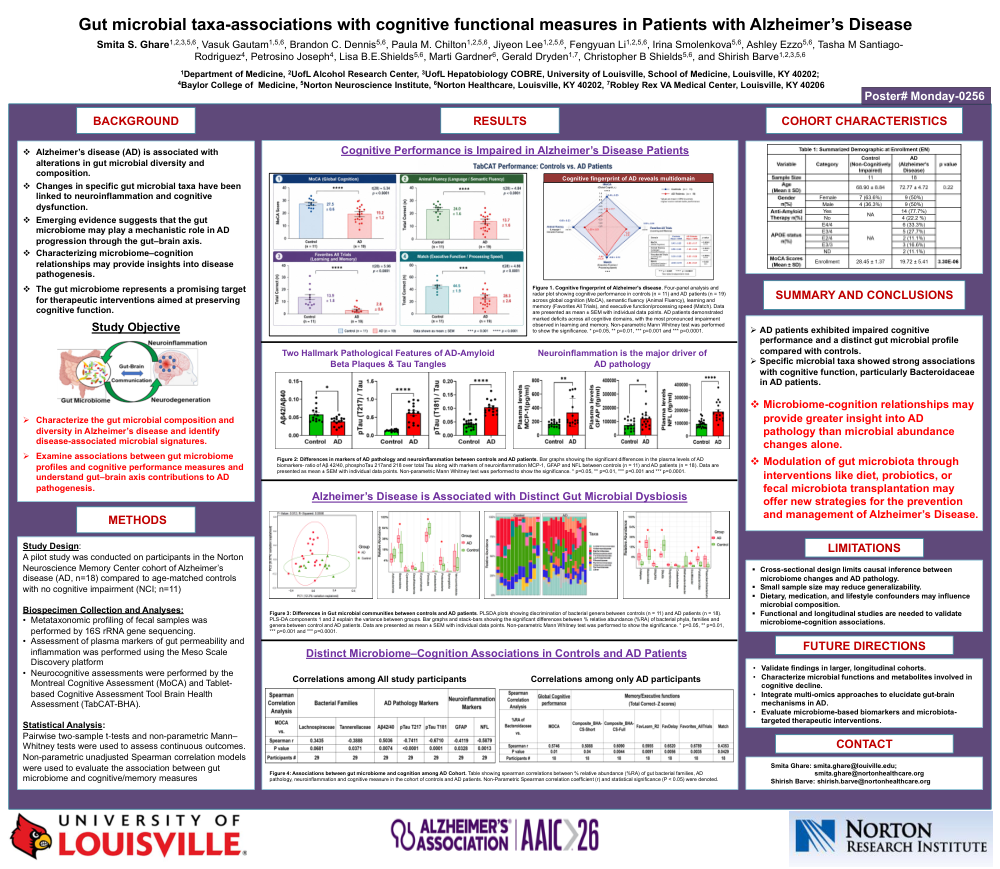
Background: Alzheimer’s disease (AD) is associated with altered gut microbial diversity with shifts in key taxa. Gut microbiome alterations may play a mechanistic role in cognitive decline in AD and represent a potential target for therapeutic intervention. The present study reports the significant associations between gut microbiome and cognitive functional measures in AD patients.
Methods: A pilot study was conducted on participants in the Norton Neuroscience Memory Center cohort of Alzheimer’s disease (AD, n=18) compared to age matched controls with no cognitive impairment (NCI; n=11). Metataxonomic profiling of fecal samples were performed by 16S rRNA gene sequencing. Neurocognitive assessments were performed by Montreal Cognitive Assessment (MoCA) and Tablet-based Cognitive Assessment Tool Brain Health Assessment (TabCAT-BHA). Group-wise comparisons were made using Mann-Whitney U-test and non-parametric Spearman correlation models were used to evaluate the association between gut microbiome, and cognitive/memory measures.
Results: AD patients showed worse performance on TabCAT tasks and MoCA than control participants, demonstrating cognitive impairment. Taxonomic profiling of the gut microbiome showed that in comparison to controls, AD patients had significant reductions in percent relative abundance (%RA) of phylum Firmicutes, family Lachnospiraceae and genus Blautia, and increased %RA in phyla Bacteriodota and Proteobacteria, families Rikenellaceae, Oscillospiraceae and Tannerellaceae and genera Oscillibacter, and Parabacteroides. Spearman correlation analysis among controls showed significant positive correlation between Lactobacillaceae, Barnesiellaceae families and MoCA scores (Spearman r=0.69 and 0.74 and p<0.05). In comparison, in AD patients, although there was no significant differential change in %RA of Bacteroidaceae family, levels strongly correlated with memory/executive functions assessed by TabCAT (Spearman r=0.56 to 0.79 and p<0.01 to <0.0001), and with global cognitive performance assessed by MoCA (Spearman r=0.6933 and p=0.0003).
Conclusion: The current findings demonstrate that complex relationships between specific microbial taxa and cognitive functional measures are more significant than relative changes in bacterial abundance alone. Modulation of gut microbiota through interventions like diet, probiotics, or fecal microbiota transplantation may offer new strategies for the prevention and management of AD.
Comments
Email is required but is not shown publicly.
Loading comments...