4,068 posters, 219 videos, 101 topics, 69 sessions, 14,365 authors, 6,128 institutions
ePostersLive by SciGen Technologies S.A. All rights reserved.
Alzheimer's Association International Conference 2026
July 12-15, 2026 | London, United Kingdom, and Online

9646
Data-driven Analysis Of Clinical Profiles And Their Post-mortem Neuropathological Correlates Using A Multicenter, Real-world Database
Part of Topic
BACKGROUND: The heterogeneity of neurodegenerative diseases challenges accurate clinical
diagnosis and clinico-pathological correlation. Traditional univariate methods
often fail to capture the complex relationships between multi-domain clinical
symptoms and distinct neuropathological burden.
METHOD: This study utilises data from the National Alzheimer Coordinating Center, a
tertiary referral real-world database comprising clinical and post-mortem
neuropathological data from both cognitively unimpaired and symptomatic
participants. General characteristics and clinical (behavioural, cognitive, and
functional) features documented at the final visit prior to death were jointly
analysed with pathological findings. A multi-block sparse Partial Least Squares
(sPLS) analysis was employed to identify latent clinico-pathological profiles
sharing variance between clinical and pathological blocks. The significance,
stability, predictive performance, and clinical validity were assessed.
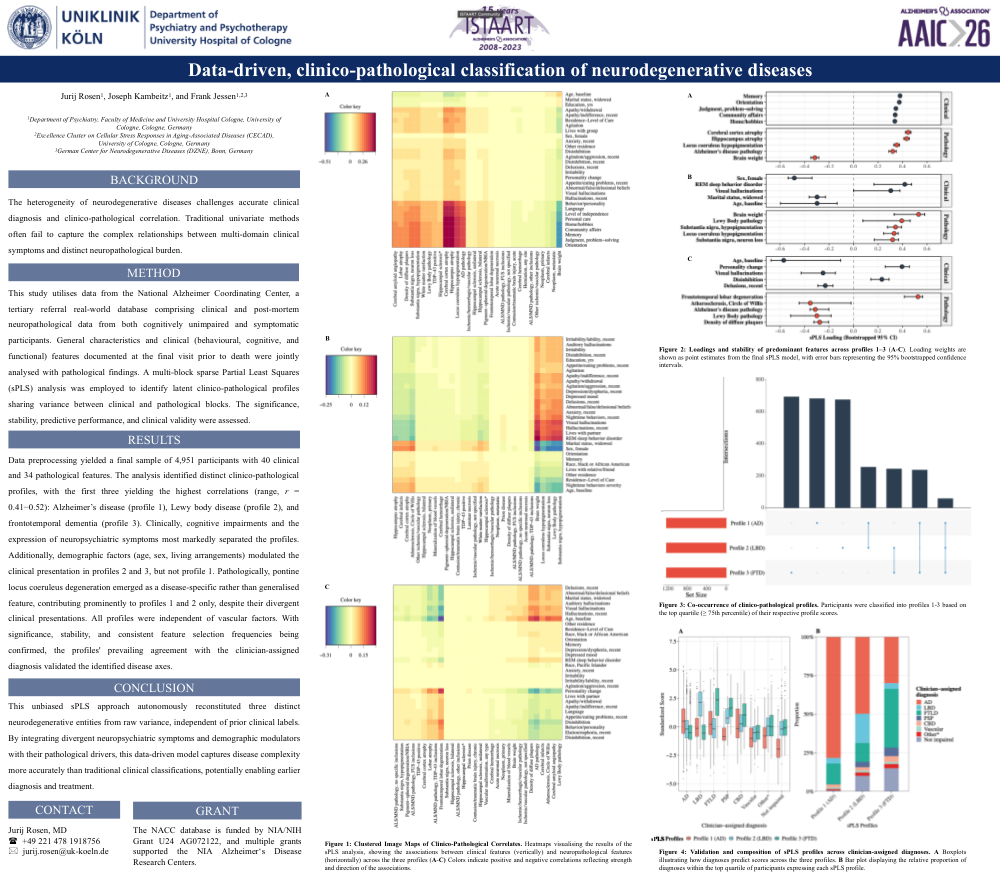
RESULTS: Data preprocessing yielded a final sample of 4,951 participants with 40 clinical
and 34 pathological features. The analysis identified distinct clinico-pathological
profiles, with the first three yielding the highest correlations (range, r =
0.41−0.52): Alzheimer’s disease (profile 1), Lewy body disease (profile 2), and
frontotemporal dementia (profile 3). Clinically, cognitive impairments and the
expression of neuropsychiatric symptoms most markedly separated the profiles.
Additionally, demographic factors (age, sex, living arrangements) modulated the
clinical presentation in profiles 2 and 3, but not profile 1. Pathologically, pontine
locus coeruleus degeneration emerged as a disease-specific rather than generalised
feature, contributing prominently to profiles 1 and 2 only, despite their divergent
clinical presentations. All profiles were independent of vascular factors. With
significance, stability, and consistent feature selection frequencies being
confirmed, the profiles' prevailing agreement with the clinician-assigned
diagnosis validated the identified disease axes.
CONCLUSION: This unbiased sPLS approach autonomously reconstituted three distinct
neurodegenerative entities from raw variance, independent of prior clinical labels.
By integrating divergent neuropsychiatric symptoms and demographic modulators
with their pathological drivers, this data-driven model captures disease complexity
more accurately than traditional clinical classifications, potentially enabling earlier
diagnosis and treatment.
Comments
Email is required but is not shown publicly.
Loading comments...