4,068 posters, 219 videos, 101 topics, 69 sessions, 14,365 authors, 6,128 institutions
ePostersLive by SciGen Technologies S.A. All rights reserved.
Alzheimer's Association International Conference 2026
July 12-15, 2026 | London, United Kingdom, and Online

9419
Plasma TDP-43 Biomarkers For Distinguishing Autopsy-Confirmed LATE From Non-TDP-43 Cases
Poster Presenter
Authors
Azadeh Feizpour, Claire E. Shepherd, Vincent Doré, Vibeke S. Catts, Perminder S. Sachdev, Henry Brodaty, Ralph Martins, Catriona McLean, Kathryn Laloli, Christopher Fowler, Brett Trounson, Christopher C. Rowe
Affiliations
Florey Institute of Neuroscience and Mental Health, VIC, Australia, Neuroscience Research Australia, University of New South Wales, Australia, CSIRO, VIC, Australia, Centre for Healthy Brain Ageing (CHeBA), School of Clinical Medicine, University of New South Wales, NSW, Australia, Centre for Healthy Brain Ageing (CHeBA), School of Clinical Medicine, University of New South Wales, Australia, Centre of Excellence for Alzheimer’s disease Research and Care, Edith Cowan University, WA, Australia, Florey Institute of Neuroscience and Mental Health, Australia, Department of Molecular Imaging & Therapy, Austin Health, Australia
Part of Topic
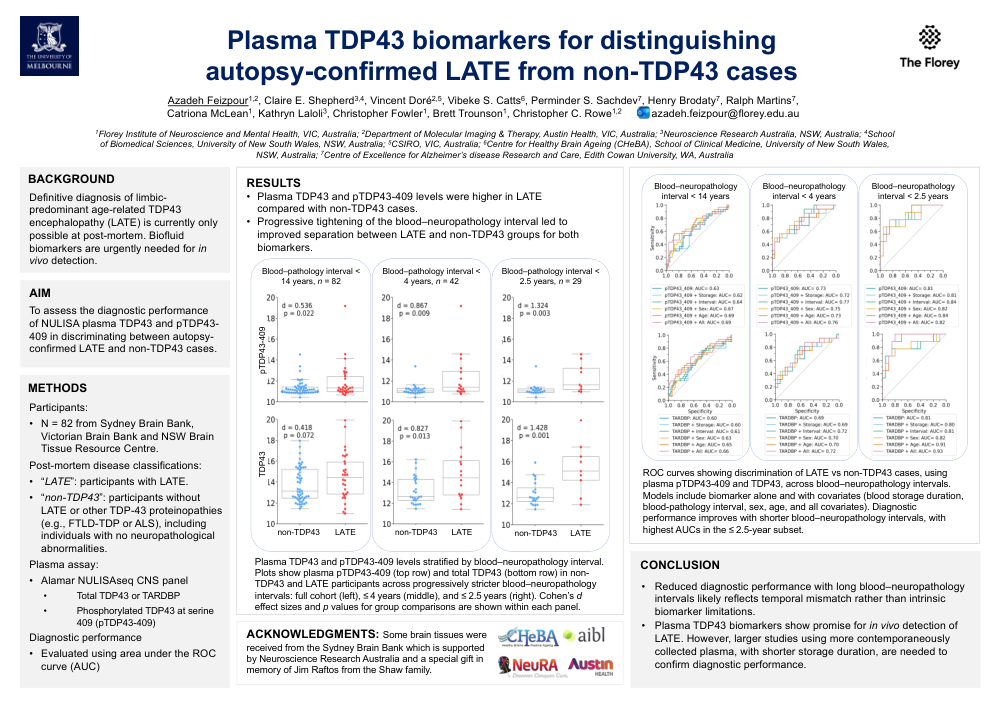
Background: Biofluid biomarkers are urgently needed for in-vivo detection of TDP-43–related diseases, including LATE. We evaluated the performance of NULISA plasma TDP-43 and phosphorylated TDP-43 (pTDP-43-409) in discriminating autopsy-confirmed LATE from non-TDP-43 cases.
Methods: Post-mortem data from 82 participants from three Australian brain banks (Sydney Brain Bank, Victorian Brain Bank, NSW Brain Tissue Resource Centre) were analysed (mean age at death: 90 years; 41% female). Blood samples were collected 0.1–14 years before death (median: 3.9 years) between 2006 to 2020. Neuropathology was classified as LATE if present alone or with other pathologies, and as non-TDP-43 if no pathology or any pathology other than LATE, FTD-TDP-43, or ALS was reported. Matching plasma samples were obtained from CHeBA and AIBL cohorts. TDP-43 and pTDP-43-409 were quantified using NULISA (v2). Laboratory personnel were blinded to disease status. Diagnostic performance was assessed using ROC analyses, with and without covariates (age at blood collection, sex, time interval). AUCs, sensitivity, specificity, PPV, and NPV with 95% bootstrapped confidence intervals (CI) were estimated.
Results: Assay intra‑plate mean coefficient of variation (CV) was 12.1%, with 94.7% target detectability. Across all participants (30 LATE and 52 non-TDP43), TDP43 and pTDP43-409 showed limited discrimination between LATE and non-TDP-43 cases (AUC: 0.60 [95% CI: 0.50 - 0.74] and 0.63 [0.50 - 0.76]; Cohen’s d: 0.418 and 0.536, respectively). However, restricting analyses to those with plasma collected within 2.5 years of death (9 LATE, 20 non-TDP43) markedly improved performance (AUC: 0.81 [0.58 - 1.0] for both biomarkers; Cohen’s d: 1.428 and 1.324, respectively). For pTDP43-409, Youden’s index threshold was 11.46 [10.95 - 13.22] NPQ, yielding sensitivity: 0.67 [0.50 - 1.0], specificity: 0.95 [0.36 - 1.0], PPV: 0.83 [0.22 - 1.0] and NPV: 0.86 [0.70 - 1.0].
Conclusion: Plasma TDP-43 biomarkers show promise for in-vivo detection of LATE using a minimally invasive approach. These findings, based on a small sample, require validation in larger cohorts with plasma collected closer to death (ideally within two years). If validated, such biomarkers could enable accessible screening and accelerate recruitment for LATE-targeted clinical trials. Modest measurement variability should be considered due to the age of some plasma samples.
Comments
Email is required but is not shown publicly.
Loading comments...